


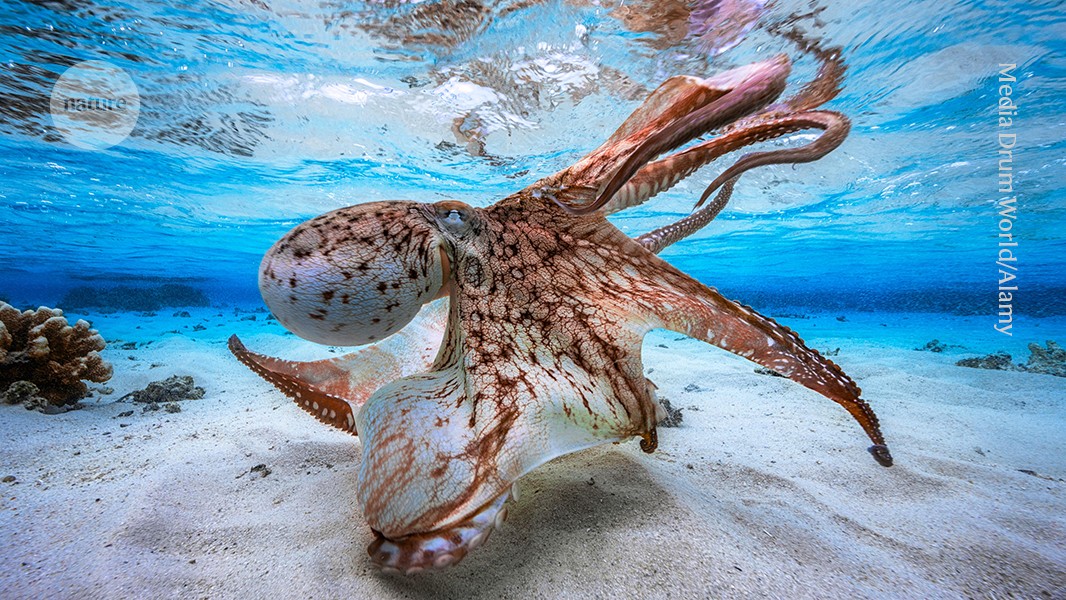
Three hearts; blue blood; no skeleton; arms like tongues. These are just some of the alien features of octopuses, squid and cuttlefish — members of the cephalopod family. The outlandish list continues. Cephalopod skin can taste chemicals, sense light and change colour and texture rapidly. In many species, the sucker-covered arms can even regenerate.
Cephalopods deserve higher welfare standards in research
These invertebrates have evolved independently from the vertebrate lineage for more than 600 million years. Their last common ancestor was probably a worm-like creature with a rudimentary nervous system and eye-like patches of light-sensitive cells. Despite this evolutionary gulf, vertebrates and these highly specialized molluscs share strange similarities. Their eyes, for example. “It’s eerie how similar they ended up,” says Cristopher Niell, a neuroscientist at the University of Oregon in Eugene. “The convergent evolution of the eye still blows my mind.”
Now, one similarity is spurring a boom in cephalopod neuroscience. Around 400 million years ago, cuttlefish, squid and octopuses diverged from the only other living cephalopods — the nautiluses. They then lost their protective shells and evolved brains that are uniquely large among invertebrates. These brains bestow the soft-bodied cephalopods with high intelligence. Cuttlefish, squid and octopuses have excellent memories, use tools and are adept problem-solvers; they have a concept of time and are capable of delayed gratification.
Cephalopods are the only non-vertebrate animals that have big, smart brains, says Cliff Ragsdale, a comparative neuroscientist at the University of Chicago in Illinois. And that presents a unique opportunity. Neuroscientists have gained a wealth of knowledge about how vertebrate brains work, but are increasingly looking to cephalopods for insights into ways to build large, high-functioning nervous systems.
“It is incredibly exciting for those of us who are interested in figuring out the rules of how brains work,” says Carrie Albertin, a cephalopod researcher at Harvard University in Cambridge, Massachusetts. “This is very clearly an elaborate brain driving elaborate behaviours.”
But a set of ethical challenges accompany the study of those powerful brains. Vertebrates used in scientific research have strong legal protections, but that is not always the case for invertebrates. Even the best efforts to provide gold-standard care are constrained — limited options for pain relief exist for cephalopods, for instance.
Nonetheless, over the past decade and, especially, the past several years, neuroscientists have been refashioning the tools of modern neuroscience and molecular genetics — developed mainly in mice and other model animals — for use in these enigmatic invertebrates. “There are so many biological questions that have not been explored with a modern cellular and molecular approach,” Ragsdale says.
Building a brain
A rudimentary look at the cephalopod nervous system reveals that there is more than one way to construct a large, smart brain. For starters, cephalopod brains are doughnut-shaped organs built around the oesophagus (see ‘Unusual anatomy’). Moreover, a large number of a cephalopod’s neurons — more than half in the case of octopuses — are located in the eight nerve cords, or minibrains, that control the arms.
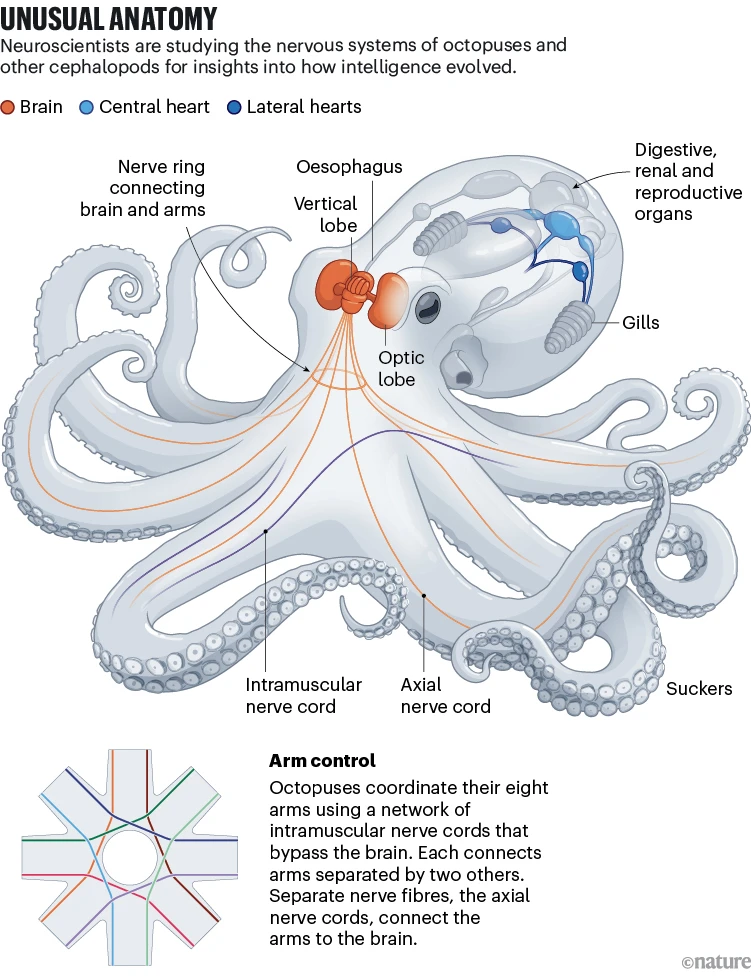
Source: Arm-control diagram, A. Kuuspalu et al. Curr. Biol. 32, 5415–5421 (2022)
Even systems that perform recognizable functions are mystifying. Although octopus eyes resemble those of vertebrates, the visual system in the brain does not. “It’s hard to convey how different it is,” says Niell. “We just have no idea of how it functions.”
“When you look at the octopus-arm nerve cord, it is just — we call it horrible grey spaghetti,” says Robyn Crook, a cephalopod neurobiologist at San Francisco State University in California. “Everything is tiny. There are no bundles. There are no big cells and small cells. It’s just horrifically disorganized. And yet, obviously, it makes beautiful sense.”
As well as looking different, these neurons also communicate in several strikingly different ways. For instance, in a December preprint1, William Schafer, a neurobiologist at the MRC Laboratory of Molecular Biology in Cambridge, UK, and his postdoc Amy Courtney showed that the octopus visual system contains a dopamine receptor that works differently from those of vertebrates. The octopus receptor is an ion channel that is opened directly by dopamine, allowing ions to flow through, whereas the vertebrate receptor is activated when dopamine binds to its surface, which triggers biochemical signalling inside neurons.
The overarching questions are whether these differences are just superficial and whether therefore cephalopod brains operate through the same principles as do vertebrate ones.
Duck! Octopuses caught on camera throwing things at each other
It might be the case that once they are mapped, circuits of neurons turn out to be organized in comparable ways in cephalopods and mammals, says Gilles Laurent, a systems neuroscientist at the Max Planck Institute for Brain Research in Frankfurt, Germany. “But it could be that you have to be even more abstract than that and figure out what computation is being accomplished” before you find the parallels, he says.
Whether or not cephalopod brains work like vertebrates, studying them should be a win–win situation. “Either it’s going to tell us that there are these fundamental principles shared by all brains,” says Tessa Montague, a cuttlefish neurobiologist at Columbia University in New York City, “or, if they actually do things differently, then that’s pretty amazing, too, because that tells you that there are different ways to build a complex, functional brain.”
A classic model
Neuroscience already owes cephalopods a debt of gratitude. In 1929, zoology graduate John Zachary Young was working at the Zoological Station in Naples, Italy, for the summer when he discovered a cluster of nerve cells in squid that give rise to nerve fibres up to one millimetre wide. Young immediately realized that physiologists could implant electrodes into these fibres. This insight meant that scientists could decipher the fundamentals of how neurons fire electrical impulses.
But Young was intrigued mainly by cognition. With his colleague Brian Boycott, he found behavioural evidence of short- and long-term memories in octopuses — just as other scientists at the time were documenting in humans.
Yet, despite Young’s celebrated work, octopuses never became a widespread model for studying cognition. One reason for this, says Ragsdale, was that studying cephalopod brains was a huge technical headache. Boycott, for example, tried and failed for 17 years to make stable neural recordings in living animals, eventually becoming so frustrated that he left the field.
Even outside the brain, cephalopods are not easy to work with, says Graziano Fiorito, a cephalopod researcher at the Zoological Station. Octopuses won’t breed in captivity, for instance, meaning that researchers must rely on wild-caught animals. Gradually, other model species became more appealing. “You can keep tonnes of zebrafish in an octopus tank,” Fiorito says. From the 1970s onwards, the sea slug Aplysia and other animals with simpler brains offered more-tractable models of memory at the neuronal level.
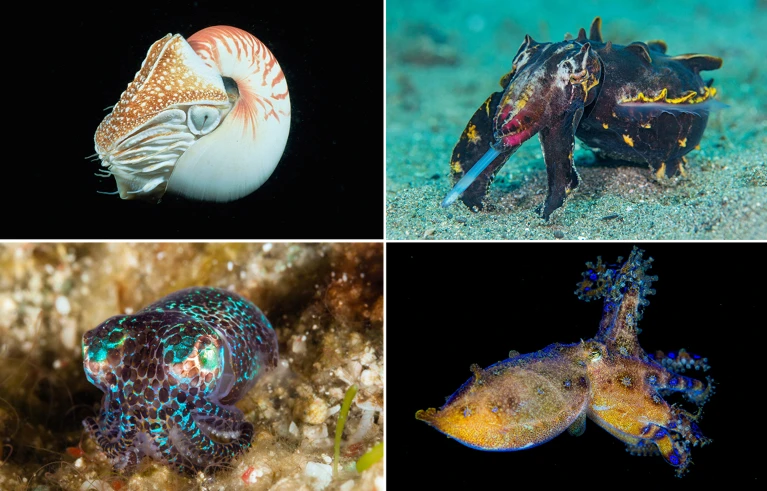
Cephalopods comprise four extant groups of species: octopuses, squid, cuttlefish and nautiluses. Clockwise from top left: Chambered nautilus (Nautilus pompilius), flamboyant cuttlefish (Metasepia pfefferi), bobtail squid (Euprymna berryi), blue ring octopus (Hapalochlaena sp.).Credit: Minden Pictures/Alamy; WaterFrame/Alamy; Nature Picture Library/Alamy (2)
Some cephalopod research continued at specialist facilities, such as the Marine Biology Laboratory in Woods Hole, Massachusetts. And a few neuroscientists even moved from conventional model organisms to studying octopuses.
Their work showed that having a wildly different body from vertebrates translates into clear neural differences. Cephalopods have no bones with which to generate contraction, force or stiffness in their arms. As a result, their motor system operates under hugely different constraints from that of a vertebrate, says Benny Hochner, a neuroscientist at the Hebrew University of Jerusalem, who has studied octopus movement and memory since the 1990s. These differences lead to fundamentally distinct mechanisms for planning and executing movement.
For memory, however, there are some striking parallels between cephalopods and vertebrates. Some octopus brain areas, for instance, have been shown to use a form of synaptic strengthening2 — thought to underlie the formation of new memories — that is similar to the process in mammals. But it is achieved through distinct molecular mechanisms. “I see a beautiful convergence, which has been reached in completely different ways,” Hochner says.
For that discovery, Hochner’s team relied on a method taken straight from mammalian neuroscience: studying neurophysiology in brain slices kept alive for hours. Neuroscientists are now seeking to adapt technologies at scale, co-opting a slew of precision tools used routinely in mammalian biology.
First glimpses inside octopus’s sleeping brains reveals human-like patterns
One of the first items in the modern cephalopod toolkit was the sequence of an octopus genome3, published in 2015 by Albertin, Ragsdale and their colleagues. As a standalone study, the work provided interesting insights. For example, it found that two large gene families that had grown to have crucial roles in nervous-system patterning in vertebrates had similarly expanded in the octopus, albeit through distinct mechanisms. But, Ragsdale says, the study also sent a sociological signal. “I think when we published the genome, it led a lot of people who’d been interested in these creatures to say, ‘Gee, it’s safe to go in the water now’.” The octopus had entered its molecular-biology era.
Since then, researchers with a broad range of interests have joined the field. Many ask how a process they studied in mice and other model organisms works in cephalopods.
Ivan Soltesz, a neuroscientist at Stanford University in Palo Alto, California, has studied how mammals navigate using a group of neurons in the hippocampus. These ‘place cells’ fire when the animal is at a specific location. His questions about octopuses were simple. “How do they do navigation? Do they have place cells?”
Laurent has used mammals, fish and flies to work out how the environment is represented in brain areas that process sensory information and is extending these studies by looking at cuttlefish camouflage. Cephalopods control the colour and pattern of their skin directly through neural activity and can change colours to match their environment — providing a read-out of the brain activity that perception evokes. Or as Montague, who also works on cuttlefish camouflage, puts it: “No other animal can tell you what it sees, except a human.”
In 2023, Laurent’s group showed that, in just a few seconds, cuttlefish home in on an optimal match to their environment by cycling through a succession of approximate ones4. He is now working out how they assess the quality of each match to create a feedback loop that improves their disguise.
At the same time, researchers in Japan published work showing that octopuses have bouts of rapid changes in skin colour when they are asleep5, suggesting that they might be dreaming.
Niell — whose lab studies vision in both mice and in octopuses — has focused on the cephalopod’s optic lobe, which, as the initial visual-processing structure, is roughly similar to a vertebrate’s retina. In 2022, his team analysed gene expression in individual neurons, identifying six main classes of cell6. By looking at the cells’ locations, the researchers found a previously unknown layered organization. They then looked at neuronal responses to visual stimuli7.
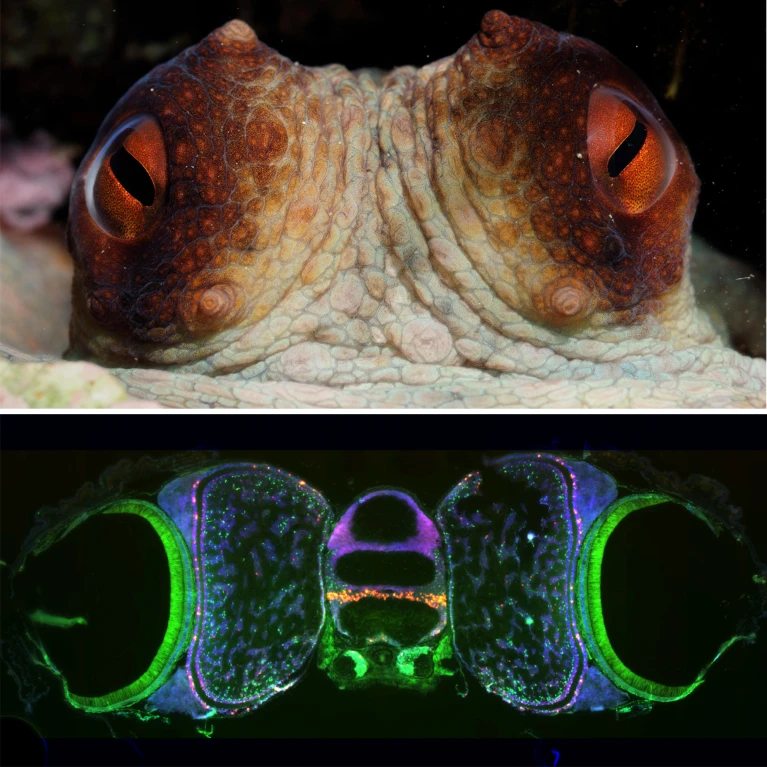
Octopuses have complex, camera-like eyes (top) and highly organized visual systems (below).Credit: Nature Picture Library/Alamy; Dr Denise Piscopo, Niell lab

