


You have full access to this article via your institution.
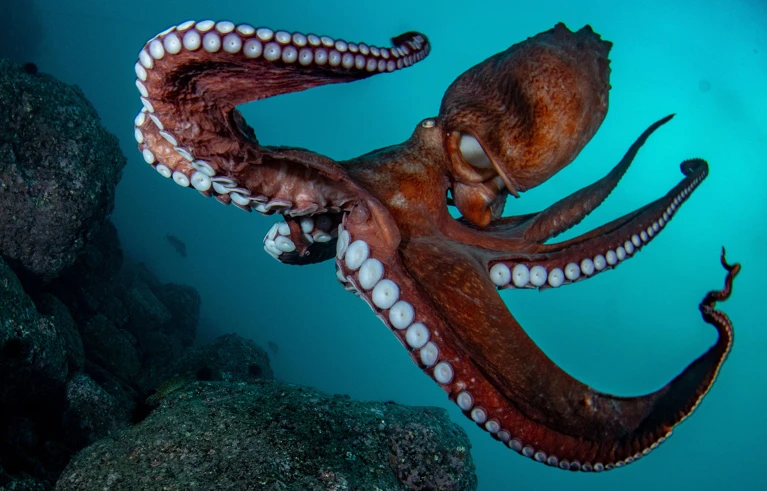
Cephalopods such as octopuses are known to feel pain, but there is a lack of suitable analgesics for use in these animals.Credit: Mark Edward Eite/Alamy
Cephalopod neuroscience is booming. Octopuses, cuttlefish and squid have uniquely large, complex brains among invertebrates. As a News Feature reports, more neuroscientists are asking how these brains are responsible for cephalopods’ sophisticated cognitive abilities and complex behaviours. In doing so, they are applying current techniques from mammalian neuroscience. For example, they record neuronal activity in awake animals by surgically implanting electrodes or imaging devices in the brain, as well as physically restraining animals during recording sessions.
Do octopus brains work like humans’ — or is there another way to be smart?
The use of animals in research must comply with laws and regulations, which vary from country to country. In many nations, non-human vertebrates — mice and zebrafish, for example — are legally entitled to appropriate anaesthesia and pain relief when used in research. Their overall care, including the quality of accommodation, is also regulated in many of those countries. By contrast, such laws have historically not applied to invertebrates, which is now actively being discussed among researchers1. Moves are also under way to gather support to establish a United Nations Convention on Animal Health and Protection.
In the past few years, studies of cephalopod behaviour and their nervous systems have further supported the idea that they are sentient2 and capable of feeling pain3. In the past three decades, many countries have extended enhanced research protections to cephalopods in line with a greater number of studies showing that they have these capacities, along with the fact that animals free of pain and other stressors are a prerequisite for doing the best quality science4,5. Many more nations would benefit from adopting and implementing these protections.
A history of care

How to measure the brain of an octopus
Giving legal protections to vertebrates but not invertebrates was a dividing line introduced by the world’s first law on animals used in scientific experimentation. This was the United Kingdom’s 1876 Cruelty to Animals Act, in which the government demanded individuals obtain licences to conduct animal experiments. The law also required investigators to justify how using animals would benefit science, and mandated anaesthesia and other basic care provisions for experimental animals. At the time, a backbone was used as a proxy indicator that an animal was sentient and capable of suffering, similar to humans.
Over the past 150 years, protections have become stronger. In most countries with an extensive research infrastructure, proposed experimental procedures on vertebrates need to be reviewed by experts and must comply with minimum standards for ensuring these animals undergo as little pain, stress and suffering as possible.
Similar protections were given to cephalopods from the 1990s6. In 1991, Canada extended certain vertebrate legal protections to these animals. Two years later, the United Kingdom gave the common octopus (Octopus vulgaris) the same rights as vertebrates in scientific research. New Zealand followed in 1999, Australia in 2004, Norway in 2010 and Switzerland in 2011. In 2010, the European Union issued a directive requiring each EU nation to implement cephalopod protection in national laws by 2013.
Octopus genome holds clues to uncanny intelligence
The EU directive prompted researchers working on cephalopods and in animal welfare to review the available scientific literature and to develop best-practice guidelines for cephalopod care. These reviews4,5 are now touchstones for research in this field, and not only in Europe.
Several cephalopod researchers in the United States whom Nature spoke to say that they adhere to the EU guidelines. In 2023, the US National Institutes of Health (NIH) asked for comments on proposed guidelines for cephalopod research. Many scientists assumed that it would lead to legislation to regulate cephalopod use, but this has not yet happened. The NIH’s Office of Laboratory Animal Welfare had not responded to an e-mail request for comment as Nature went to press.
New drugs, please
Even in countries that have enhanced animal-welfare standards, one key obstacle that still needs to be overcome is the lack of drugs that reliably reduce pain in cephalopods. Such medicines are routinely used in vertebrates and are essential for their good care. However, researchers say that few of the anaesthetics and analgesics used to minimize suffering in vertebrates work in cephalopods, because the two groups are so different. Finding ways to provide this care for cephalopods needs to be addressed. Research funders should also recognize the importance of doing so.
Improving the standards for care and welfare of animals in research should concern all researchers. It is important that conversations on such standards gather momentum. It is equally important that these happen globally, and that the research community engages more fully with the idea of a UN convention. The highest standards of animal welfare are an integral part of research done with integrity.

