


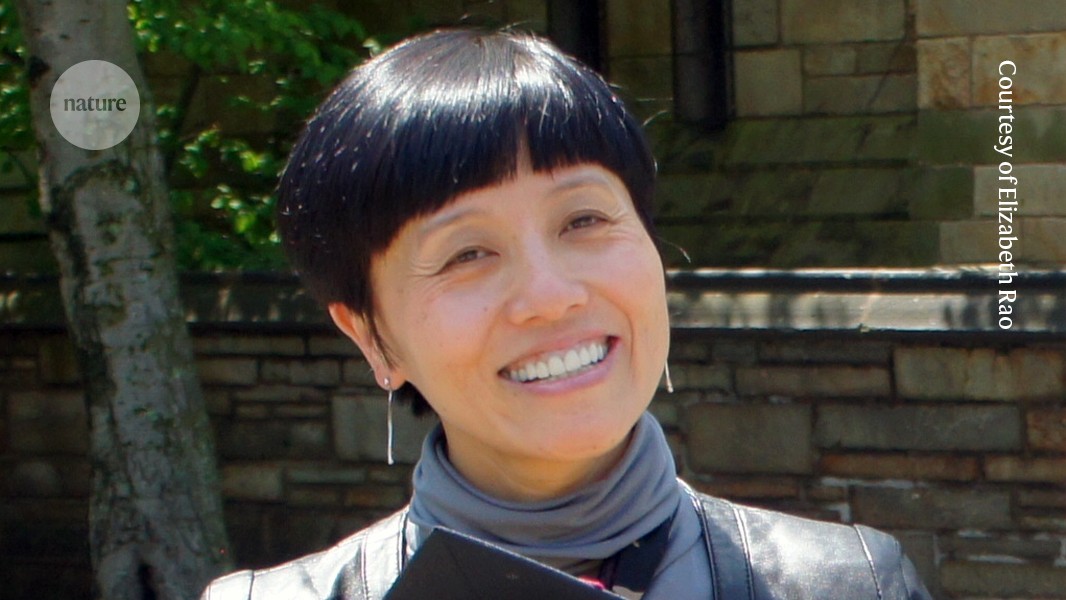
Neuroscientist Jane Ying Wu was the subject of an investigation by the US National Institutes of Health as part of US President Donald Trump’s China Initiative. Credit: Courtesy of Elizabeth Rao
University leaders are facing calls to apologize for their alleged treatment of a tenured neuroscientist who died by suicide after being investigated as part of US President Donald Trump’s China Initiative.
A letter signed by more than 1,000 academics from across the United States accuses Northwestern University Feinberg School of Medicine in Chicago, Illinois, of “unjust treatment” of Jane Ying Wu, saying it disregarded the principle of innocent until proven guilty.
The letter, sent in February by the Asian American Scholar Forum and the Federation of Asian Professor Associations to university president Henry Bienen and dean Eric Neilson, cites an ongoing lawsuit that alleges discriminatory treatment of Wu, who died by suicide in July 2024. (If you or someone you know is contemplating suicide, please reach out through https://findahelpline.com.)
According to the lawsuit, which was filed by Wu’s estate last year, Wu was the subject of an investigation by the US National Institutes of Health (NIH), beginning in 2019. But, Wu, who was a naturalized US citizen born in China, was never charged or found to have committed wrongdoing through her research ties to China. Wu had worked at Northwestern for nearly two decades and was a principal investigator on 31 NIH projects. In December 2023, Northwestern was apparently notified that the NIH investigation into Wu had ended, the complaint alleges.
China Initiative’s shadow looms large for US scientists
During the investigation, the complaint adds, the university “limited the work of Dr. Wu, partly closed her lab space, broke up her research team, reassigned her grants to her white male faculty colleagues, and left her isolated”. After the investigation was closed, Northwestern allegedly “cut her salary for lack of funding of her research during the NIH investigation, raised new requirements she had to meet to restore her funded status, gave her only a limited chance to meet them, and refused to assign back to her a prior grant that had been taken away from her but was still active”. The university informed Wu in May 2024 that it would close her laboratory for good that summer, making it impossible for Wu to apply for future funding.
The lawsuit goes on to allege that Northwestern “sent its University Police and City of Chicago Police to evict Dr. Wu from her office by force and placed her in handcuffs”, then took her, “against her will”, to be admitted to Northwestern Memorial Hospital’s Norman and Ida Stone Institute of Psychiatry in Chicago, less than two months before she ended her life.
The alleged treatment of Wu led to widespread shock and fear in the academic community, especially for “those of Asian descent”, the letter says. A spokeperson for Northwestern University told Nature in a statement that it cannot comment on pending litigation but “vehemently denies the allegations in the lawsuit”.
Unwavering commitment
Margaret Flanagan, a physician-scientist at the University of Texas Health Science Center at San Antonio who was mentored by Wu, calls her former adviser “one of the toughest people I’ve ever met — resilient, focused and unwavering in her commitment to her work and her trainees. That strength is part of what made her mentorship so impactful, and also why her passing was so shocking to me.”
Arnold Strauss, a retired paediatric cardiologist who knew Wu for 30 years and signed the letter, contrasted the alleged treatment of Wu with that of two of his colleagues who reported to him. When they were investigated as part of the China Initiative, the institution where he worked provided them with emotional and financial support, and acted as a go-between with the NIH, all of which, he thinks, “every institution should have done” for its faculty members. Ultimately, one researcher lost his grants and returned to China; the other was able to continue his work.
US scientist cleared of hiding ties to China sues university that fired him
The China Initiative was launched in 2018, during the first Trump administration, to root out “economic espionage” in the United States, according to a 2018 government press release. Its remit included research labs and universities.
Most people under investigation self-identified as Asian, according to an NIH report that was issued on 10 December 2025. Of the 691 scientists involved in allegations made to the NIH up to 3 December 2025, the report states, the agency had contacted institutions in 271 cases. Of those, they determined that “for over 85 percent of cases there was at least one serious compliance violation”, such as undisclosed grant support, awards or patents.
Only six cases have led to either criminal or civil actions, the report notes. Since a peak in 2019, when Wu was under investigation, the number of cases “has been declining”.

