


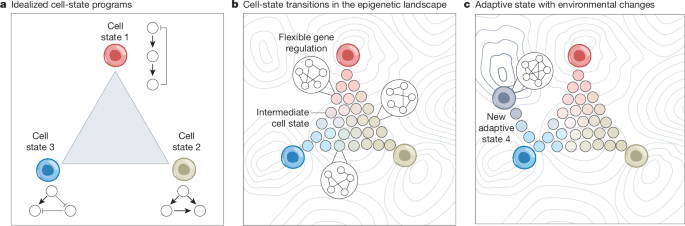
Llinás, R. R. The contribution of Santiago Ramón y Cajal to functional neuroscience. Nat. Rev. Neurosci. 4, 77–80 (2003).
McCulloch, E. A. & Till, J. E. Perspectives on the properties of stem cells. Nat. Med. 11, 1026–1028 (2005).
Kumar, T. et al. A spatially resolved single-cell genomic atlas of the adult human breast. Nature 620, 181–191 (2023).
Sikkema, L. et al. An integrated cell atlas of the lung in health and disease. Nat. Med. 29, 1563–1577 (2023).
Barkley, D. et al. Cancer cell states recur across tumor types and form specific interactions with the tumor microenvironment. Nat. Genet. 54, 1192–1201 (2022).
Gavish, A. et al. Hallmarks of transcriptional intratumour heterogeneity across a thousand tumours. Nature 618, 598–606 (2023). The Barkley et al. and Gavish et al. studies define meta programs of gene expression across many tumour types, showing that cancer cell states tend to be shared across tumours.
Gargiulo, G., Serresi, M. & Marine, J.-C. Cell states in cancer: drivers, passengers, and trailers. Cancer Discov. 14, 610–614 (2024).
Zeng, H. What is a cell type and how to define it? Cell 185, 2739–2755 (2022).
Velten, L. et al. Human haematopoietic stem cell lineage commitment is a continuous process. Nat. Cell Biol. 19, 271–281 (2017).
Pastushenko, I. et al. Identification of the tumour transition states occurring during EMT. Nature 556, 463–468 (2018).
Ladewig, J., Koch, P. & Brüstle, O. Leveling Waddington: the emergence of direct programming and the loss of cell fate hierarchies. Nat. Rev. Mol. Cell Biol. 14, 225–236 (2013).
West-Eberhard, M. J. Developmental Plasticity and Evolution (Oxford Univ. Press, 2003).
Levis, N. A. & Pfennig, D. W. Evaluating ‘plasticity-first’ evolution in nature: key criteria and empirical approaches. Trends Ecol. Evol. 31, 563–574 (2016).
Frank, S. A. & Yanai, I. The origin of novel traits in cancer. Trends Cancer 10, 880–892 (2024). This article argues that novel traits in cancer can originate through initially non-heritable phenotypic variation, challenging the classic gene-centric view.
Frank, S. A. How cancer arises: genetics releases, plasticity creates, genetics stabilizes. Proc. Natl Acad. Sci. USA 122, e2505377122 (2025).
Frank, S. A. & Rosner, M. R. Nonheritable cellular variability accelerates the evolutionary processes of cancer. PLoS Biol. 10, e1001296 (2012).
Gupta, P. B. et al. Stochastic state transitions give rise to phenotypic equilibrium in populations of cancer cells. Cell 146, 633–644 (2011).
Kaern, M., Elston, T. C., Blake, W. J. & Collins, J. J. Stochasticity in gene expression: from theories to phenotypes. Nat. Rev. Genet. 6, 451–464 (2005).
Kreso, A. et al. Variable clonal repopulation dynamics influence chemotherapy response in colorectal cancer. Science 339, 543–548 (2013).
Marsolier, J. et al. H3K27me3 conditions chemotolerance in triple-negative breast cancer. Nat. Genet. 54, 459–468 (2022).
Oren, Y. et al. Cycling cancer persister cells arise from lineages with distinct programs. Nature 596, 576–582 (2021).
Goyal, Y. et al. Diverse clonal fates emerge upon drug treatment of homogeneous cancer cells. Nature 620, 651–659 (2023). This paper shows that genetically identical cancer cells can give rise to distinct drug-resistant phenotypes, which are largely predetermined by intrinsic cell-state differences before treatment.
Shaffer, S. M. et al. Rare cell variability and drug-induced reprogramming as a mode of cancer drug resistance. Nature 546, 431–435 (2017). This landmark study demonstrates that non-genetic drug resistance arises from rare cells that transiently express resistance-associated genes.
Rosano, D. et al. Long-term multimodal recording reveals epigenetic adaptation routes in dormant breast cancer cells. Cancer Discov. 14, 866–889 (2024).
Rehman, S. K. et al. Colorectal cancer cells enter a diapause-like DTP state to survive chemotherapy. Cell 184, 226–242.e21 (2021).
Dhimolea, E. et al. An embryonic diapause-like adaptation with suppressed myc activity enables tumor treatment persistence. Cancer Cell 39, 240–256.e11 (2021).
Hastings, J. F. et al. Memory of stochastic single-cell apoptotic signaling promotes chemoresistance in neuroblastoma. Sci. Adv. 9, eabp8314 (2023).
Sharma, S. V. et al. A chromatin-mediated reversible drug-tolerant state in cancer cell subpopulations. Cell 141, 69–80 (2010). This seminal work discovers a new mechanism of drug resistance, in which cancer cells can transiently and reversibly enter a drug-tolerant state through non-genetic changes.
Russo, M. et al. Cancer drug-tolerant persister cells: from biological questions to clinical opportunities. Nat. Rev. Cancer 24, 694–717 (2024).
Marine, J.-C., Dawson, S.-J. & Dawson, M. A. Non-genetic mechanisms of therapeutic resistance in cancer. Nat. Rev. Cancer 20, 743–756 (2020).
Brock, A., Chang, H. & Huang, S. Non-genetic heterogeneity — a mutation-independent driving force for the somatic evolution of tumours. Nat. Rev. Genet. 10, 336–342 (2009).
Pisco, A. O. et al. Non-Darwinian dynamics in therapy-induced cancer drug resistance. Nat. Commun. 4, 2467 (2013).
Tong, X. et al. Adeno-to-squamous transition drives resistance to KRAS inhibition in LKB1 mutant lung cancer. Cancer Cell 42, 413–428.e7 (2024).
Chan, J. M. et al. Lineage plasticity in prostate cancer depends on JAK/STAT inflammatory signaling. Science 377, 1180–1191 (2022).
Tsoi, J. et al. Multi-stage differentiation defines melanoma subtypes with differential vulnerability to drug-induced iron-dependent oxidative stress. Cancer Cell 33, 890–904.e5 (2018).
Shibue, T. & Weinberg, R. A. EMT, CSCs, and drug resistance: the mechanistic link and clinical implications. Nat. Rev. Clin. Oncol. 14, 611–629 (2017).
Oliveira, E. A. et al. Epigenetic heritability of cell plasticity drives cancer drug resistance through a one-to-many genotype-to-phenotype paradigm. Cancer Res. 85, 2921–2938 (2025).
Marusyk, A., Janiszewska, M. & Polyak, K. Intratumor heterogeneity: the Rosetta stone of therapy resistance. Cancer Cell 37, 471–484 (2020).
Marjanovic, N. D. et al. Emergence of a high-plasticity cell state during lung cancer evolution. Cancer Cell 38, 229–246.e13 (2020).
Mzoughi, S. et al. Oncofetal reprogramming drives phenotypic plasticity in WNT-dependent colorectal cancer. Nat. Genet. 57, 402–412 (2025).
Moorman, A. et al. Progressive plasticity during colorectal cancer metastasis. Nature 637, 947–954 (2025). This study uncovers extreme phenotypic plasticity driving metastasis in colorectal cancer, in which intestinal cells undergo dedifferentiation through a highly plastic oncofetal state and adopt squamous and neuroendocrine-like states.
França, G. S. et al. Cellular adaptation to cancer therapy along a resistance continuum. Nature 631, 876–883 (2024). This work introduced the concept of the ‘resistance continuum’, revealing that drug resistance emerges through progressive adaptive cell-state transitions towards increased fitness, underpinned by phenotypic plasticity and chromatin reprogramming for stress response.
Vander Velde, R. et al. Resistance to targeted therapies as a multifactorial, gradual adaptation to inhibitor specific selective pressures. Nat. Commun. 11, 2393 (2020). This work introduced the notion that resistance to targeted therapy arises through a gradual process of adaptation explained by both genetic and non-genetic mechanisms.
Li, J. et al. AP-1 mediates cellular adaptation and memory formation. Nat. Commun. https://doi.org/10.1038/s41467-026-70862-w (2026). This study reveals that melanoma cells develop therapy resistance by forming AP-1-dependent cellular memories, suggesting heritable adaptive genome reprogramming.
Fennell, K. A. et al. Non-genetic determinants of malignant clonal fitness at single-cell resolution. Nature 601, 125–131 (2022).
Morgan, D., Gardner, A. L. & Brock, A. Lineage tracing reveals clone-specific responses to doxorubicin in triple-negative breast cancer. Preprint at bioRxiv https://doi.org/10.1101/2025.03.18.643980 (2025).
Lee, P., Chandel, N. S. & Simon, M. C. Cellular adaptation to hypoxia through hypoxia inducible factors and beyond. Nat. Rev. Mol. Cell Biol. 21, 268–283 (2020).
Jacob, F. & Monod, J. Genetic regulatory mechanisms in the synthesis of proteins. J. Mol. Biol. 3, 318–356 (1961).
Davidson, E. H. Emerging properties of animal gene regulatory networks. Nature 468, 911–920 (2010).
Chalancon, G. et al. Interplay between gene expression noise and regulatory network architecture. Trends Genet. 28, 221–232 (2012).
Levine, M. & Davidson, E. H. Gene regulatory networks for development. Proc. Natl Acad. Sci. USA 102, 4936–4942 (2005).
Braun, E. The unforeseen challenge: from genotype-to-phenotype in cell populations. Rep. Prog. Phys. 78, 036602 (2015). This work proposes a unifying framework in which cell states can emerge from exploratory dynamics of gene regulation, offering a transformative view of how cells can adapt to unfamiliar environmental conditions.
Shomar, A., Barak, O. & Brenner, N. Cancer progression as a learning process. iScience 25, 103924 (2022). This paper proposes that cellular adaptation in cancer arises through a process analogous to cellular learning facilitated by transcription factors that work as regulatory hubs.
Freddolino, L., Yang, J., Momen-Roknabadi, A. & Tavazoie, S. Stochastic tuning of gene expression enables cellular adaptation in the absence of pre-existing regulatory circuitry. eLife 7, e31867 (2018). This study proposed a stochastic tuning mechanism by which cells adapt to novel environments through fitness-driven adjustments of individual gene expression.
Momen-Roknabadi, A., Oikonomou, P. & Tavazoie, S. Adaptation by stochastic tuning of gene expression in mammalian cells. Preprint at bioRxiv https://doi.org/10.1101/2025.05.07.651953 (2025).
Schreier, H. I., Soen, Y. & Brenner, N. Exploratory adaptation in large random networks. Nat. Commun. 8, 14826 (2017).
Baron, M. et al. The stress-like cancer cell state is a consistent component of tumorigenesis. Cell Syst 11, 536–546.e7 (2020). This study describes a conserved stress-like cancer cell state in tumorigenesis, characterized by enhanced tumour seeding and drug tolerance.
Vihervaara, A., Duarte, F. M. & Lis, J. T. Molecular mechanisms driving transcriptional stress responses. Nat. Rev. Genet. 19, 385–397 (2018).
Greenberg, M. E. & Ziff, E. B. Stimulation of 3T3 cells induces transcription of the c-fos proto-oncogene. Nature 311, 433–438 (1984).
Baudre, L. et al. Characterization of drug-tolerant persister cells in triple-negative breast cancer identifies a shared persistence program across treatments and patients. Cancer Res. 86, 802–817 (2026).
Diao, S. et al. Lineage plasticity of the integrated stress response is a hallmark of cancer evolution. Preprint at bioRxiv https://doi.org/10.1101/2025.02.10.637516 (2025).
D’Urso, A. & Brickner, J. H. Mechanisms of epigenetic memory. Trends Genet. 30, 230–236 (2014).
Owen, J. A., Osmanović, D. & Mirny, L. Design principles of 3D epigenetic memory systems. Science 382, eadg3053 (2023).
Espinosa-Martínez, M., Alcázar-Fabra, M. & Landeira, D. The molecular basis of cell memory in mammals: the epigenetic cycle. Sci. Adv. 10, eadl3188 (2024).
Tian, C. et al. Impaired histone inheritance promotes tumor progression. Nat. Commun. 14, 3429 (2023).
Zhao, S., Allis, C. D. & Wang, G. G. The language of chromatin modification in human cancers. Nat. Rev. Cancer 21, 413–430 (2021).
Shaulian, E. & Karin, M. AP-1 as a regulator of cell life and death. Nat. Cell Biol. 4, E131–E136 (2002). This seminal review discusses the key functional and mechanistic properties of the AP-1 family members.
Eferl, R. & Wagner, E. F. AP-1: a double-edged sword in tumorigenesis. Nat. Rev. Cancer 3, 859–868 (2003).
Chiu, R. et al. The c-Fos protein interacts with c-Jun/AP-1 to stimulate transcription of AP-1 responsive genes. Cell 54, 541–552 (1988).
Cohen, D. R., Ferreira, P. C., Gentz, R., Franza, B. R. Jr & Curran, T. The product of a fos-related gene, fra-1, binds cooperatively to the AP-1 site with Jun: transcription factor AP-1 is comprised of multiple protein complexes. Genes Dev. 3, 173–184 (1989).
van Dam, H. & Castellazzi, M. Distinct roles of Jun: Fos and Jun: ATF dimers in oncogenesis. Oncogene 20, 2453–2464 (2001).
Bejjani, F., Evanno, E., Zibara, K., Piechaczyk, M. & Jariel-Encontre, I. The AP-1 transcriptional complex: local switch or remote command? Biochim. Biophys. Acta Rev. Cancer 1872, 11–23 (2019).
Seo, J. et al. AP-1 subunits converge promiscuously at enhancers to potentiate transcription. Genome Res. 31, 538–550 (2021). This study maps the genome-wide binding of AP-1 subunits and reveals promiscuous binding at genomic hotspots, suggesting this is key for regulating cell-type-specific gene expression and environmental responses.
Vierbuchen, T. et al. AP-1 transcription factors and the BAF complex mediate signal-dependent enhancer selection. Mol. Cell 68, 1067–1082.e12 (2017).
Zhou, H. et al. Frequency and distribution of AP-1 sites in the human genome. DNA Res. 12, 139–150 (2005).
Fonseca, G. J. et al. Diverse motif ensembles specify non-redundant DNA binding activities of AP-1 family members in macrophages. Nat. Commun. 10, 414 (2019).
Hess, J., Angel, P. & Schorpp-Kistner, M. AP-1 subunits: quarrel and harmony among siblings. J. Cell Sci. 117, 5965–5973 (2004).
Markov, G. J. et al. AP-1 is a temporally regulated dual gatekeeper of reprogramming to pluripotency. Proc. Natl Acad. Sci. USA 118, e2104841118 (2021).
Comandante-Lou, N., Baumann, D. G. & Fallahi-Sichani, M. AP-1 transcription factor network explains diverse patterns of cellular plasticity in melanoma cells. Cell Rep. 40, 111147 (2022). This study reveals that the AP-1 transcription factor network determines cellular states in melanoma, showing that the balance among its subunits governs differentiation states and therapy response.
Kuonen, F. et al. c-FOS drives reversible basal to squamous cell carcinoma transition. Cell Rep. 37, 109774 (2021).
Li, Y. et al. Mutant Kras co-opts a proto-oncogenic enhancer network in inflammation-induced metaplastic progenitor cells to initiate pancreatic cancer. Nat. Cancer 2, 49–65 (2021).
Eckert, L. et al. Biochemically plausible models of habituation for single-cell learning. Curr. Biol. 34, 5646–5658.e3 (2024).
Karin, M. The regulation of AP-1 activity by mitogen-activated protein kinases. J. Biol. Chem. 270, 16483–16486 (1995).
Karin, M., Liu, Z. G. & Zandi, E. AP-1 function and regulation. Curr. Opin. Cell Biol. 9, 240–246 (1997).
Boyle, W. J. et al. Activation of protein kinase C decreases phosphorylation of c-Jun at sites that negatively regulate its DNA-binding activity. Cell 64, 573–584 (1991).
Reddy, C. E. et al. Multisite phosphorylation of c-Jun at threonine 91/93/95 triggers the onset of c-Jun pro-apoptotic activity in cerebellar granule neurons. Cell Death Dis. 4, e852 (2013).
Pulverer, B. J., Kyriakis, J. M., Avruch, J., Nikolakaki, E. & Woodgett, J. R. Phosphorylation of c-Jun mediated by MAP kinases. Nature 353, 670–674 (1991).
Waudby, C. A. et al. An intrinsic temporal order of c-JUN N-terminal phosphorylation regulates its activity by orchestrating co-factor recruitment. Nat. Commun. 13, 6133 (2022). This study reveals that multisite phosphorylation of JUN by JNK occurs with distinct temporal kinetics, suggesting a mechanism that switches JUN between repressive and activating states.
Degefu, Y. N., Bujnowska, M., Baumann, D. G. & Fallahi-Sichani, M. Cell state plasticity emerging from co-regulated, competitive, and configurable interactions within the AP-1 network. Preprint at bioRxiv https://doi.org/10.1101/2025.11.06.686987 (2025). This study examines AP-1 as a configurable, competitive network whose dimerization dynamics encode discrete cell states and drive melanoma plasticity and therapy resistance.
Biddie, S. C. et al. Transcription factor AP1 potentiates chromatin accessibility and glucocorticoid receptor binding. Mol. Cell 43, 145–155 (2011).
Wolf, B. K. et al. Cooperation of chromatin remodeling SWI/SNF complex and pioneer factor AP-1 shapes 3D enhancer landscapes. Nat. Struct. Mol. Biol. 30, 10–21 (2023).
Kamei, Y. et al. A CBP integrator complex mediates transcriptional activation and AP-1 inhibition by nuclear receptors. Cell 85, 403–414 (1996).
Naik, S. et al. Inflammatory memory sensitizes skin epithelial stem cells to tissue damage. Nature 550, 475–480 (2017).
Naik, S. & Fuchs, E. Inflammatory memory and tissue adaptation in sickness and in health. Nature 607, 249–255 (2022).
Larsen, S. B. et al. Establishment, maintenance, and recall of inflammatory memory. Cell Stem Cell 28, 1758–1774.e8 (2021). This study uncovers how inflammatory memory is established and recalled in epidermal stem cells, showing the role of AP-1 in establishing chromatin memory for faster responses to subsequent stresses.
Nagaraja, S. et al. Epigenetic memory of colitis promotes tumour growth. Nature https://doi.org/10.1038/s41586-026-10258-4 (2026).
Benhar, M., Engelberg, D. & Levitzki, A. ROS, stress-activated kinases and stress signaling in cancer. EMBO Rep. 3, 420–425 (2002).
Savy, T., Flanders, L., Karpanasamy, T., Sun, M. & Gerlinger, M. Cancer evolution: from Darwin to the extended evolutionary synthesis. Trends Cancer 11, 204–215 (2025).
Suski, J. M., Braun, M., Strmiska, V. & Sicinski, P. Targeting cell-cycle machinery in cancer. Cancer Cell 39, 759–778 (2021).
Sawyers, C. Targeted cancer therapy. Nature 432, 294–297 (2004).
Groelly, F. J., Fawkes, M., Dagg, R. A., Blackford, A. N. & Tarsounas, M. Targeting DNA damage response pathways in cancer. Nat. Rev. Cancer 23, 78–94 (2023).
Lee, L. J. et al. Cancer plasticity: the role of mRNA translation. Trends Cancer 7, 134–145 (2021).
Faubert, B., Solmonson, A. & DeBerardinis, R. J. Metabolic reprogramming and cancer progression. Science 368, eaaw5473 (2020).
Geffen, Y. et al. Pan-cancer analysis of post-translational modifications reveals shared patterns of protein regulation. Cell 186, 3945–3967.e26 (2023).
Poulikakos, P. I. et al. RAF inhibitor resistance is mediated by dimerization of aberrantly spliced BRAF(V600E). Nature 480, 387–390 (2011).
Harmange, G. et al. Disrupting cellular memory to overcome drug resistance. Nat. Commun. 14, 7130 (2023).
Boumahdi, S. & de Sauvage, F. J. The great escape: tumour cell plasticity in resistance to targeted therapy. Nat. Rev. Drug Discov. 19, 39–56 (2020).
Mu, P. et al. SOX2 promotes lineage plasticity and antiandrogen resistance in TP53- and RB1-deficient prostate cancer. Science 355, 84–88 (2017).
Liau, B. B. et al. Adaptive chromatin remodeling drives glioblastoma stem cell plasticity and drug tolerance. Cell Stem Cell 20, 233–246.e7 (2017).
Zawistowski, J. S. et al. Enhancer remodeling during adaptive bypass to MEK inhibition is attenuated by pharmacologic targeting of the P-TEFb complex. Cancer Discov. 7, 302–321 (2017).
Falkenberg, K. J. & Johnstone, R. W. Histone deacetylases and their inhibitors in cancer, neurological diseases and immune disorders. Nat. Rev. Drug Discov. 13, 673–691 (2014).
Lasko, L. M. et al. Discovery of a selective catalytic p300/CBP inhibitor that targets lineage-specific tumours. Nature 550, 128–132 (2017).
Soragni, A. et al. Acquired resistance in cancer: towards targeted therapeutic strategies. Nat. Rev. Cancer 25, 613–633 (2025).
Yao, C. D. et al. AP-1 and TGFβ cooperativity drives non-canonical Hedgehog signaling in resistant basal cell carcinoma. Nat. Commun. 11, 5079 (2020).
Wagner, E. F. & Nebreda, A. R. Signal integration by JNK and p38 MAPK pathways in cancer development. Nat. Rev. Cancer 9, 537–549 (2009).
Pei, G. et al. Spatial mapping of transcriptomic plasticity in metastatic pancreatic cancer. Nature 642, 212–221 (2025).
de Visser, K. E. & Joyce, J. A. The evolving tumor microenvironment: from cancer initiation to metastatic outgrowth. Cancer Cell 41, 374–403 (2023).
Hunter, M. V. et al. Mechanical confinement governs phenotypic plasticity in melanoma. Nature 647, 517–527 (2025).
Quintanilla, M., Brown, K., Ramsden, M. & Balmain, A. Carcinogen-specific mutation and amplification of Ha-ras during mouse skin carcinogenesis. Nature 322, 78–80 (1986).
Bala, P. et al. Aberrant cell state plasticity mediated by developmental reprogramming precedes colorectal cancer initiation. Sci. Adv. 9, eadf0927 (2023).
Balmain, A. The critical roles of somatic mutations and environmental tumor-promoting agents in cancer risk. Nat. Genet. 52, 1139–1143 (2020).
Baggiolini, A. et al. Developmental chromatin programs determine oncogenic competence in melanoma. Science 373, eabc1048 (2021).
Liu, H., Able, A. J. & Able, J. A. Priming crops for the future: rewiring stress memory. Trends Plant Sci. 27, 699–716 (2022).
Nadal-Ribelles, M. et al. Transcriptional heterogeneity shapes stress-adaptive responses in yeast. Nat. Commun. 16, 2631 (2025).
Moye-Rowley, W. S., Harshman, K. D. & Parker, C. S. Yeast YAP1 encodes a novel form of the Jun family of transcriptional activator proteins. Genes Dev. 3, 283–292 (1989).
Stern, S., Dror, T., Stolovicki, E., Brenner, N. & Braun, E. Genome-wide transcriptional plasticity underlies cellular adaptation to novel challenge. Mol. Syst. Biol. 3, 106 (2007).
Griffith, E. C., West, A. E. & Greenberg, M. E. Neuronal enhancers fine-tune adaptive circuit plasticity. Neuron 112, 3043–3057 (2024). This perspective article links AP-1 with the dynamics of activity-dependent enhancers in fine-tuning neuronal plasticity.
Pettit, N. L., Yap, E.-L., Greenberg, M. E. & Harvey, C. D. Fos ensembles encode and shape stable spatial maps in the hippocampus. Nature 609, 327–334 (2022).
Santoni, G. et al. Chromatin plasticity predetermines neuronal eligibility for memory trace formation. Science 385, eadg9982 (2024).
Raivich, G. et al. The AP-1 transcription factor c-Jun is required for efficient axonal regeneration. Neuron 43, 57–67 (2004).
Netea, M. G. et al. Defining trained immunity and its role in health and disease. Nat. Rev. Immunol. 20, 375–388 (2020).
Sarate, R. M. et al. Dynamic regulation of tissue fluidity controls skin repair during wound healing. Cell 187, 5298–5315.e19 (2024).
Wagner, G. P., Erkenbrack, E. M. & Love, A. C. Stress-induced evolutionary innovation: a mechanism for the origin of cell types. Bioessays 41, e1800188 (2019).
Love, A. C. & Wagner, G. P. Co-option of stress mechanisms in the origin of evolutionary novelties. Evolution 76, 394–413 (2022).
Peng, J., Wang, B.-J., Svetec, N. & Zhao, L. Gene regulatory networks and essential transcription factors for de novo-originated genes. Nat. Ecol. Evol. 9, 1487–1498 (2025).
Patel, A. S. & Yanai, I. A developmental constraint model of cancer cell states and tumor heterogeneity. Cell 187, 2907–2918 (2024).
Jacob, F. Evolution and tinkering. Science 196, 1161–1166 (1977).
Malnic, B., Hirono, J., Sato, T. & Buck, L. B. Combinatorial receptor codes for odors. Cell 96, 713–723 (1999).
Tonegawa, S. Somatic generation of antibody diversity. Nature 302, 575–581 (1983).
Barrangou, R. et al. CRISPR provides acquired resistance against viruses in prokaryotes. Science 315, 1709–1712 (2007).
Perkins, N. D. The diverse and complex roles of NF-κB subunits in cancer. Nat. Rev. Cancer 12, 121–132 (2012).
Hsiung, C. C.-S. et al. Engineered CRISPR–Cas12a for higher-order combinatorial chromatin perturbations. Nat. Biotechnol. 43, 369–383 (2025).
Fu, X. et al. A foundation model of transcription across human cell types. Nature 637, 965–973 (2025).
Neftel, C. et al. An integrative model of cellular states, plasticity, and genetics for glioblastoma. Cell 178, 835–849.e21 (2019).
Karras, P. et al. A cellular hierarchy in melanoma uncouples growth and metastasis. Nature 610, 190–198 (2022).
Becker, W. R. et al. Single-cell analyses define a continuum of cell state and composition changes in the malignant transformation of polyps to colorectal cancer. Nat. Genet. 54, 985–995 (2022).
Tirosh, I. & Suva, M. L. Cancer cell states: lessons from ten years of single-cell RNA-sequencing of human tumors. Cancer Cell 42, 1497–1506 (2024).

