


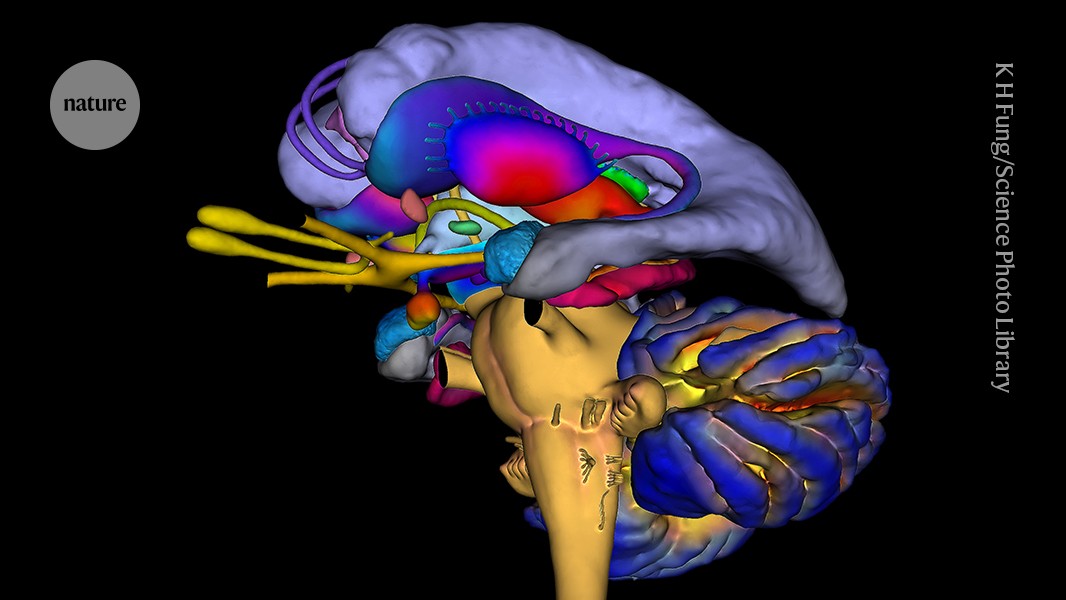
Stress has widespread effects on the brain.Credit: K H Fung/Science Photo Library
Acute stress makes it difficult to link memories of past events with fresh information, a study1 suggests. The results help to explain why people struggle to show insight under pressure.
The study, published today in Science Advances, combined brain imaging and psychological testing to show how stress disrupts people’s ability to tap into records of previous experiences and make deductions.
The combination of behavioural testing and neural imaging “to actually see what’s going awry is really compelling”, says Brice Kuhl, a neuroscientist at the University of Oregon in Eugene, who was not involved in the study.
Only connect
The brain connects new and old information to make inferences through a cognitive process called integration. For example, if you have a memory of your friend wearing a bright green jacket, and you see a bright green jacket on a park bench, you might integrate your memory and the visual input to infer that your friend is at the park. This ability can be impaired in individuals with some mental-health conditions, such as anxiety disorders and psychosis.
The brain area called the hippocampus is essential for integration. Since it is also particularly vulnerable to stress, Lars Schwabe, a cognitive psychologist at the University of Hamburg in Germany, and his colleagues decided to test how acute stress would affect the brain’s ability to integrate information and make inferences.
Memory task
On the experiment’s first day, 121 participants were asked to memorize a series of paired images, each containing one image of an animal and one image of either a face or a scene.
The next day, roughly half of the participants underwent a mock job interview that required them to defend their suitability for a hypothetical role and perform complex mental mathematics. Participants in the control group, meanwhile, were asked to give a speech about a topic of their choice and complete a simple mental maths task.
Sleep deprivation disrupts memory: here’s why
Afterwards, participants were presented with another series of paired images, with each pair containing a picture of an animal and of a 3D shape.
Then, the participants were shown, one by one, the 3D shapes that they’d seen previously alongside a collection of various faces and scenes. They were asked to select the face or scene most likely to be associated with each 3D shape.
For example, an individual might hypothetically have memorized a pair containing a cat and a forest scene on the first day and a pair with a cat and a blue cube on the second. If the person’s brain had successfully integrated the memories from the two separate days, then they should associate a blue cube with a forest scene.

