



Companies have proposed launching fleets of satellites into orbit that would act similar to data centres on Earth.Credit: NicoElNino/Alamy
As the huge data centres powering the artificial-intelligence boom grow ever more unpopular on Earth, companies are planning to launch them into space.
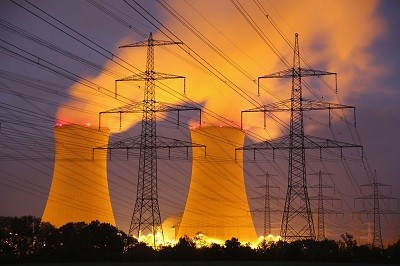
Data centres will use twice as much energy by 2030 — driven by AI
In the past few months, firms including SpaceX, Google and Blue Origin have all shared plans to launch large fleets, or constellations, of satellites into low Earth orbit. The networks would act in a similar way to the interconnected computers inside data centres on Earth, which process, store and transmit data on a massive scale. Putting these ‘orbital data centres’ into space could, in theory, address concerns about their energy and water consumption, and their occupation of wide swathes of land. The idea is that constellations would use sunlight for energy rather than driving up electricity costs on Earth, and they would be cooled by space’s naturally cold environment rather than by water sources on our planet.
For some, such a solution can’t come soon enough. Data centres on Earth have become so environmentally taxing that communities and politicians are taking action against them. For example, the board of trustees for a township in the US state of Michigan voted last week to institute a one-year moratorium on the delivery of water to hyperscale data centres so that the township can study the effects of a planned facility.
As companies plug away at satellite designs and lobby for launch approvals, they are pushing for the space-based data centres to become a reality in the next few years. Researchers who spoke to Nature, however, see it taking longer to wrangle the sci-fi technology into being.
How did the trend start?
The chatter surrounding orbital data centres to power AI isn’t new. In September 2024, engineers at the space-technology company Starcloud in Redmond, Washington, published a white paper arguing that orbital data centres are “feasible, economically viable, and necessary to realize the potential of AI”. And in November 2025, researchers at the technology giant Google announced its Suncatcher project, with a plan to “one day scale machine learning compute in space”.
But it was in January this year that “everything blew up in this area”, says Kathleen Curlee, who studies the space economy at Georgetown University in Washington DC. That’s when billionaire Elon Musk’s aerospace and tech company SpaceX, headquartered in Starbase, Texas, shared plans to launch one million satellites to form an orbital data centre — a staggering number compared with the roughly 15,000 satellites now in low Earth orbit. Not to be outdone, the China Aerospace Science and Technology Corporation, based in Beijing, joined the race at about the same time, and billionaire Jeff Bezos’ space-tech firm Blue Origin, based in Kent, Washington, later filed for its own constellation.

US communities have been meeting to oppose data centres that would use their electricity and water (shown is a gathering on 4 August in Tucson, Arizona, that discussed installation of a facility by Amazon Web Services).Credit: Wild Horizons/Universal Images Group via Getty
Adding more pressure to get data centres into orbit is a March plan released by US President Donald Trump’s administration called the Ratepayer Protection Pledge. AI firms such as Google, OpenAI and Musk’s xAI signed the pledge, agreeing to build infrastructure for or to buy any power their data centres need, to prevent US residents from footing the bill. It’s a non-binding agreement, but by implementing it ahead of the US mid-term elections in November, Trump has made clear that data centres are a political issue that could sway voters.
What are the challenges to building the data centres in space?
For these projects to succeed, several engineering obstacles need to be overcome. One is ensuring that the satellites’ electronics cool properly. Although space is much colder than Earth, it is also a vacuum, meaning that the extreme heat generated primarily by AI chips will probably not easily dissipate on its own. Technologies already exist to cool gadgets in space, such as the heat radiators on the International Space Station. But these are probably too heavy — and, consequently, too expensive to launch — to be practical for orbital data centres, says Igor Bargatin, a mechanical engineer at the University of Pennsylvania in Philadelphia.

Huge new satellite outshines nearly every star in the sky

