


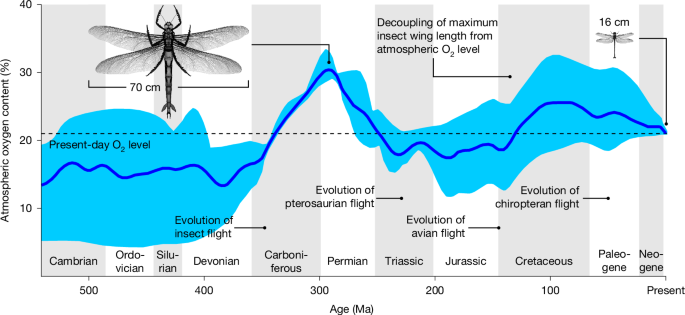
Klowden, M. J. & Palli, S. R. Physiological Systems in Insects 4th edn (Academic Press, 2022).
Nation, J. L. Sr. Insect Physiology and Biochemistry 4th edn (CRC Press, 2022).
Björkman, C., Gotthard, K. & Pettersson, M. W. in Encyclopedia of Insects 2nd edn (eds Resh, V. H. & Cardé, R. T.) Ch. 29 (Academic Press, 2009).
Graham, J. B., Dudley, R., Aguilar, N. M. & Gans, C. Implications of the late Palaeozoic oxygen pulse for physiology and evolution. Nature 375, 117–120 (1995).
Raymond, J. & Segrè, D. The effect of oxygen on biochemical networks and the evolution of complex life. Science 311, 1764–1767 (2006).
Dismukes, G. C. et al. The origin of atmospheric oxygen on Earth: the innovation of oxygenic photosynthesis. Proc. Natl Acad. Sci. USA 98, 2170–2175 (2001).
Sperling, E. A. et al. Breathless through time: oxygen and animals across Earth’s history. Biol. Bull. 243, 184–206 (2022).
Payne, J. L. et al. The evolutionary consequences of oxygenic photosynthesis: a body size perspective. Photosynth. Res. 107, 37–57 (2011).
Butterfield, N. J. Oxygen, animals and oceanic ventilation: an alternative view. Geobiology 7, 1–7 (2009).
Carpenter, F. M. The Lower Permian insects of Kansas. Part 8. Additional Megasecoptera, Protodonata, Odonata, Homoptera, Psocoptera, Protelytroptera, Plectoptera, and Protoperlaria. Proc. Am. Acad. Arts Sci. 73, 29–70 (1939).
Kukalová-Peck, J. Ephemeroid wing venation based upon new gigantic Carboniferous mayflies and basic morphology, phylogeny and metamorphosis of pterygote insects (Insecta, Ephemerida). Can. J. Zool. 63, 933–955 (1985).
Dudley, R. Atmospheric oxygen, giant Paleozoic insects and the evolution of aerial locomotor performance. J. Exp. Biol. 201, 1043–1050 (1998).
Rutten, M. G. Geologic data on atmospheric history. Palaeogeogr. Palaeoclimatol. Palaeoecol. 2, 47–57 (1966).
Wade, D. C. et al. Simulating the climate response to atmospheric oxygen variability in the Phanerozoic: a focus on the Holocene, Cretaceous and Permian. Clim. Past 15, 1463–1483 (2019).
Berner, R. A. GEOCARBSULF: a combined model for Phanerozoic atmospheric O2 and CO2. Geochim. Cosmochim. Acta 70, 5653–5664 (2006).
Berner, R. A. Phanerozoic atmospheric oxygen: new results using the GEOCARBSULF model. Am. J. Sci. 309, 603–606 (2009).
Bergman, N. M., Lenton, T. M. & Watson, A. J. COPSE: a new model of biogeochemical cycling over Phanerozoic time. Am. J. Sci. 304, 397–437 (2004).
Berner, R. A. & Canfield, D. E. A new model for atmospheric oxygen over Phanerozoic time. Am. J. Sci. 289, 333–361 (1989).
Wigglesworth, V. B. Growth and regeneration in the tracheal system of an insect, Rhodnius prolixus (Hemiptera). Q. J. Microsc. Sci. 95, 115–137 (1954).
Snelling, E. P., Duncker, R., Jones, K. K., Fagan-Jeffries, E. P. & Seymour, R. S. Flight metabolic rate of Locusta migratoria in relation to oxygen partial pressure in atmospheres of varying diffusivity and density. J. Exp. Biol. 220, 4432–4439 (2017).
Harrison, J. F. et al. Air sacs are a key adaptive trait of the insect respiratory system. J. Exp. Biol. 226, jeb245712 (2023).
Socha, J. J., Förster, T. D. & Greenlee, K. J. Issues of convection in insect respiration: insights from synchrotron X-ray imaging and beyond. Respir. Physiol. Neurobiol. 173, S65–S73 (2010).
Schmitz, A. & Perry, S. F. Stereological determination of tracheal volume and diffusing capacity of the tracheal walls in the stick insect Carausius morosus (Phasmatodea, Lonchodidae). Physiol. Biochem. Zool. 72, 205–218 (1999).
Hartung, D. K., Kirkton, S. D. & Harrison, J. F. Ontogeny of tracheal system structure: a light and electron-microscopy study of the metathoracic femur of the American locust, Schistocerca americana. J. Morphol. 262, 800–812 (2004).
Snelling, E. P., Seymour, R. S., Runciman, S., Matthews, P. G. D. & White, C. R. Symmorphosis and the insect respiratory system: a comparison between flight and hopping muscle. J. Exp. Biol. 215, 3324–3333 (2012).
Dejours, P. Principles of Comparative Respiratory Physiology 2nd revised edn (Elsevier/North-Holland Biomedical Press, 1981).
Weis-Fogh, T. Diffusion in insect wing muscle, the most active tissue known. J. Exp. Biol. 41, 229–256 (1964).
Centanin, L., Gorr, T. A. & Wappner, P. Tracheal remodelling in response to hypoxia. J. Insect Physiol. 56, 447–454 (2010).
Jarecki, J., Johnson, E. & Krasnow, M. A. Oxygen regulation of airway branching in Drosophila is mediated by branchless FGF. Cell 99, 211–220 (1999).
VandenBrooks, J. M. et al. Supply and demand: how does variation in atmospheric oxygen during development affect insect tracheal and mitochondrial networks? J. Insect Physiol. 106, 217–223 (2018).
Harrison, J. F. et al. Developmental plasticity and stability in the tracheal networks supplying Drosophila flight muscle in response to rearing oxygen level. J. Insect Physiol. 106, 189–198 (2018).
Gjoni, V., Tan, H., Hirst, A., Kratina, P. & Atkinson, D. Locomotion reveals contrasting responses in body mass-scaling of metabolic rates between winged and wingless arthropods. Ecol. Lett. 28, e70277 (2025).
Duell, M. E., Klok, C. J., Roubik, D. W. & Harrison, J. F. Size-dependent scaling of stingless bee flight metabolism reveals an energetic benefit to small body size. Integr. Comp. Biol. 62, 1429–1438 (2022).
Wagner, J. M. et al. Isometric spiracular scaling in scarab beetles — implications for diffusive and advective oxygen transport. eLife 11, e82129 (2022).
Kaiser, A. et al. Increase in tracheal investment with beetle size supports hypothesis of oxygen limitation on insect gigantism. Proc. Natl Acad. Sci. USA 104, 13198–13203 (2007).
Greenlee, K. J., Nebeker, C. & Harrison, J. F. Body size-independent safety margins for gas exchange across grasshopper species. J. Exp. Biol. 210, 1288–1296 (2007).
Henry, J. R. & Harrison, J. F. Effects of body size on the oxygen sensitivity of dragonfly flight. J. Exp. Biol. 217, 3447–3456 (2014).
Lease, H. M., Klok, C. J., Kaiser, A. & Harrison, J. F. Body size is not critical for critical PO2 in scarabaeid and tenebrionid beetles. J. Exp. Biol. 215, 2524–2533 (2012).
Harrison, J. F., Klok, C. J. & Waters, J. S. Critical PO2 is size-independent in insects: implications for the metabolic theory of ecology. Curr. Opin. Insect Sci. 4, 54–59 (2014).
Cannell, A. E. R. The engineering of the giant dragonflies of the Permian: revised body mass, power, air supply, thermoregulation and the role of air density. J. Exp. Biol. 221, jeb185405 (2018).
Hoppeler, H. & Kayar, S. R. Capillarity and oxidative capacity of muscles. Physiology 3, 113–116 (1988).
Mathieu-Costello, O., Suarez, R. K. & Hochachka, P. W. Capillary-to-fiber geometry and mitochondrial density in hummingbird flight muscle. Respir. Physiol. 89, 113–132 (1992).
Mathieu-Costello, O., Szewczak, J. M., Logemann, R. B. & Agey, P. J. Geometry of blood-tissue exchange in bat flight muscle compared with bat hindlimb and rat soleus muscle. Am. J. Physiol. Regul. Integr. Comp. Physiol. 262, R955–R965 (1992).
Snelling, E. P. et al. A structure-function analysis of the left ventricle. J. Appl. Physiol. 121, 900–909 (2016).
Snelling, E. P., Seymour, R. S., Matthews, P. G. D. & White, C. R. Maximum metabolic rate, relative lift, wingbeat frequency and stroke amplitude during tethered flight in the adult locust Locusta migratoria. J. Exp. Biol. 215, 3317–3323 (2012).
Mizisin, A. P. & Josephson, R. K. Mechanical power output of locust flight muscle. J. Comp. Physiol. A 160, 413–419 (1987).
Weis-Fogh, T. Respiration and tracheal ventilation in locusts and other flying insects. J. Exp. Biol. 47, 561–587 (1967).
Harrison, J. F. & Wasserthal, L. T. in The Insects: Structure and Function 5th edn (eds Simpson, S. J. & Douglas, A. E.) 501–545 (Cambridge Univ. Press, 2013).
Huang, S.-P., Talal, S., Ayali, A. & Gefen, E. The effect of discontinuous gas exchange on respiratory water loss in grasshoppers (Orthoptera: Acrididae) varies across an aridity gradient. J. Exp. Biol. 218, 2510–2517 (2015).
Clapham, M. E. & Karr, J. A. Environmental and biotic controls on the evolutionary history of insect body size. Proc. Natl Acad. Sci. USA 109, 10927–10930 (2012).
Ellers, O. et al. Induced power scaling alone cannot explain griffenfly gigantism. Integr. Comp. Biol. 64, 598–610 (2024).
Price, P. W. Insect Ecology 3rd edn (John Wiley & Sons, 1997).
Gee, H. A (Very) Short History of Life on Earth (Pan Macmillan, 2021).
Vermeij, G. J. Gigantism and its implications for the history of life. PLoS ONE 11, e0146092 (2016).
Snelling, E. P. et al. Scaling of morphology and ultrastructure of hearts among wild African antelope. J. Exp. Biol. 221, jeb184713 (2018).
Kreuzer, F. Oxygen supply to tissues: the Krogh model and its assumptions. Experientia 38, 1415–1426 (1982).
Howard, C. V. & Reed, M. G. Unbiased Stereology: Three Dimensional Measurement in Microscopy (BIOS Scientific, 1998).
Schneider, C. A., Rasband, W. S. & Eliceiri, K. W. NIH Image to ImageJ: 25 years of image analysis. Nat. Methods 9, 671–675 (2012).
Snelling, E. P., Seymour, R. S. & Runciman, S. Moulting of insect tracheae captured by light and electron-microscopy in the metathoracic femur of a third instar locust Locusta migratoria. J. Insect Physiol. 57, 1312–1316 (2011).
Snelling, E. P. Data for insect flight muscle tracheole scaling [data set]. Zenodo https://doi.org/10.5281/zenodo.18523523 (2026).
Snelling, E. P. R coding for insect flight muscle tracheole scaling. Zenodo https://doi.org/10.5281/zenodo.18523485 (2026).
Orme, D. The caper package: comparative analysis of phylogenetics and evolution in R, version 1.0.1. CRAN https://CRAN.R-project.org/package=caper (2018).
R Core Team. R: A Language and Environment for Statistical Computing. https://www.R-project.org (R Foundation for Statistical Computing, 2025).
Chesters, D. The phylogeny of insects in the data-driven era. Syst. Entomol. 45, 540–551 (2020).
Pagel, M. Inferring the historical patterns of biological evolution. Nature 401, 877–884 (1999).
Hartigan, J. A. & Hartigan, P. M. The dip test of unimodality. Ann. Statist. 13, 70–84 (1985).
Maechler, M. diptest: Hartigan’s dip test statistic for unimodality — corrected, version 0.76-0. CRAN https://CRAN.R-project.org/package=diptest (2022).
Tercel, M. P. T. G., Veronesi, F. & Pope, T. W. Phylogenetic clustering of wingbeat frequency and flight-associated morphometrics across insect orders. Physiol. Entomol. 43, 149–157 (2018).
Burnham, K. P. & Anderson, D. R. Multimodel inference: understanding AIC and BIC in model selection. Sociol. Methods Res. 33, 261–304 (2004).

