


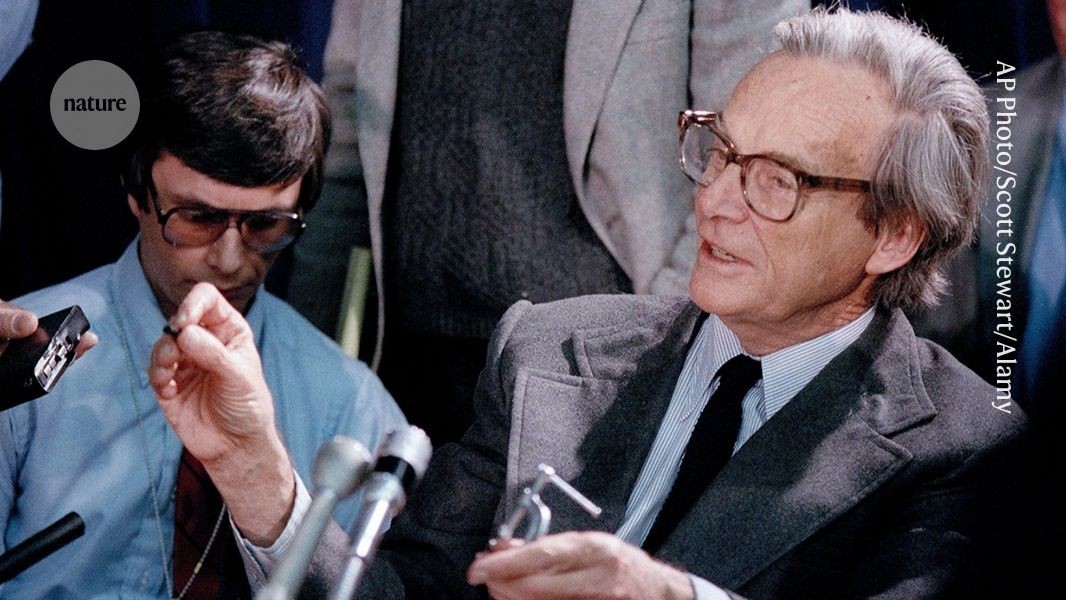
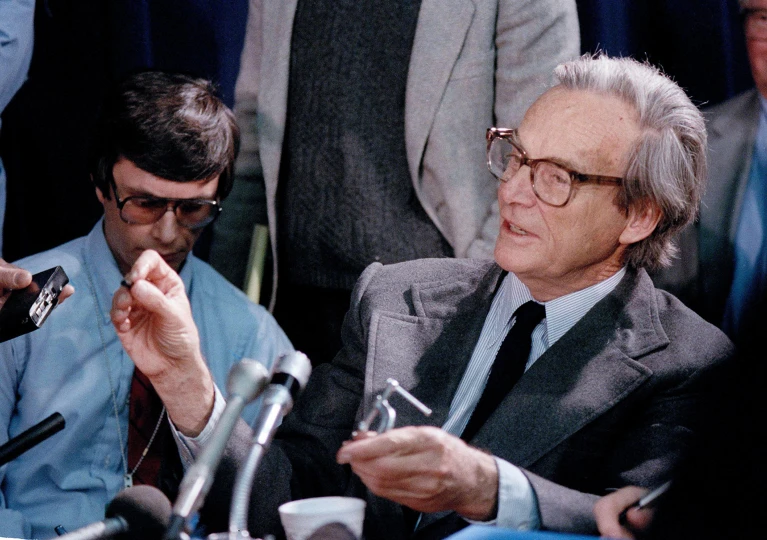
Richard Feynman was awarded the 1965 Nobel Prize in Physics.Credit: AP Photo/Scott Stewart/Alamy
In a scene that could have easily featured in an episode of the US television sitcom The Big Bang Theory, the late US physicist Richard Feynman once turned a visit to a Thai restaurant he often dined at into a mathematical riddle: how adventurous should we be in trying new dishes? Feynman promptly solved this on a sheet of paper.
Now, behavioural scientists have revisited Feynman’s solution — some of which had been obscured by his inscrutable handwriting — and found that his was indeed the optimal strategy.
Feynman’s dilemma is one that will be familiar to any restaurant-goer. Do we keep ordering the best dish we’ve had so far, or do we explore the menu in the hope of finding something better? A study published in the Proceedings of the National Academy of Sciences on 1 June probes this question, and includes experimental findings that participants adopt meal-choosing strategies that closely approximate Feynman’s mathematical solution1.
Behavioural scientist Shoham Choshen-Hillel at the Hebrew University of Jerusalem says that the authors wrote a “super creative article”. “The restaurant example stands in for decisions in many settings,” she adds. Real-life examples include choosing a home to buy, deciding whom to partner up with and selecting a parking spot.
Are you ready to order?
The story begins with a regular visit by Feynman, a Nobel prizewinning physicist at the California Institute of Technology in Pasadena, and his friend Ralph Leighton, to a Thai restaurant in nearby Glendale in the late 1970s. (Leighton helped Feynman to write his popular 1985 memoir Surely You’re Joking, Mr. Feynman! and was the son of the late physicist Robert Leighton, the co-author of the influential 1964 The Feynman Lectures on Physics, together with Feynman and Matthew Sands.) Leighton wondered whether he should order ginger chicken — his favourite dish — or explore the rest of the menu. Feynman began scribbling and promptly claimed he had found a mathematical solution: in his simplified model of the situation, he calculated a threshold — a number of visits beyond which Leighton’s rational decision would be to always settle on his favourite dish.
When do girls fall behind in maths? Gigantic study pinpoints the moment
What Feynman had done was turn the restaurant dilemma into a question in decision theory — a field at the intersection of economics and psychology that analyses strategies in one-person games. In particular, it was an original contribution to a larger family of problems in decision theory called stopping problems. These include real-life problems in which someone has to decide whether the possibility they have in front of them is good enough, or whether to keep searching.
Leighton saved the notes, and years later he partially transcribed Feynman’s spidery cursive handwriting to the best of his ability. Leighton described his interpretation in an article he posted online in the early 2000s. A decade later, in 2013, Tom Griffiths, a cognitive scientist at Princeton University in New Jersey, became interested in the question while he was researching a book with his collaborator Brian Christian, a computer scientist and cognitive scientist. Griffiths then transcribed Feynman’s notes in full for the first time.
Christian, who is now at the University of California, Berkeley, says the question then lay dormant for nearly another decade, until the two researchers decided to revisit it in 2021. “We’d understood the meaning of Feynman’s notes, but there was all this work to be done,” he says. The researchers then went on to confirm that Feynman had indeed come up with the best solution, and also solved a generalized version of the problem.

