


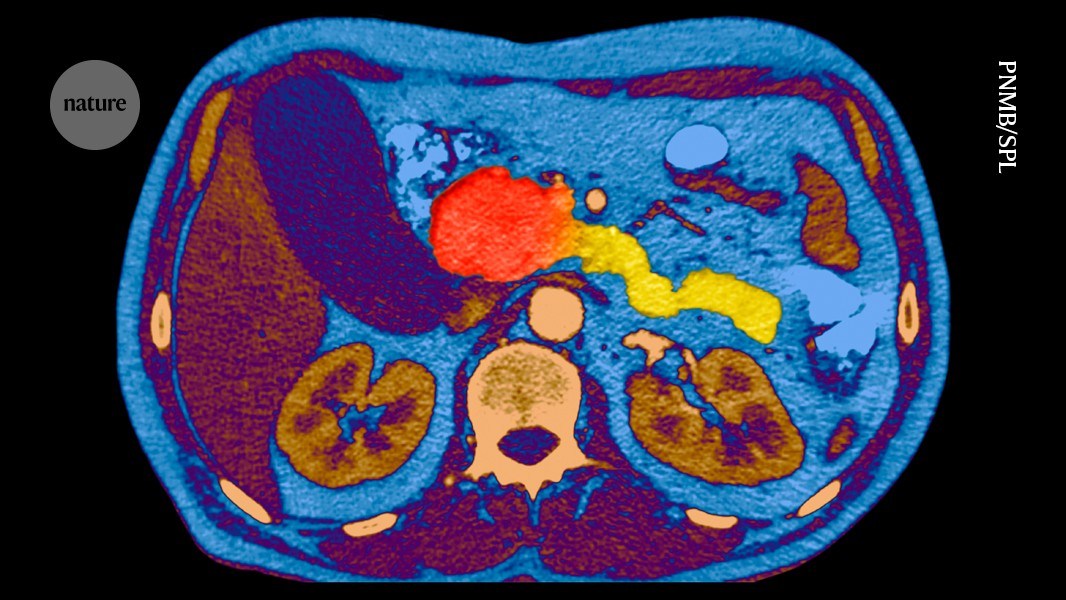

Pancreatic-head tumours (red, artificially coloured) have proven highly resistant to treatment, but a new drug nearly doubles the lifespan of people with this type of cancer.Credit: PNMB/Science Photo Library
The landmark success of a drug against an ‘undruggable’ cancer is spurring fresh optimism in the quest to treat seemingly untouchable tumour targets.
The experimental drug, daraxonrasib, disarms all three members of the RAS family of proteins, which are linked to some of the deadliest cancers. Designing drugs that target the RAS proteins has been notoriously challenging. But a large clinical trial has found that daraxonrasib nearly doubled survival — from 6.7 months to 13.2 months — in people with a form of advanced pancreatic cancer.
The results were presented to a packed room at the American Society of Clinical Oncology annual meeting in Chicago, Illinois on 31 May, and published in the New England Journal of Medicine1. At the conference, the talk was met with a long standing ovation, says Ecaterina Dumbrava, an oncologist at the University of Texas MD Anderson Cancer Center in Houston. “After more than a decade without major advances in treatment for pancreatic cancer, seeing this is really emotional,” she says.
That success is raising hopes that other challenging targets might also soon fall. Nature talked to researchers about progress in targeting RAS and other “undruggable” cancer proteins that can’t be bested with conventional approaches.
RAS: locked into overdrive
RAS proteins are molecular on–off switches that help to control cell growth and division. But some mutations leave RAS proteins stuck in the ‘on’ position, which drives tumour growth.
Ideally, a cancer drug would switch these proteins off. But drugs typically work by nestling into deep pockets on the surfaces of proteins, and RAS proteins are unhelpfully smooth.

Cheap blood test detects pancreatic cancer before it spreads
The first anti-RAS drug was approved in the United States in 2021. It targeted only one mutation in one member of the family, a protein called KRAS. That meant that the drug was only suitable for a fraction of people with RAS-driven cancers, and even those tumours quickly became resistant to it.
Daraxonrasib, by contrast, switches off all three members of the RAS family. In a trial of 500 people with advanced pancreatic cancer, those who received daraxonrasib lived another 13.2 months, compared with 6.7 months for those treated with chemotherapy. Daraxonrasib was developed by Revolution Medicines in Redwood City, California.
Researchers hope that this will be just the starting point. Combining daraxonrasib with other drugs — such as a single-mutation KRAS drug — could produce longer-lasting benefits2, says Kevan Shokat, a chemical biologist at the University of California, San Francisco. And future variations on daraxonrasib might be able to reduce its toxicity, he adds. “Sometimes the very first molecule just shows that it’s possible,” he says.
MYC: smooth operator
About 70% of all cancers are fuelled by excessive levels of a protein called MYC. But MYC, like RAS proteins, has a smooth surface, making anchoring drugs there difficult.
Furthermore, cancer-driving mutations in the MYC gene are rarely a straightforward, single change to a DNA base — the kind of mutation that might be easily targeted with a drug. Instead, the gene is sometimes duplicated, or other genetic changes make it more active, resulting in more MYC protein than usual. “MYC is going to be a little more complicated” than targeting KRAS, says Shokat.
One leading approach is an experimental drug called OMO-103, made by Peptomyc in Barcelona, Spain. The drug is a ‘mini protein’ that interferes with MYC’s ability to interact with another protein, and has shown promise in a small trial with 19 participants3.

Better treatments on the way for lung cancer that spreads to the brain
Other researchers are screening large libraries of compounds in search of those that might inhibit specific functions of the protein. At Oregon Health and Science University in Portland, cancer researcher Rosalie Sears and her collaborators are using artificial intelligence to hunt for compounds that bind to the part of MYC that helps to repair damaged DNA — a crucial ability in rapidly dividing tumour cells. And Michael Cole, a cancer researcher at the Geisel School of Medicine at Dartmouth College in Hanover, New Hampshire, who has been studying MYC for more than 40 years, is looking for compounds that block MYC’s ability to activate certain other genes.
Cole’s effort got a boost from the first KRAS drug, which was approved around the time that he co-founded a company called cosMYC in Cambridge, Massachusetts, to chase such compounds. Buzz around the KRAS-drug approval helped the firm to raise initial financing, says Ed Feris, cosMYC’s chief executive and co-founder. “Everyone was asking, ‘what can we do next’?” he says. “And people were thinking: MYC.”
p53: restoring the guardian
The protein p53 has been called the guardian of the genome, because of its role in preventing cells with damaged DNA from proliferating. The gene encoding p53 is the most commonly mutated gene in cancer, and a lack of normal p53 can fuel many kinds of tumour.

