


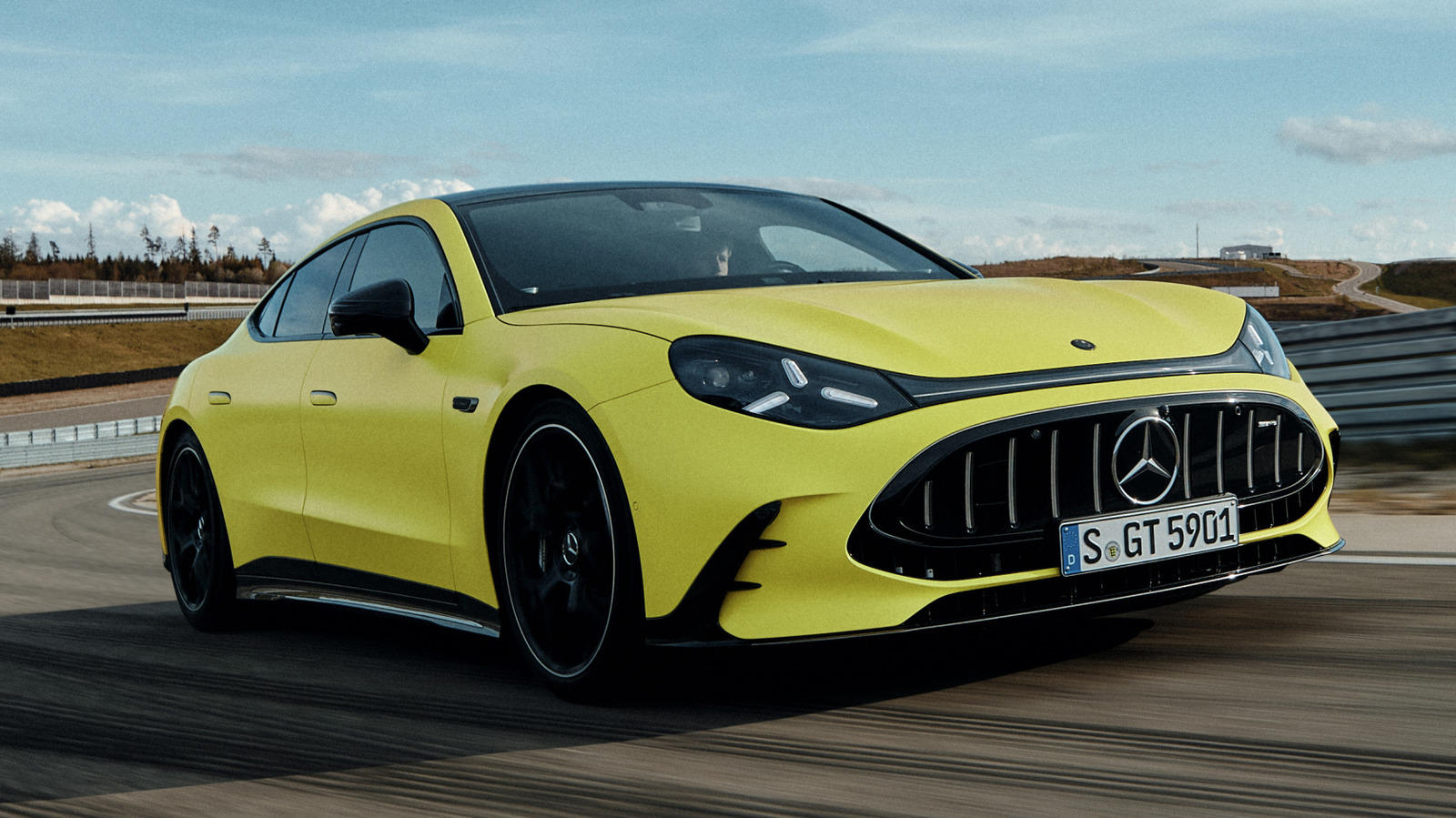
Mercedes has been talking about axial-flux motors for a few years now, acquiring British company YASA in 2021, and the new AMG GT is the brand’s first production car to use them, with both the GT55 and GT63 getting one motor on the front axle and two on the rear axle, like the Lucid Air Sapphire. Compared to more typical permanent magnet synchronous motors in existing EVs, axial-flux motors are smaller, lighter, more power-dense and capable of repeated performance in quick succession. If you want to get really nerdy, here’s what Mercedes’ release says:
In an axial flux motor, the electromagnetic flux runs parallel to the motor’s axis of rotation. In a conventional electric motor, it runs perpendicular to the axis. Key components of the axial flux motor are designed as thin discs: two rotors enclose the stator like a sandwich on the left and right. This arrangement – also known as an H-configuration – allows optimal coupling of the magnetic flux generated by the stator to the rotors. In the new Mercedes-AMG GT 4-Door Coupe, this combination at the front axle is approximately 3.5 inches wide; each of the two motors at the rear axle are approximately 3.2 inches wide.
The motors are integrated into a High Performance Electric Drive Unit (HP.EDU) on each axle. At the rear axle, the HP.EDU contains two axial flux motors, which are combined together with a compact single-stage planetary gearbox in a shared housing. The motors and gearboxes are oil cooled. The required Pump Control Unit, including hydraulic pumps and suction filters, is also integrated into the HP.EDU to save space. In addition, two water-cooled silicon carbide (SiC) inverters (one per motor) are used. The material properties of silicon carbide offer numerous benefits for demanding applications that require high voltages, high currents, high temperatures and excellent thermal conductivity. The axial flux motors reach more than 13,000 rpm at top speed.
The front HP.EDU comprises one axial flux motor, a spur gear transmission with integrated parking lock, a liquid-cooled silicon carbide (SiC) inverter and a Pump Control Unit. The front axial flux motor reaches more than 15,000 rpm at top speed. The front electric drive acts as a “booster motor,” activated only when additional power or traction is required on the front axle. During steady state driving, coasting or under low load, the Disconnect Unit (DCU) decouples the front electric motor within milliseconds to maximize efficiency. During acceleration and recuperation, the DCU engages for optimal performance.
 Mercedes-AMG
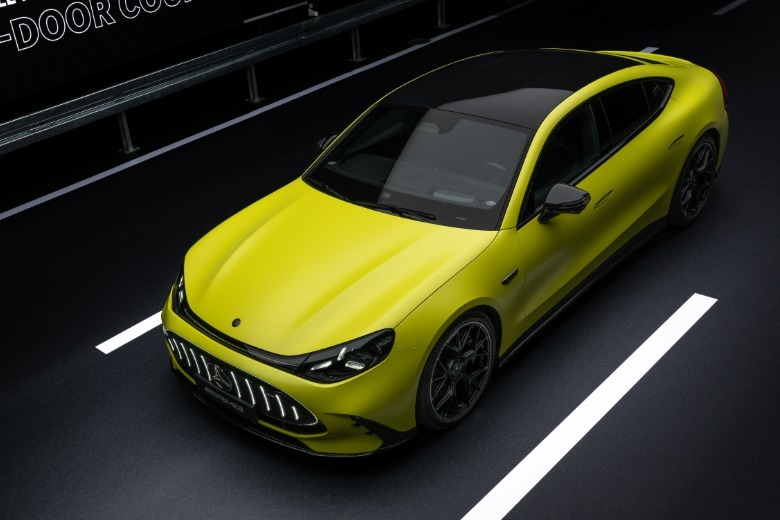
The GT55 has a continuous output of 503 hp and 1,328 pound-feet of torque, with the peak of 805 hp coming in when launch control is used and the car has an 80% state of charge. It needs just 2.4 seconds to reach 60 mph and 8.7 seconds to hit 124 mp, both three-tenths slower without a 1-foot rollout. If that’s not enough, the GT63 has 1,475 lb-ft of torque, 711 hp of continuous output and 1,153 hp of peak output. The GT63 will hit 60 mph in 2.0 and needs only 6.4 seconds to hit 124 mph, again both figures slightly slower without rollout included, making it comfortably Mercedes’ quickest production car ever. Mercedes says the GT63 weighs in at 5,432 pounds, which is only a couple hundred pounds more than the current GT63 S E Performance PHEV.
Top speed for both models is 186 mph — that’s how fast the GT XX was driving around Nardo. Mercedes says the car can handle more than 1,300 hp, so expect even more extreme models in the future. If you pull on both steering wheel paddles at once, a boost of 67 hp in the GT55 or 148 hp in the GT63 is deployed along with sharper throttle response, special sounds and tightening seatbelts. All that torque is fully variable between the axles, and the rear-motor setup means torque can also be distributed individually between each rear wheel. All of that torque control is done instantly and automatically based on the situation, driver behavior and weather, and the car can be driven in full rear-drive mode.

