


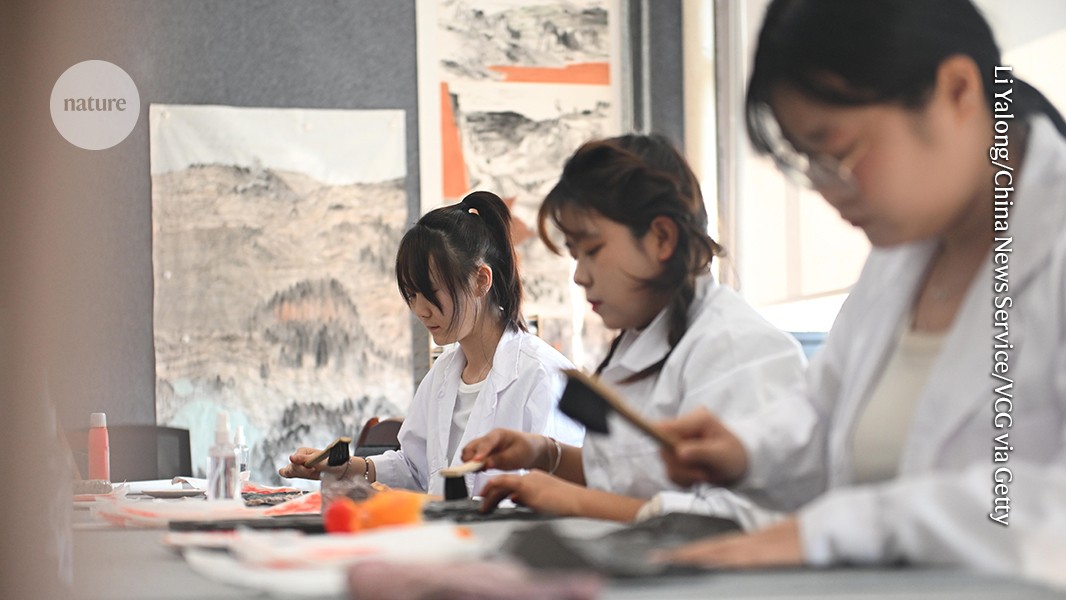

Students restore relics as part of their course at a technical college in China.Credit: Li Yalong/China News Service/VCG via Getty
A narrative has taken hold that science and the humanities are at odds. In universities around the world, investment in cutting-edge technologies often comes at the expense of retrenchment in philosophy, history, literature and the arts. Contraction of the humanities is presented as an unavoidable cost of modernization. But that ‘zero sum’ logic is flawed. As science and technology race ahead, the world needs humanities research to understand the reasons and implications.
My experience at ShanghaiTech University in China tells this story. Since its founding in 2013, the university has invested heavily in science, technology, engineering and mathematics (STEM). And it has built the Institute of Humanities as a core academic unit.
The power that a liberal-arts education can have in a science-oriented institution is embedded in ShanghaiTech’s vision. Jiang Mianheng, the former and founding president of ShanghaiTech, has argued that a technological university must move beyond narrow career preparation and cultivate well-rounded people (M. Jiang Daedalus 153, 98–105; 2024). Higher education should not just develop students’ technical skills but also foster judgement, creativity, ethical awareness and character.
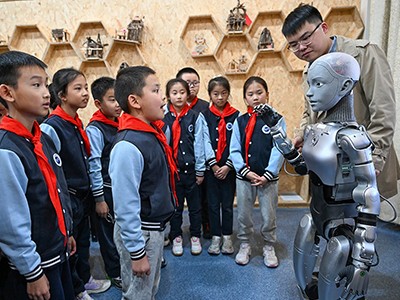
Innovation starts in schools — lessons from China
Today, the Institute of Humanities comprises more than 30 scholars working across philosophy, history, religious studies, and Chinese and English languages and cultures. Many members hold degrees from leading international institutions and about a dozen are international scholars who do not speak a Chinese language as their first language. One visitor described creating this vibrant environment from scratch in such a short period of time as nothing short of heroic.
In the first few months of assuming my role as deputy dean of the institute in September 2025, I surprised myself at how much my colleagues and I achieved. By November, we had hosted two conferences and nine public lectures, and organized a campus-wide humanities festival. Speakers came from Armenia, Canada, France, Germany, the United Kingdom and the United States, and even included a former official of the United Nations.
Why do humanities scholars at ShanghaiTech work with such intensity? One answer is the pressure that comes with operating alongside colleagues in STEM fields. In a research university that is oriented towards science and technology, humanities researchers cannot rely on the inherited prestige of their disciplines. Making research visible, engaging and relevant is essential — and can generate fresh ideas and collaborations.
From this perspective, the humanities are not a supplement to, but a foundational component of, undergraduate education, especially in a technology-driven institution. And universities and governments must recognize this.
Profound transformations
There was another reason for my surprise at our achievements at the institute: this was not the Chinese university system I remembered from my youth. When I left China to study abroad two decades ago, universities were materially poor and institutionally constrained. Faculty members and students had limited resources, heavy workloads and narrowly circumscribed academic horizons. International exchange was rare, and academic life often felt insular.
But the system I encountered when I returned to China in 2025 was transformed — not only in terms of infrastructure and funding but also in ambition and institutional self-confidence.

The great university shake-up: four charts show how global higher education is changing
A historical perspective is required to appreciate the deeper significance of this transformation. For much of the twentieth century, historians of China, both Chinese and foreign, were preoccupied with what was widely perceived as a Chinese ‘science problem’. British biochemist and historian Joseph Needham once famously asked why modern science had developed in Europe, when China had so many past achievements and a long history of invention.
This question cast a long shadow over subsequent debates. China was seen through the lens of a persistent paradox: celebrated as an ancient civilization with a rich intellectual and cultural heritage, but without the scientific and industrial transformations that came to define European modernity.
This perceived paradox is not merely a retrospective puzzle; it has shaped the Chinese university system. In the early twentieth century, Chinese modernizers were eager to embrace scientists from the West as teachers who could help them to rebuild China’s future. Yet the difficulty they confronted lay not in China’s apparent rejection of science, but in the absence of scientific infrastructure. It was hard to embed experimental and technological knowledge in existing academic conventions and institutional systems.

University students learn about ‘Nushu’, a Chinese script used only by women.Credit: Jade Gao/AFP via Getty
To some observers, this period was a golden age for the humanities. Universities developed under relatively liberal and decentralized models inspired by European and US precedents — conditions that proved conducive to the growth of the humanities and social sciences. A generation of scholars established a vibrant culture in history, literature, philosophy and law, supported by expanding university systems, commercial publishing networks and a flourishing textbook market.
At the same time, science and engineering remained comparatively underdeveloped. Although ‘scientific methods’ were embraced by the humanities — most notably in historical studies that emphasized empiricism, specialization and professional rigour — laboratory sciences and applied engineering lacked stable institutional bases, state investment and social prestige. As a result, scientific and technical fields occupied a marginal position in universities and in broader intellectual debates. This imbalance shaped educational choices: university students tended to enrol in humanities courses, contributing, by the 1930s, to an oversupply of these graduates in an increasingly constrained job market.
The founding of the People’s Republic of China in 1949 marked a break from this educational legacy. The new state interpreted the imbalance between the humanities and the sciences as an ideological vulnerability and a developmental bottleneck. In the context of cold-war competition and socialist state-building, science and technology were elevated to the status of national imperatives. They were no longer seen as merely academic disciplines; they became instruments of sovereignty, modernization and political legitimacy.
This shift was institutionalized through a comprehensive restructuring of higher education in the early 1950s, modelled mostly on the Soviet system. Universities were reorganized according to principles of specialization and professionalization. Engineering schools and applied-science institutes expanded rapidly, while many comprehensive universities were dismantled or redefined.
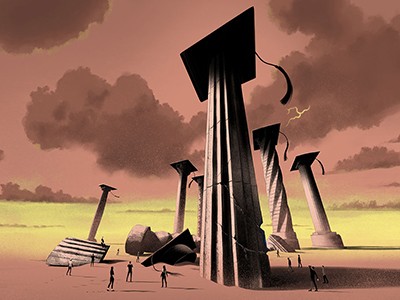
The future of universities
Elite institutions such as Tsinghua University in Beijing were transformed into science- and engineering-focused universities, with their humanities and social-science faculties relocated, merged or dissolved. Private universities were closed and faculty members were reassigned to other institutions and disciplines in accordance with centralized state planning.
These reforms positioned science and technology as the foundations of national development. They also fostered a durable public reverence for scientific expertise, one that continues to shape Chinese society today. Science and engineering came to be portrayed as the vanguard of modernization, while the humanities were increasingly relegated to a secondary role. Officials developed technocratic mindsets, in which scientific and technical knowledge became central to governance, policymaking and visions of the future. The situation was not unique to China. It reflected a broader pattern shared by many socialist states, and indeed by numerous societies after the Second World War, and characterized by what scholars have described as high modernism: a faith in scientific rationality, comprehensive planning and the state’s capacity to redesign society from above.
In China, however, this technocratic vision was implemented with exceptional speed and scale, leaving a deep and enduring imprint on the organization of knowledge and the relative standing of different disciplines.

