


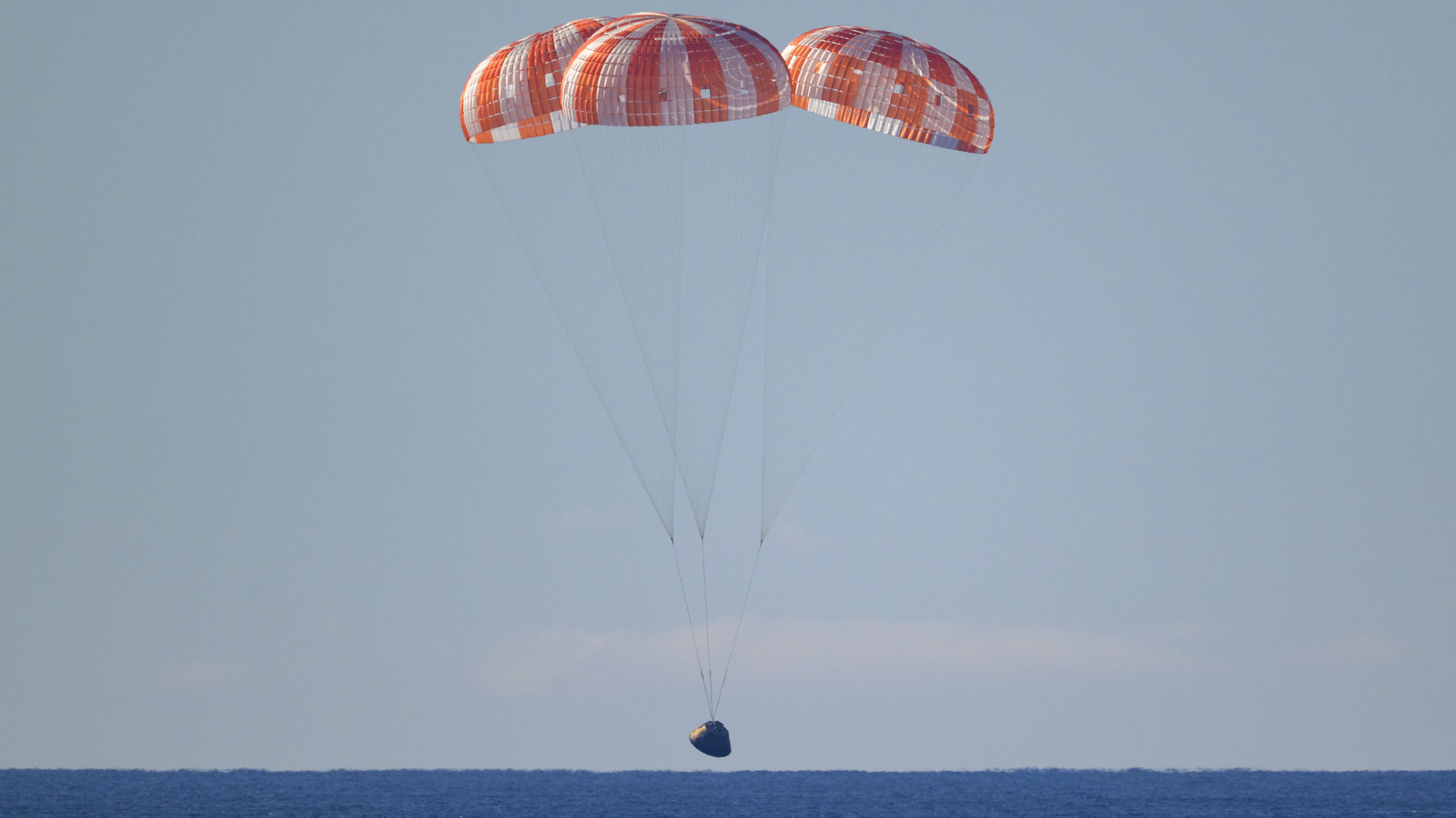
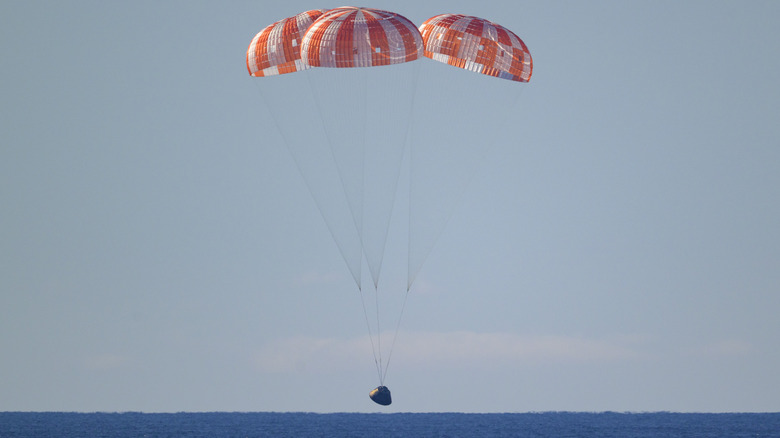
On April 10, the Orion spacecraft of NASA’s Artemis II mission successfully splashed down off the coast of San Diego. What it did not do was, you know, land in San Diego. In a lot of ways, that would be the preferred option. The ocean has nasty waves, and occasionally, things sink in it. The retrieval process in the ocean requires tapping in U.S. Navy vessels and exfiltrating the astronauts by helicopter, none of which is exactly cheap. It would be easier if the spacecraft ended up on land, where the astronauts and the capsule itself could retrieved by a truck and some cars. And it turns out, it’s what the Russians have been doing all along. What are we doing putting Americans (and now one Canadian) out in the sea? It turns out, making a precision landing on the ground runs into a number of technical constraints that NASA chose to forego, necessitating the splashdown approach. But technology is improving, and soon, American spacecraft might not have to hit water at all anymore.
As you may have heard, rocket science is complicated. The primary issue is that a returning spacecraft is hurtling at the Earth at breathtaking speed; Orion hit Mach 35. How on Earth (literally) do you slow that down enough for a nice, gentle landing? All vehicles coming back from space use parachutes, but that only gets you so far. Orion’s final speed before splashdown was still 20 mph, enough to cause damage and injury if it hit a solid object. So for as long as NASA has been sending people into space, it’s been dunking them in the ocean as a kind of giant pillow to catch them.
There’s another advantage to the sea: if your landing is off by a few miles, it doesn’t particularly matter. That might not exactly be true on land, where a trajectory error of a few degrees might mean hitting a mountain or, worse, a city. In fact, to do a land landing, you’d really need a huge, flat, unpopulated expanse. And a country wild enough to put retrorockets on a capsule falling from space. Welcome, comrades, to the Soviet Union.
Fighting the ground and winning
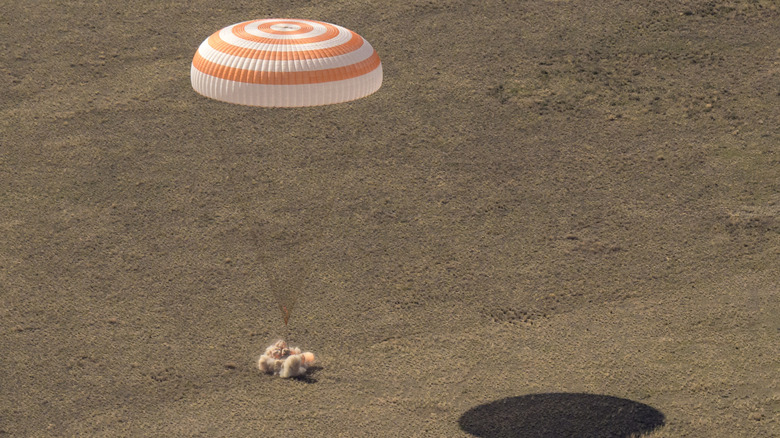
While Russia may have plenty of coastline, nearly all of it is in the Arctic circle, where ice and stormy conditions make a water landing unpalatable. What the Soviet Union did have at the time was Kazakhstan, which has exactly the sort of empty plains that a landing from space would require. Still, Soviet engineers needed to find a way to slow down their Soyuz capsule more than parachutes could.
Their solution, still in use by Russian cosmonauts today, was, shall we say, gutsy. Basically, once the last set of parachutes have deployed, the Soyuz spits off its own heat shield (no longer necessary now that it’s returned to atmosphere). Hidden underneath are six retrorockets, which gives the flight one final ignition before touchdown. And I do mean “before touchdown,” as in, literally one second before impact. That is a very brief punch of propulsion, slowing the Soyuz down to just 3 mph before smashing into the ground. The Smithsonian Magazine quotes NASA astronaut Michael Lopez-Alegria as saying, “It’s kind of like a series of explosions followed by a car crash… After seven months in space, it doesn’t feel great.”
American attempts to land on land
As you can imagine, the Russian system has its drawbacks. Beyond the obvious danger and discomfort, the retrorockets and their fuel cost a lot in terms of weight. Weight is the main problem with spaceflight; the more you have, the more rockets and fuel you need to get off the Earth in the first place. The Soyuz pays for this weight with smaller crew capacity: it can only fit three people. By contrast, Orion took four astronauts around the Moon, and the SpaceX Dragon capsule can take up to seven people to the International Space Station (ISS).
It’s worth noting that SpaceX CEO Elon Musk originally wanted to give Dragon retrorockets and let it land “anywhere on Earth with the accuracy of a helicopter.” Amazingly, a promise from Musk didn’t come to pass. NASA, who was looking for a new spacecraft to get astronauts to the ISS, didn’t want to pay for the R&D necessary to make that work. Plus, there was that old weight issue. SpaceX thus went for an old-fashioned water landing aided by parachutes, just like the old days.
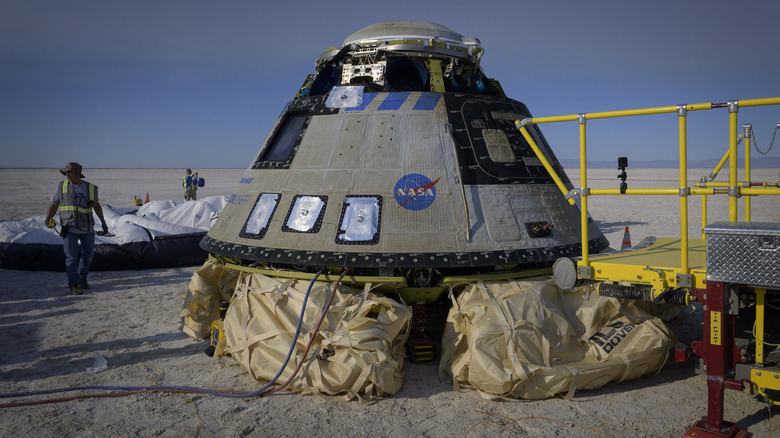
The fact remains, though, that it would be much easier to retrieve both the spacecraft and the astronauts from the land than the sea. And American companies are now trying to solve for that in a gentler way than Soyuz. For Boeing’s Starliner spacecraft, the idea is to have inflatable bags pop underneath the capsule; instead of using the ocean as a pillow, it will just bring its own. Combined with far more accurate navigation than NASA had decades ago, Boeing believes this will allow for land landings in several areas inside the U.S. They will inflate with nitrogen and oxygen, exactly like car airbags, although with interior lining like tires.
Technically, this has already worked! Following several successful test flights, in September of 2024, a Starliner safely landed in New Mexico after delivering its crew to the ISS. The only trouble was, its engines during the flight in failed so badly that NASA didn’t dare risk bringing the astronauts home onboard it; they ended up being stuck on the ISS for months.
The future is reuseable
This landing issue may end up being solved as part of a bigger engineering feat: reuseable spacecraft. For a few decades there, the Space Shuttle attempted to fulfill this dream. But even though it could take off (with a lot of assistance from disposable boosters) and land again, in the end it was too costly to unlock a new age of space travel.
That era came in the form of the SpaceX Falcon 9 booster, which flies itself to a drone barge for recovery. That did indeed bring the cost of spaceflight down significantly. However, that’s just the booster; the upper stage, where cargo or astronauts go, is disposed. SpaceX is now trying to create the first entirely reuseable spacecraft in the form of the Starship. The intention of this still-in-development vehicle is that both its booster and its upper stage can fly themselves back to the landing pad, where the launch towers will recover them with giant “chopstick” arms. The booster has already performed this feat, which is a pretty remarkable sight.
The upper stage of Starship has not yet attempted this, but SpaceX will try it eventually. If they can get it to do so — reliably, safely, and repeatedly — then, in theory, this will one day be how astronauts return to Earth. No more bobbing in the ocean for hours on end, hoping you don’t sink: they’ll be in the loving embrace of a spaceport tower, ready to hop out and head right home.

