


You have full access to this article via your institution.
Hello Nature readers, would you like to get this Briefing in your inbox free every day? Sign up here.
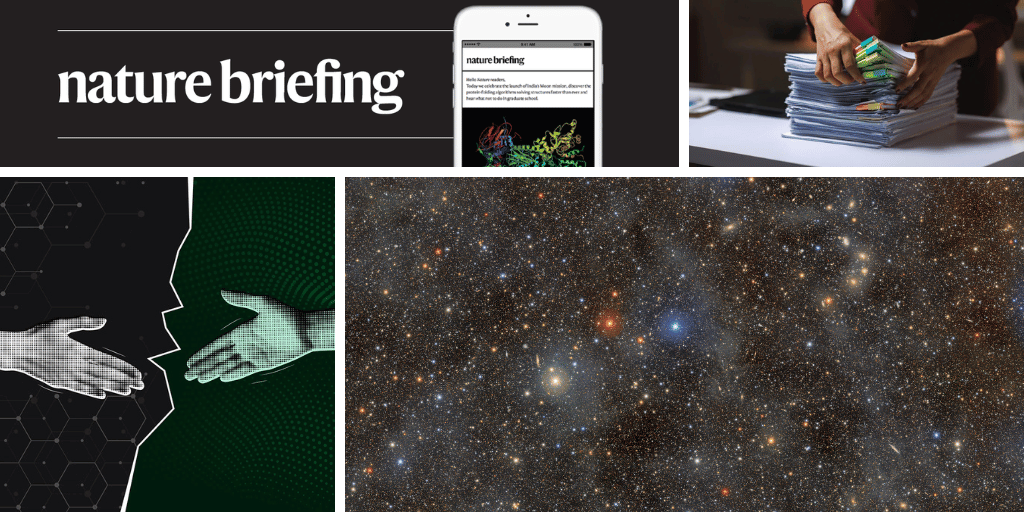
This huge image of the constellation Lupus demonstrates the Rubin observatory’s wide view of the sky combined with the ability to detect extremely faint objects. (See a bigger version here.) (NSF–DOE Vera C. Rubin Observatory/NOIRLab/SLAC/AURA)
Yesterday, the Vera Rubin Observatory in Chile started a 10-year mission to image the sky with unprecedented breadth. In its first year, its nightly sweeps will generate more data than all previous optical telescopes combined. And this is just the beginning. “The first year of data is not going to be great for faint stuff, but as they build up the data over 10 years, it gets better and better,” says astrophysicist Aaron Romanowsky.
Read more: Physicist Tony Tyson reflects on the Rubin Observatory — a project he first dreamt up more than 30 years ago (Nature | 5 min read)
Infographic of the week

In July 2024, the journal Biology Open trialled paying peer reviewers that turned around ‘good quality’ reports within four working days. The experiment was a success: paying reviewers led to faster first editorial decisions and improved review quality, as judged by handling editors on the basis of helpfulness in making a decision. (Nature | 6 min read)
Reference: bioRxiv preprint (not peer reviewed)
Features & opinion
Trust in science has collapsed — right? The evidence says that it’s not necessarily so. From a global perspective, public trust in science and scientists is high. Trust has dropped in certain groups, notably among Republican-leaning people in the United States. And research in the United Kingdom shows that the proportion of people who have “a lot” of trust in science tends to be lower among politically right-leaning groups than those on the left. In many countries, people are also increasingly questioning definitive evidence on divisive issues such as vaccines, partly because scientific information is being drowned out online.

Source: Ipsos Global Trustworthiness index 2024.
An influential climate study published 22 years ago has the fingerprints of oil executives all over it, reports ProPublica. In it, researchers identified a portfolio of actions they called “stabilization wedges” that used existing technology to limit atmospheric carbon dioxide. However, the study was funded by the oil company BP and much of its content was shaped by the company, finds ProPublica’s investigation. The result: too much focus on carbon capture and storage, an unproven idea that some think could neutralize some ongoing greenhouse gas emissions. A former BP exec says the company “did not oversee” the paper and took academic freedom seriously, and the study’s authors deny BP had any control over the paper’s scientific content.
As I mentioned on Monday, Nature’s news team has gathered from across the globe this week to discuss how best to keep bringing you the finest science journalism in the world. Today, that means a shorter Briefing than usual — but in the long run, should lead to even better newsletters.
Everything we do, we do for you, our readers (and video watchers, and podcast listeners). So please do let us know what you think about this newsletter, and about any of our news, features and opinion content, at [email protected].
Thanks for reading,
Flora Graham, chief editor, Nature Briefing
With contributions by Jacob Smith
• Nature Briefing: Careers — insights, advice and award-winning journalism to help you optimize your working life
• Nature Briefing: Microbiology — the most abundant living entities on our planet — microorganisms — and the role they play in health, the environment and food systems
• Nature Briefing: Anthropocene — climate change, biodiversity, sustainability and geoengineering
• Nature Briefing: AI & Robotics — 100% written by humans, of course
• Nature Briefing: Cancer — a weekly newsletter written with cancer researchers in mind
• Nature Briefing: Translational Research — covers biotechnology, drug discovery and pharma

