


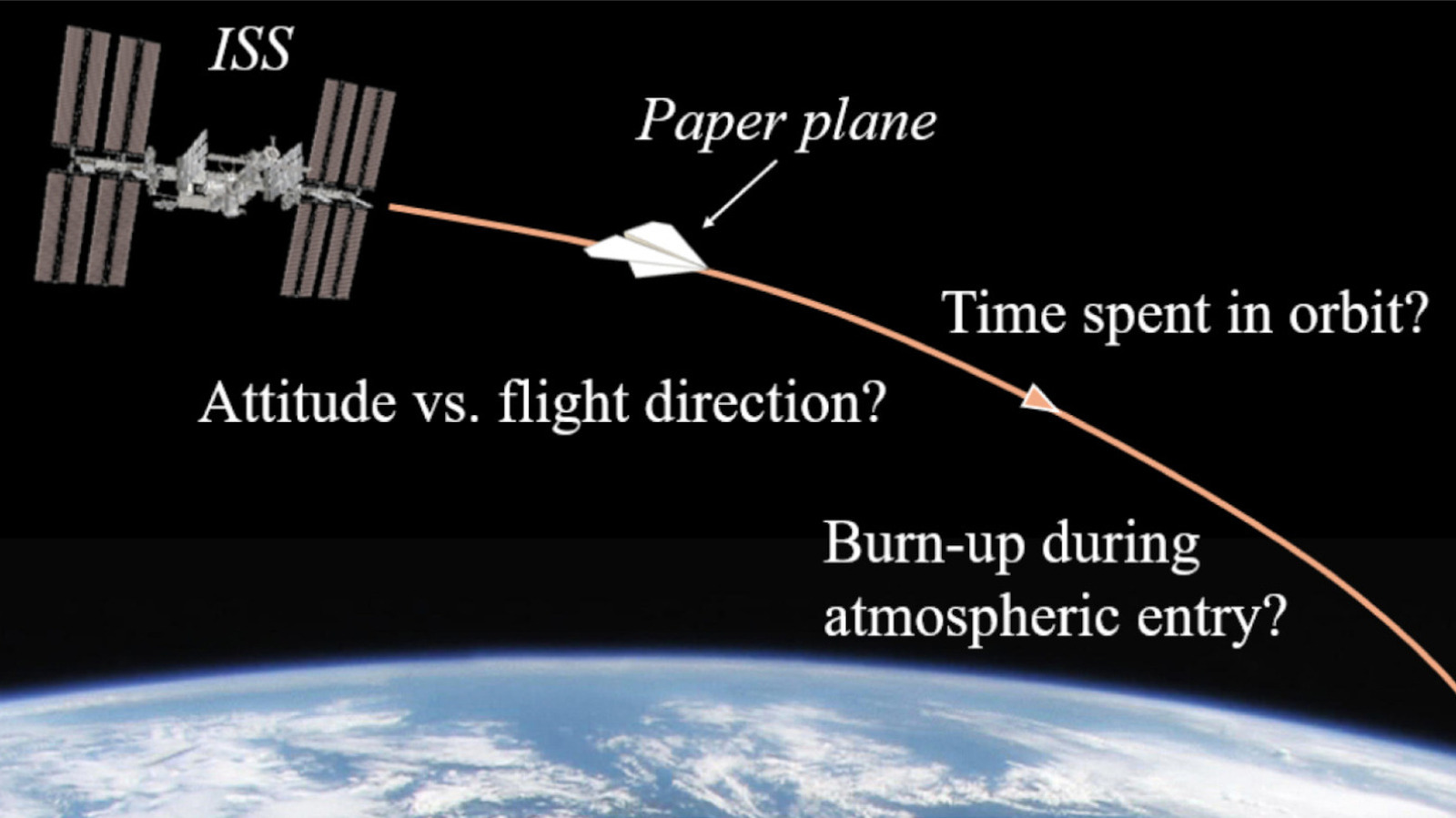
Admit it, there’s really only one question on your mind. It’s the same one you first had when you were 8 years old. Sure, you might be an “adult” now with “grown-up” things to do, but when you have a moment to yourself, your thoughts always return to it: What would happen if you threw a paper airplane in space? Fortunately, a pair of such so-called adults happen to be astronautical engineers at the University of Tokyo. And unlike you or me, they haven’t been content to just wonder. By golly, they went and found out.
In what can only be considered the greatest scientific paper of all time, published in Acta Astronautica, Maximilien Berthet and Kojiro Suzuki attack the problem with the most serious faces imaginable. Using a numerical model (basically, an advanced algorithm fed into a computer) and an honest-to-goodness wind tunnel, the pair explored what would happen if an A4 “origami space plane” were yeeted out the window of the International Space Station 250 miles above the Earth. How long would it take the orbit to decay? Would it immediately tip straight down, exactly like every single paper airplane I’ve ever thrown? Would it burn up on atmospheric re-entry, or crash down on Earth with tremendous impact?
We must know. For science.
Transcending the limits of science
The numerical model tied together all relevant science about an object moving through low-Earth orbit. Once run through a computer, it determined that the hypothetical paper space plane would dive at the Earth pretty quickly. Still, “quickly” takes a long time in space: it wouldn’t actually hit atmosphere until around the 80 hour mark. 80 glorious hours of a paper plane orbiting the world. If this is not the path to peace, I’m not sure what hope we have.
Amazingly, the hypothetical plane also keeps pointed more or less correctly, only nosediving suddenly and violently around that same 80 hour point. Yes, science has mathematically estimated the angle of a paper plane in space. That trajectory should sound familiar to anyone who’s ever thrown one in their life: okay for a bit, then a horrific crash at the end.
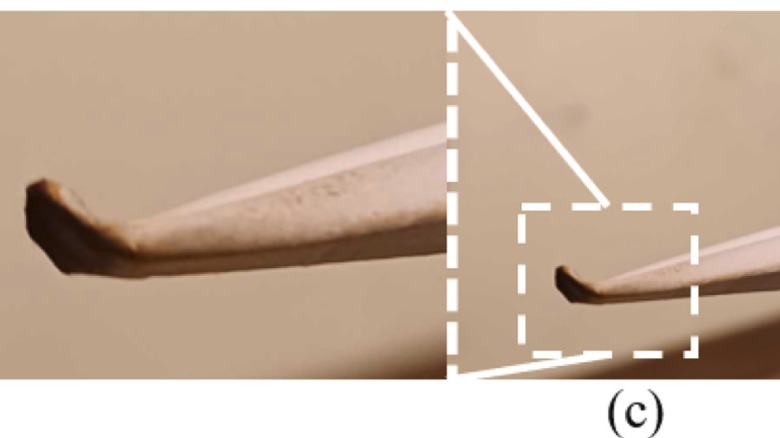
Trouble is, that numerical model only works above 75 miles; below that, a thicker atmosphere makes the math fall apart. This is where things get tactile, as our intrepid scientists made an actual paper plane, for science, to put in an actual wind tunnel, for science. And it did pretty well! Though its poor little nose bent upwards, it made it through the Mach 7 speed and 710 degrees Fahrenheit conditions, which is what you’d get upon reentry. It even made shock waves, very likely the first paper plane to ever do so. That said, it did get slightly singed at the edges. Our scientists were forced to conclude the horrible truth: a paper plane would indeed burn up in atmosphere. Pour one out.
Still, cheer up. As the paper puts it: “Owing to the extremely low cost of a paper space plane, multiple deployments could be conducted at the same time.” Turns out, some paper is cheaper than a full-blown satellite. Could vast swarms of them be launched, each of them carrying small research instruments that could collectively do some real science? Probably not, if we’re being honest! But hey, you never know until you do the work.

