


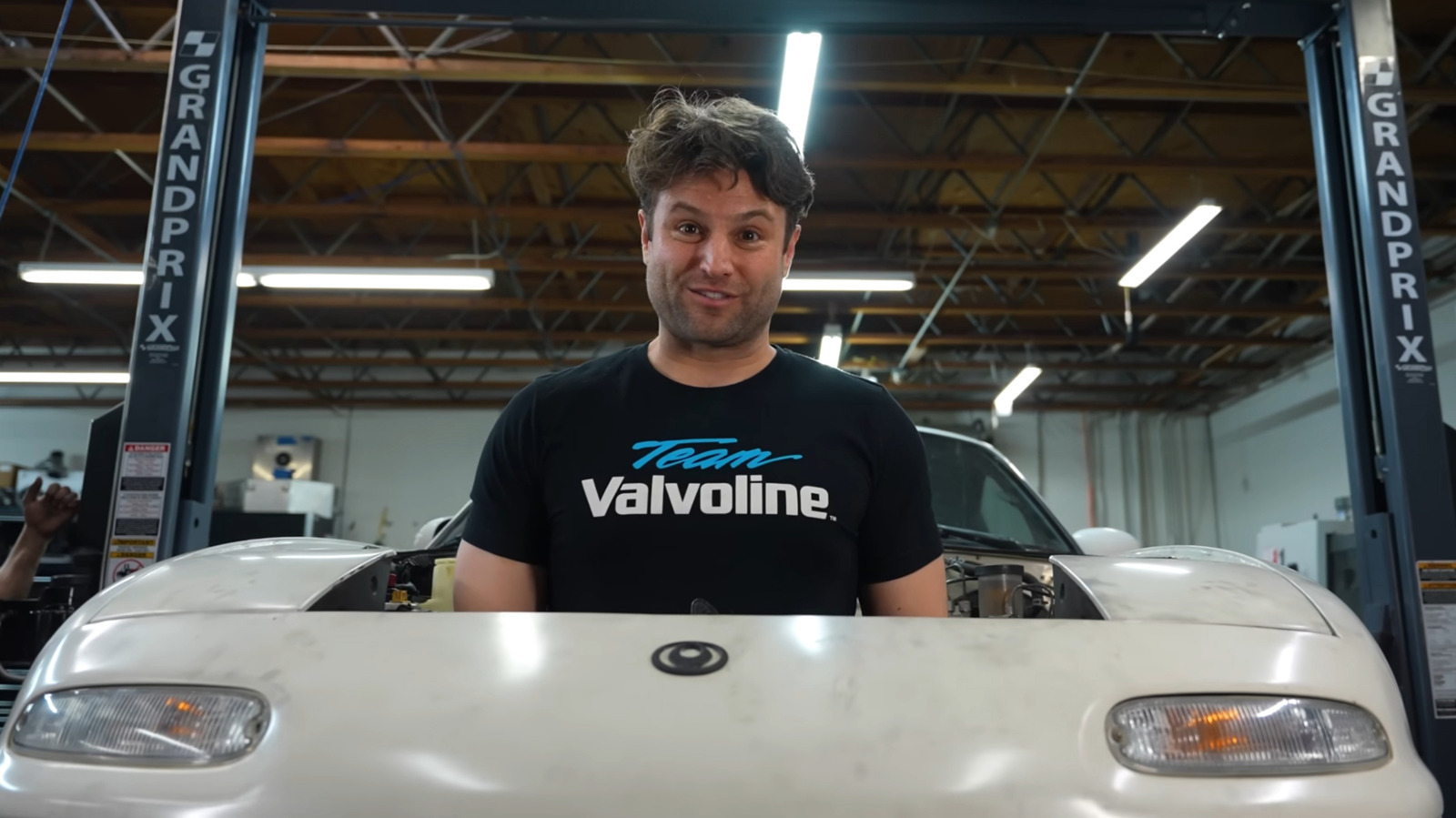
9,000 RPM and 19 pounds of boost makes for a potent little platform, especially in a tiny lightweight platform like the NA-generation Mazda Miata. This isn’t the first time a rotary engine has been swapped into a Miata chassis, and it certainly won’t be the last, but Rob Dahm‘s single-rotor is a fun science experiment in minimalism. Can a single rotor Miata exist without shaking itself apart? Can a single rotor Miata be even more fun to drive than its piston-driven siblings? Is more power and less weight even an admirable goal in an NA Miata? Rob is going to find out the hard and expensive way, and I’m happy to be along for the YouTube ride. He’s a wrencher you should know.
You’re probably already familiar with Rob Dahm. This guy has been building big-power Mazdas for a couple decades now, and his Golden Retriever happy, excitable, and friendly energy can only be matched by his rotary enthusiasm. Not only is he always shoving engines into cars that don’t belong there, but he’s trying to tack on more rotors than should be there anyway. His usual fare is expensive and makes the big four-digit power that we try to avoid with this series. This most recent project, however, is an exercise in restraint and I am so excited to see how it turns out.
That’s why we’re taking it upon ourselves to highlight some of our favorite underrated builders in a new series we’re calling Wrenchers You Should Know. Not only do some of these people deserve way more views than they’re getting, but they’re typically the Do It Yourselfer type, rather than the big corporate-sponsored four-figure-horsepower slop that’s dominating your feeds. At least Rob’s big-power builds are more unique than a Lamborghini with a turbo kit. In each installment we’ll introduce you to a cool new builder, talk about some of their work, and give you a few reasons why you should be watching their progress. Here we go, Dahm it!
Why a one-rotor engine?
This isn’t one of those projects that asks why. This is a project asking why not? The NA Miata is one of those all-timer driving enthusiast chassis, combining lightweight dynamics with an unmatched connectivity between driver and car. If you were out in the shop benchracing with your friends and you said you could build a better car, most people wouldn’t believe you. When Rob says he can do better than the NA Miata formula, he’s going to follow through on it eventually. That’s one of the things I like about watching Rob’s work. The project won’t be rushed to fit into a video release schedule. The work will get done in the time it takes to get the work done. Has he spent several weeks trying to get the tuning right on this rotary engine? Sure, but it’s been entertaining all along the way.
Introduced in 1989 with a 115 horsepower 1.6-liter inline four-cylinder engine, the original Miata attempted to revive the love of motoring imbued in vintage Brit roadsters like the MGB and Lotus Elan, but with modern and reliable stuff under the hood. All told it was just 2,200 pounds ready to drive, and that low horsepower figure starts to seem pretty sporting. It’s been 37 years since the car’s introduction, and its legacy as maybe the greatest enthusiast car in history has been all but cemented. Improving on that formula isn’t impossible, but it certainly isn’t easy to make .
Allegedly a stock Miata four-cylinder weighs around 290 pounds with all of the accessories bolted on. A rotary engine is always going to be lighter than that, and Rob set out to figure out just how much lighter, and how much more powerful he could make a Miata. With a custom-build one-rotor and a bunch of custom components, he figured out that he could build a complete engine that weighs about 70 pounds. That’s quite a lot of weight off the nose of the car!
What’s wrong with it?
After about a year of wrenching on this particular project, Rob finally has a car that can run and drive on its own, but rarely goes more than a trip or two without a major issue. One of the frequent failures early on, repeated alternator and starter failures, were caused by the engine’s propensity to vibrate everything loose. Typically a multi-rotor engine will have the rotation of the individual rotors offset to reduce the engine’s rattly nature, but with a single rotor it’s just flinging that triangle around at high speed. This engine is about as smooth as Jif Extra Chunky peanut butter, and there’s not much anyone can do about that.
Later, Rob ran into issues with exhaust components, and most recently found that he had shattered the rear differential housing in a drag race against a Honda Insight. With big boost and tons more torque than you would normally expect from a rotary, this little one-rotor motor is wreaking havoc. Surely the answer will be to increase the boost and make it faster. I think I’d like to see a solid 200 horsepower from this engine and sub-2,000 pounds from the chassis. At that point it might just be the perfect car.
Getting the little engine to reduce the rate at which it rattles everything apart has been a science experiment all its own. Once that got sorted, however, the engine seems to be doing pretty well in normal driving. Sure, it’s way too loud and needs a couple extra silencers to be driven comfortably, and I’m sure 150-ish horsepower won’t be enough for Rob’s sensibilities, but I appreciate how simple this build has been compared to his normal fare. You need to be watching this one, for sure.
The Indycar
Rob isn’t known for sticking to simple builds like this one. He’s built a 12-rotor tri-turbo engine, he has an all-wheel drive four-rotor RX-7 making a thousand horsepower, he raced at Pikes Peak with a 1,000 horsepower timebomb of an engine, and he’s building a vintage IndyCar with the explicit purpose of breaking the outright track record at Laguna Seca. Most of the time he’s a lesson in excess, and learns how to do everything on the fly. Usually he learns how stuff works by breaking it.
After the one-rotor, my favorite project of his is the Indy car. The guy was so serious about getting this thing running fast laps at the track again the he bought an entire stockpile of 20 Cosworth-developed XD CART engines. With modern tires, modern suspension development, and no rulebook, it seems plausible that Dahm could get the car under the track record at Laguna. I hope he makes it. Just think of how excited he’ll be on the subsequent YouTube episode.
If you have suggestions for some lesser known builders on social media, please feel free to drop them in the comments section as well. I’m always on the lookout for folks out there doing cool stuff. It doesn’t have to be just cars, either. While I’m well apprised of the car and motorcycles building scenes, I’d love to get deep into the nitty gritty of some more niche topics. Do you follow some cool folks building snowmobiles, jet skis, or DIY fighter jets or something? I want to know about it.
And yes, you’re welcome to do some self promotion in the comments as well. Let everyone know where they can follow your build and what you’re up to. If it’s unique or good, we’ll feature it on the blogs.

