



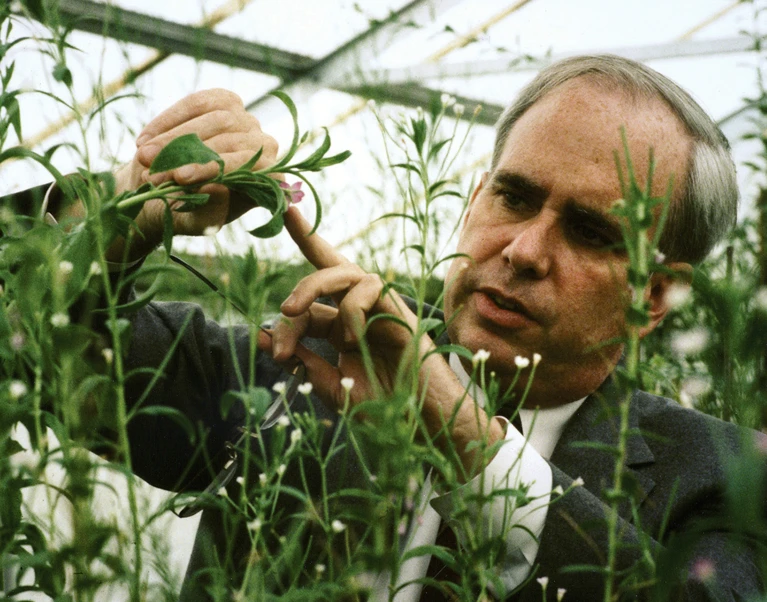
Credit: Missouri Botanical Garden
Peter Raven transformed the field of botany. His research in plant evolution, classification and biogeography deepened our understanding of how plants evolved and diversified across the world. His visionary leadership helped to position botany and biodiversity conservation at the centre of humanity’s most urgent global challenges. Raven was a passionate advocate for the importance of plants to human well-being, and the role of science, education and international collaboration in building a sustainable future. He was a kind, generous and supportive mentor who inspired students, scientists and the public around the world. He has died, aged 89.
Raven was born in Shanghai, China, in 1936 to parents from the United States. The following year, Japan invaded China, and the family moved to San Francisco, California. From an early age, Raven took an interest in biodiversity. He was a child naturalist, collecting butterflies, beetles and plants.
The scale of the biodiversity crisis laid bare
At age eight, he joined the student section of the California Academy of Sciences (CAS), becoming the youngest member ever to enrol. Through CAS, he met the prolific botanist Alice Eastwood, who shared tips on preparing plant specimens. Later, botanist John Thomas Howell became Raven’s mentor, and added his collection to the CAS herbarium. At age 12, Raven joined the Sierra Club, a non-profit environmental organization based in Oakland, California, and soon began publishing botany articles in the Sierra Club’s Base Camp book series. By the time he had graduated from secondary school, he had collected hundreds of plant specimens, including two undescribed species.
Raven went on to earn a bachelor’s degree in biology at the University of California, Berkeley, in 1957 and a PhD in botany at the University of California, Los Angeles, in 1960. He taught at Stanford University in California before assuming leadership of the Missouri Botanical Garden in St Louis in 1971, at age 35.
At the time, the institution was modest in scope. But during his 39-year tenure, Raven redefined what botanical gardens could be, cementing their crucial roles in documenting biodiversity, advocating for conservation, training the next generation of scientists and educating the public about the essential part plants play in their everyday lives.
Current conservation policies risk accelerating biodiversity loss
While at the institute, Raven authored his seminal paper on how butterflies and plants evolved together, cowritten with Paul Ehrlich (P. R. Ehrlich and P. H. Raven Evolution 18, 586–608; 1964). The paper advanced the idea that different species can shape each other’s evolutionary trajectories. A decade later, his account of how the evolution and dispersal of flowering plants is linked to plate tectonics and Earth’s geological history, co-authored with Daniel Axelrod (P. H. Raven & D. I. Axelrod Ann. Missouri Bot. Gard. 61, 539–673; 1974), shaped the field of biogeography.
By the time he retired in 2010, he had transformed the Missouri Botanical Garden into a global hub for research, education, horticulture and sustainability. He launched numerous research projects, conservation projects and partnerships in the United States, China, Madagascar, Peru, Bolivia and Tanzania, among many other countries. The garden’s staff had grown from 150 to nearly 500, including around 50 PhD-level research scientists.

