


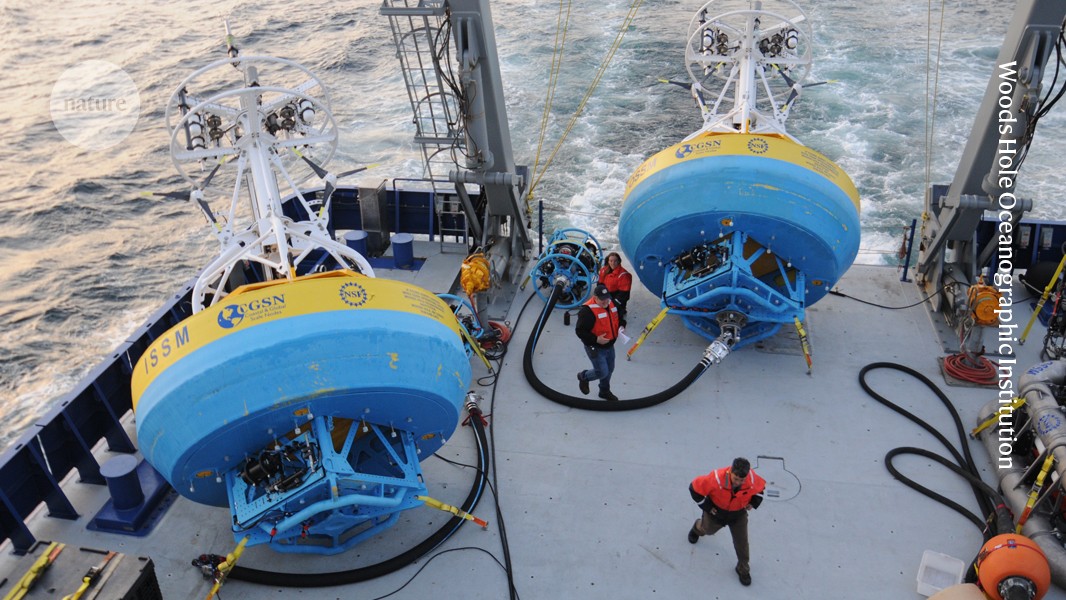

Buoys for the US Ocean Observatories Initiative rest on a ship deck.Credit: Woods Hole Oceanographic Institution
As the RV Marcus G. Langseth sails across the Pacific Ocean this month, researchers are dropping robotic ‘floats’ into the sea to measure chlorophyll levels and other biogeochemical properties of the water. With a powerful El Niño weather system set to unfold later this year, such observations are crucial for understanding how the ocean will change. But these high-tech floats face an uncertain fate.
The devices, which are part of a global flotilla called Argo, were paid for by the US National Science Foundation (NSF). Their funding expires in four months, and NSF officials have so far been silent about future support to keep the devices up and running.

Oceans in Asia smash heat records — what it means for extreme weather
The uncertainty hanging over the Argo floats is only one of the worries facing oceanographers. The United States has historically led other nations in peppering the ocean with monitoring instruments and supporting cutting-edge research on the resulting data. But now US support for such studies looks precarious — as does the future of several monitoring systems that rely on US money.
Scientists were especially rattled when the NSF announced in May that it would dismantle an array of hundreds of marine instruments known as the Ocean Observatories Initiative (OOI) — in keeping, the agency said, with its aim to adopt “smart life cycle management within its research infrastructure portfolio”. On 18 June, the NSF reversed its decision and said it would continue operating the OOI, but scientists are still on edge.
“The US is no longer a reliable global partner in ocean observation,” says Brad deYoung, an oceanographer at Memorial University in St John’s, Canada.
Asked about these concerns, the agency said in a statement, “NSF remains committed to ocean sciences, to responsible stewardship of its research infrastructure and to supporting the stakeholders that depend on it.”
Seaborne robots
One programme facing immediate crisis is the NSF-funded network of Argo floats dedicated to marine biogeochemistry.
In 2020, the NSF agreed to spend US$53 million to put 500 of these robots into global waters. Around 440 of them have been deployed so far and are helping researchers to understand how carbon flows into and out of the ocean. But the initial deployment funding runs out at the end of October, and it’s unclear who will pay the $15 million a year needed for their operation after that. Project leaders submitted a proposal to the NSF for that funding in late 2024, but no decision has been made.
“So the US sits back, having developed it, but we don’t have the funding right now to maintain leadership,” says Lynne Talley, an oceanographer at the Scripps Institution of Oceanography in La Jolla, California. Without servicing, the floats would eventually stop working.
Diving deep
In contrast to Argo, which has floats scattered across the world’s oceans, the OOI collects data in only a few locations, but it intensively samples a vast range of ocean properties. The system includes two arrays of floating instruments, two deep-sea stations and a network of sea-floor instruments. Data from the OOI are used to understand ocean processes from marine heatwaves to deep-sea ecology.

Floating science stations: my month on a research vessel looking after buoys
Past changes to the system were made with intensive community involvement, says Rick Murray, an oceanographer at the Woods Hole Oceanographic Institution in Massachusetts who formerly worked for the NSF. Yet the May announcement of the system’s closure came out of the blue from NSF leadership, Murray says. “It was like, ‘We’re just going to do this.’”

