


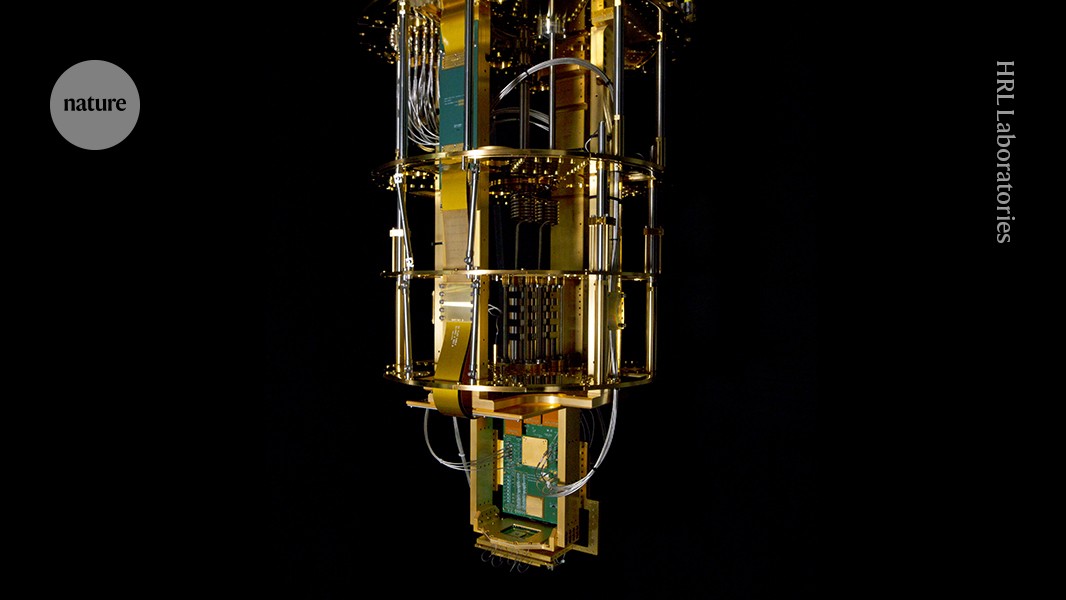

The company HRL Laboratories in Malibu, California, has created a quantum computer that reduces the wiring to its 18 spin qubits to improve performance.Credit: HRL Laboratories
In the fierce race to create a quantum computer that can solve useful problems, systems that use ‘spin qubits’ as building blocks have not been the favourites. Front-running systems from Google and other firms instead encode information in the electrons of superconducting circuits or in ions and atoms confined by light.
But now, a bevy of new results, including some published in Nature, suggest that these spin qubits shouldn’t be counted out of the fight.
Quantum computers will finally be useful: what’s behind the revolution
Much like the transistors etched into modern electronics, spin qubits are made by carving precise patterns into semiconductor wafers. Rather than forming transistors, however, the patterns form wells that each hold a single electron. Spin qubits’ use of materials and manufacturing techniques that are similar to those of classical silicon chips made them appealing to scientists, but their slow progress kept them out of the headlines.
Three years ago, the state-of-the-art for a spin-qubit quantum computer was a system containing only two qubits, operating at an error rate around 4% for certain measurements1. In two Nature papers out today, independent research teams at HRL Laboratories in Malibu, California, and at QuTech in Delft, the Netherlands, describe a leap forwards: complex measurements made on silicon devices with qubit error rates of around 0.2%. HRL’s processor included 18 spin qubits2 and QuTech’s had 53.
Other groups are also racing forwards with spin qubits. In April, Groove Quantum, a start-up also based in Delft, reported an 18-qubit germanium-based device with a similar error rate on the arXiv preprint server4, ahead of peer review. And earlier this month, a group at RIKEN, a national research institute in Wako, Japan, reported in another preprint a 5-qubit system with an ultra-low error rate of less than 0.01%5.
“It’s just great for the community that such advancement has been made,” says Daniel Loss, a theoretical physicist at King Fahd University of Petroleum and Minerals in Dhahran, Saudi Arabia. Peer-review reports for the HRL paper, which the firm shared with Nature’s news team, offered particularly high praise, with one calling it “a significant milestone in the technological maturity of semiconductor spin qubits”.
Other types of qubits are still far ahead in terms of scale: quantum computers that use superconducting circuits operate with more than 100 qubits, and those that use neutral atoms have thousands. But the latest results show that spin qubits can be of comparable quality, with low error. They are also a coup for HRL, which earlier this year faced mass layoffs after the loss of US government contracts.
Its fortunes are now shifting. To the surprise of many in the quantum computing community, IBM — which focuses on superconducting-circuit qubits — announced last week that it would acquire HRL. “The HRL team will help IBM push even farther forward toward the frontiers of quantum innovation,” Jay Gambetta, IBM’s director of research, said in a statement.
Out for a spin
Unlike modern classical computers, which are based on transistors that serve as bits, today’s rudimentary quantum computers have no single building block. Qubits can be made from many things — atoms, circuits, electrons — as long as they can be put into delicate quantum states and controlled.
Spin, for example, is a quantum state that describes the angular momentum of particles and can be oriented in any direction in space. In the late 1990s, Loss and David DiVincenzo, a physicist then at IBM, realized6 that the spins of electrons would make ideal qubits because they could be controlled similarly to how “electronics control transistors, namely just with electric pulses”, Loss says. This made spin qubits immensely attractive.
This billion-dollar firm plans to build giant quantum computers from light. Can it succeed?
Today, spin qubits such as HRL’s are formed from the spins of a trio of electrons. Electrical pulses control the electrons’ quantum spin states — which are ultimately used to perform computations.

