


You have full access to this article via your institution.
Hello Nature readers, would you like to get this Briefing in your inbox free every day? Sign up here.

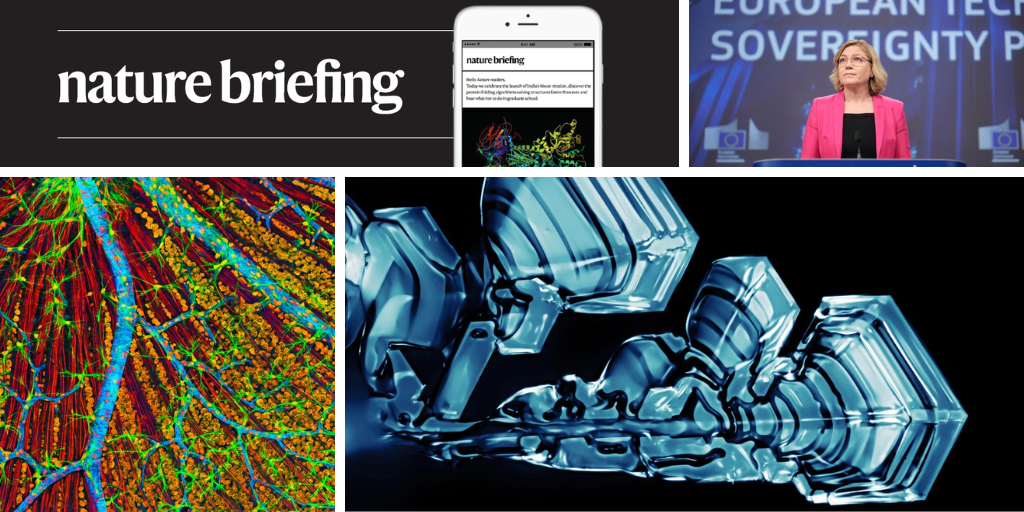
Scientists are attempting to rejuvenate cells in the optic nerve (nerve fibres in red), which channels information from the retina to the brain.Credit: Thomas Deerinck, NCMIR/Science Photo Library
The first person has been treated in a highly anticipated gene-therapy trial that aims to coax aged cells to take on a younger identity. The trial will assess the safety of ‘partial reprogramming’, a novel approach that involves turning on certain genes to enable old cells to behave as if they were young again. Researchers will activate three genes to test whether the approach can rejuvenate cells in the optic nerve as a treatment for a form of glaucoma, an eye disease that can cause blindness.
Private fusion company Commonwealth Fusion Systems (CFS) has published five papers that it says “confirm” that, if built as intended, its ARC power plant will produce more electricity than it consumes. But some researchers say that the claim might be premature. Results from an operational fusion reactor are needed to validate CFS’s predictions, and the company hasn’t demonstrated that they can generate tritium, a scarce isotope fuel that the reactor will need to run, experts say.
Reference: Journal of Plasma Physics paper collection
“It is time for Europe to be in control of its data, of its supply chains and of its future,” said the European Commission’s Henna Virkkunen in a statement that accompanied the announcement of the European Technological Sovereignty Package. The plan expands on efforts by several countries and research institutions on the continent to move away from systems and services controlled by non-European countries — particularly the United States — because of concerns about data privacy and a decline in academic freedom.
Features & opinion

Most ice crystals have a hexagonal symmetry, which can be seen using a light microscope.Credit: Frank Fox/Science Photo Library
How exactly water and other liquids freeze has eluded scientists’ understanding for decades. Now, researchers are turning to some of the world’s most powerful X-ray lasers to capture the structures that form in the first few microseconds of the process. An understanding of freezing is more than a nice-to-have, scientists say. More accurate insights into ice formation would improve the models that are used to forecast how quickly the world will warm because of greenhouse gases and could provide geophysicists with information on how Earth’s solid inner core formed.
In his new book, science writer Rowan Jacobsen argues that sunlight gets a bad rap. The emergence of evidence that exposure to the sun’s rays is one of the main causes of skin cancer spawned the idea that sunlight should be avoided. But Jacobsen suggests that this view is one-sided, and explains the myriad benefits that come with regular stints of time in the sunshine. In Defence of Sunlight is “as easily absorbed as sunlight itself”, writes science journalist Gareth Thompson in his review.
It’s not unusual for those of us in a sciencey field to be the source of IT support for friends and family, and it’s nice to know we’re not alone. Armando Jesús Lovera is an old friend of religious leader Pope Leo, whose pre-pope name was Robert Prevost. Lovera says that his brother still calls up the top pontiff for help with his computer — which is fair play, since Leo has a degree in mathematics and is a former physics teacher. “And Roberto says, ‘John, I’m the pope,’” says Lovera. Now that’s an impressive excuse.
Give us a hand by letting us know what you think of this newsletter — whether positive or critical — at [email protected].
Thanks for reading,
Flora Graham, senior editor, Nature Briefing
With contributions by Jacob Smith
• Nature Briefing: Careers — insights, advice and award-winning journalism to help you optimize your working life
• Nature Briefing: Microbiology — the most abundant living entities on our planet — microorganisms — and the role they play in health, the environment and food systems
• Nature Briefing: Anthropocene — climate change, biodiversity, sustainability and geoengineering
• Nature Briefing: AI & Robotics — 100% written by humans, of course
• Nature Briefing: Cancer — a weekly newsletter written with cancer researchers in mind
• Nature Briefing: Translational Research — covers biotechnology, drug discovery and pharma

