


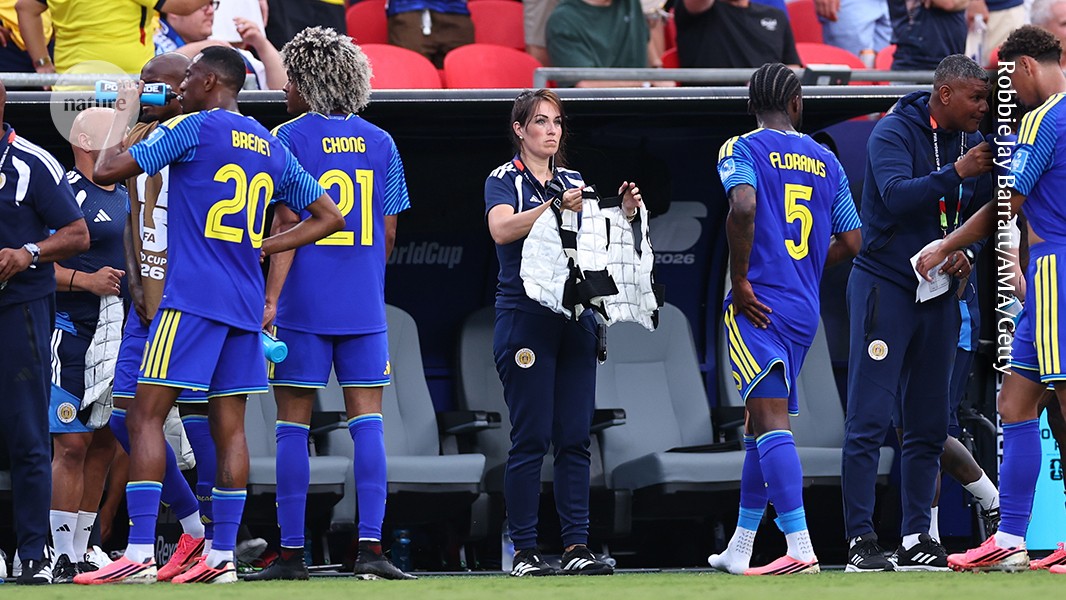

Curaçao’s team physician hands out ice-pack jackets to help players cool down during a men’s football World Cup 2026 match in Kansas City, Missouri.Credit: Robbie Jay Barratt/AMA/Getty
Twice each game, the World Cup 2026 hits pause. Drinks appear, adverts go up and fans boo. The football governing body FIFA says that these ‘hydration breaks’ are about player welfare: a response to rising temperatures and the growing risk of heat exhaustion. But right now, FIFA is missing the mark, and risks turning a sound idea into a poor example.

To save lives in heatwaves, focus on how human bodies work
I say this as a researcher who investigates the effect of heat on health and performance. Cooling breaks can work. The science is strong. But they must be executed properly.
Put simply: cooling breaks should be driven by heat-stress risk and designed around effective cooling, not broadcast schedules or commercial pressures.
On the pitch, that principle is starting to slip. Breaks that should be calibrated to environmental heat stress seem to be tied to television schedules and advertising incomes. Critics complain that the time meant for cooling is used for tactical instructions, and players are receiving guidance while standing in the sun rather than in the shade.
FIFA’s medical guidelines are clear: cooling breaks are intended solely to prevent heat illness and should be used when environmental heat stress exceeds a defined threshold (a wet-bulb globe temperature of 32 °C).
But in this World Cup, there’s a gap between policy and practice. Breaks appear in every match, regardless of conditions, even in climate-controlled stadiums. Although it might seem fair to treat all games in the same way, this blanket approach risks undermining trust in heat-safety measures. If breaks are always used, regardless of risk, they stop being meaningful and start looking like routine stoppages.

Repeated heatwaves can age you as much as smoking or drinking
Heat exhaustion in athletes is common, but preventable. My collaborators and I have run controlled experiments with participants simulating 90-minute football matches in 40 °C heat and 41% humidity. We tested different cooling approaches: passive breaks, active cooling and longer recovery periods. The difference was stark. Short in-game breaks using ice-soaked towels and cold drinks, combined with a slightly longer half-time pause, reduced core temperature and cardiovascular strain considerably. By contrast, breaks without active cooling offered little measurable benefit (H. A. Brown et al. J. Sci. Med. Sport 28, 491–497 (2025); H. A. Brown et al. Br. J. Sports Med. 58, 1044–1051; 2024).
It’s not the pause in play — it’s how it’s used. If players aren’t actively cooling, heat strain remains a problem.
This isn’t just a problem for sport. It’s an issue for human health. The same principles apply to construction workers on a hot building site or agricultural workers in a field. Across these settings, the evidence is consistent: structured interventions that combine rest, hydration and active cooling reduce physiological strain and protect health. When they’re poorly designed or inconsistently applied, the benefits might not be felt.
That wider relevance is why getting this right in football matters. Global sport sets the tone. When governing bodies misapply science in highly visible events, it risks normalizing ineffective approaches. But there are positive examples of heat-management strategies. Some sports have moved beyond temperature thresholds to physiology-first, responsive management of heat stress. The point here is flexibility, guided by science.

What is the hottest temperature humans can survive? These labs are redefining the limit
In tennis, the Australian Open, for example, uses a five-level heat-stress scale, which was developed with researchers from my centre. It combines physiological risk of heat stress with environmental measurements, and the response is adjusted accordingly. That can mean anything from implementing cooling measures courtside to suspending play. Since 2025, World Rugby has taken a similar approach, working with our centre to introduce evidence-based heat guidelines that tailor interventions to both conditions and individual player risk.

