


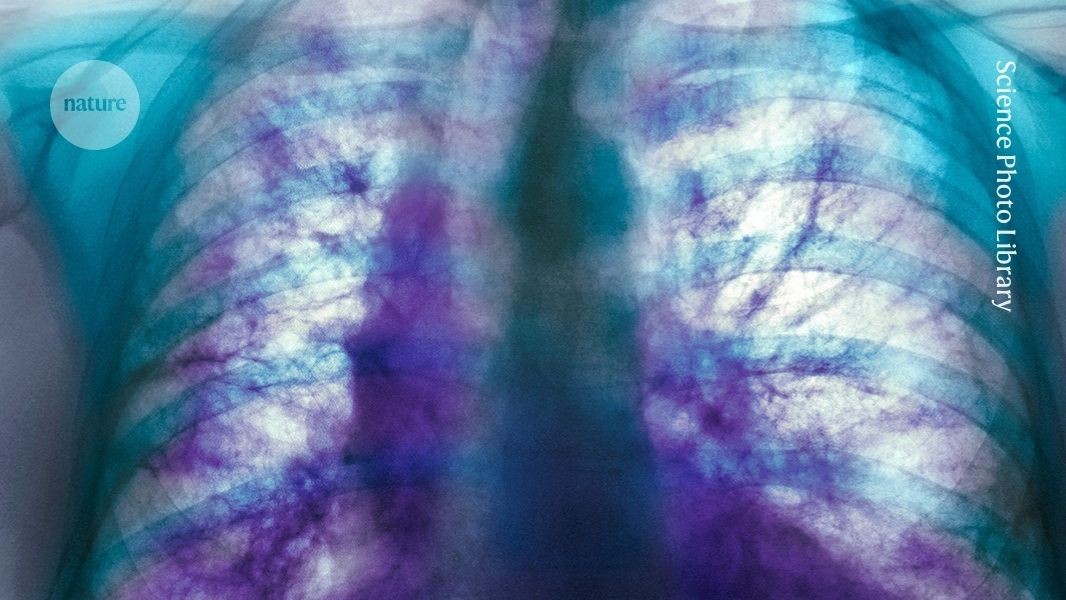

X-ray shows scarring in the lungs that occurs in people with idiopathic pulmonary fibrosis.Credit: Science Photo Library
A mysterious lung disease that affects millions of people worldwide and for which there is no cure has been treated in mice using a drug that targets a previously unknown mechanism1.
Idiopathic pulmonary fibrosis (IPF) is a life-threatening disease in which lung tissue becomes scarred, making it hard to breathe, eventually leading to death for many people. Two drugs are currently used to slow down disease progression but have not been shown to improve symptoms. The biological mechanisms that trigger IPF are mainly unknown.
In a study published in Science Translational Medicine1, Stavros Garantziotis, a clinician-researcher at the National Institute of Environmental Health Sciences in Durham, North Carolina, and his team show that mice with a mutation to a gene called toll-like receptor 5 (Tlr5) are more susceptible to IPF than are mice without the mutation. The gene encodes a receptor that recognizes bacteria, triggering an immune response to infection. With a mutated gene, the receptors do not work properly, making the body more susceptible to infections.
Garantziotis says the study is the first to identify a genetic link between the lung microbiome and IPF. They found that TLR5 receptors in airway cells is activated in response to lung injury and stops the overgrowth of harmful types of bacterium. IPF develops following injuries to the lung, caused by smoking, repeat infections and environmental exposures.
But not everyone who experiences these injuries go on to develop IPF, and a person’s genetics and the types of bacterium that cause the infections could play a part, says Brian Oliver, a respiration and pollution researcher at the University of Technology Sydney in Australia.
Oliver says the latest findings are exciting because they show a new pathway connected to the development of IPF. “It’s a very novel idea” to look at the TLR5 receptor, he adds, because it is not something many people would associate with a fibrotic lung disease.
Targeting the protein with drugs could prevent the disease from progressing, Garantziotis says.
Linking microbiome to disease
To model IPF in mice, the researchers gave the rodents a drug that damages the lung. When they deleted the Tlr5 gene, the mice developed more fibrosis, lost more weight and were less likely to survive than were control mice that had the receptor. Mice without the receptor also had less microbial diversity and reduced antimicrobial activity in the cells lining their lungs than did control mice.

