


You have full access to this article via your institution.
Hello Nature readers, would you like to get this Briefing in your inbox free every day? Sign up here.

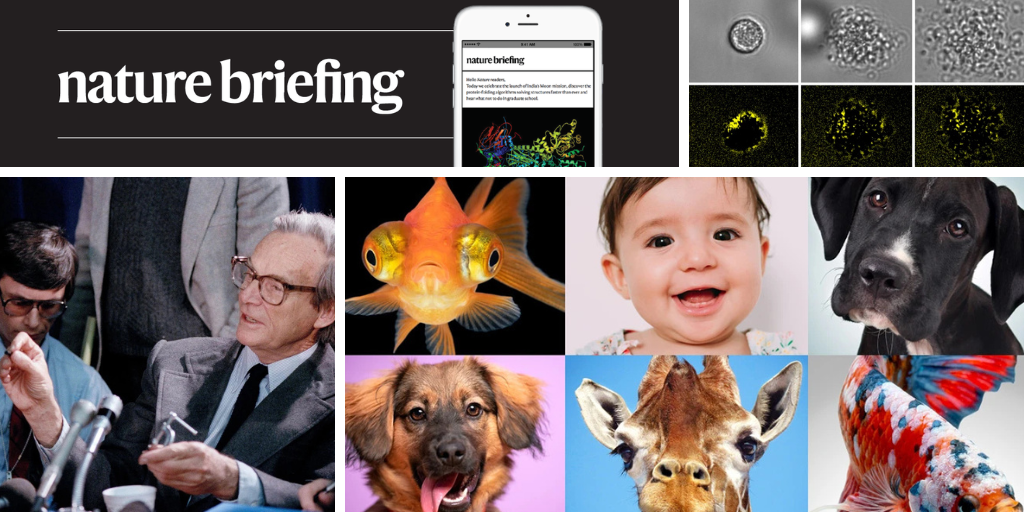
Intact immune cells (left column) had disintegrated (right column) only 100 seconds after their explosion was triggered by adding a hormone. A cell’s plasma membrane (bottom row, yellow) started to rupture 60 seconds after the hormone was added.Credit: C. Chai et al./Cell
Newly discovered immune cells called ‘ruptoblasts’ explode when triggered, ejecting toxic chemicals that make quick work of surrounding cells. This process, dubbed ruptosis, seems to be a new form of cell death that differs considerably from other known types, say researchers. The team discovered the cell type while studying Schmidtea mediterranea, a species of flatworm with extraordinary regenerative capabilities. In vitro, ruptosis of a single cell killed as many as 70 surrounding cells without discrimination — bacterial, flatworm and human cells all fell victim to the blast.
Ötzi the Iceman, the iconic mummy found in the Italian Alps, might have died 5,300 years ago, but remnants of his microbiome appear to be still active — despite him spending the last few decades chilled to –6 ℃. Researchers used a suite of genetic sequencing tools to separate what microbes might have lived on the Copper Age man’s skin and in his gut from modern environmental contaminants. The main motivation was to check how well the mummy is being conserved, but the survey turned up gut flora that are very rare today, offering a glimpse into humanity’s microbial past.
Reference: Microbiome paper
When to settle, according to maths
At a visit to a favourite restaurant, you have a dilemma: order the same great dish every time, or try something new that might end up being better? Nobel-prizewinning physicist Richard Feynman once knocked out the mathematics that described the solution while sitting in a Thai restaurant with his friend and collaborator Ralph Leighton — but no one could fully read Feynman’s writing. Now researchers have transcribed the notes and confirmed the solution to this type of ‘optimal stopping problem’ — a category that includes such conundrums as how to choose a parking spot or settle on a spouse.
Reference: Proceedings of the National Academy of Sciences paper

For his ‘what to order at your favourite restaurant’ problem, Feynman found the optimal approach was to try different options, seeking the tastiest one, but hedging your bets by keeping in mind how many chances you might have to eat there. Where n is the number of dinners, and we score the meals from 0 to 1, the threshold at which we should stick with that dish for the rest of our days can be calculated with this handy equation. But caveat calculator: the equation doesn’t take into account boredom — even the tastiest dish might not be desirable forever.
Features & opinion
Psychology is in the midst of a ‘reproducibility crisis’ — researchers often fail to replicate seminal studies in their fields. Some researchers have blamed small sample sizes in the original studies, which has prompted a boom in large-scale projects involving hundreds of international collaborators and participants. Some are concerned with human cognition; others are studying a range of species, from dogs to flamingoes. The results of these studies haven’t always replicated the original findings, but yield a huge amount of data to analyse further and add rigour to the field, experts say.
Efforts to build a copy of the human genome from synthetic DNA are worth reviving, but need a change of direction from the original plans, argues synthetic biologist Sudarshan Pinglay. Researchers should focus on defining the ‘minimal human genome’ — the smallest set of genetic elements required for a cell to function. Synthesizing a truncated version should be cheaper than tackling the entire human genome, and cells with minimal genomes could prove useful in the design of biomedicines such as chimeric-antigen-receptor T-cell therapies.
Fish such as opahs (Lampris), snake mackerels (Gempylidae) and lancetfish (Alepisaurus) that inhabit the ‘twilight zone’ of the ocean, 200 to 1,000 metres deep, are being harvested in massive numbers. But scientists warn that the impact on the underwater ecosystem is unknown. Most ‘mesopelagic’ species are not covered by mandatory catch reporting, and researchers have dubbed their ecological role “dark web” because of their important, but underexplored, place in the food web.
Reference: Global Change Biology paper
Today I’m inspired by an amateur musician who stepped in to fill a crucial role in front of 2,000 people and a fellow who didn’t hesitate to join a parade of models doing a beach-front fashion show to reach his morning swim. Imposter syndrome? Who needs it!
Tell me how you’re seizing opportunities by the horns — and any other feedback on this newsletter — at [email protected].
Thanks for reading,
Flora Graham, senior editor, Nature Briefing
With contributions by Jacob Smith
• Nature Briefing: Careers — insights, advice and award-winning journalism to help you optimize your working life
• Nature Briefing: Microbiology — the most abundant living entities on our planet — microorganisms — and the role they play in health, the environment and food systems
• Nature Briefing: Anthropocene — climate change, biodiversity, sustainability and geoengineering
• Nature Briefing: AI & Robotics — 100% written by humans, of course
• Nature Briefing: Cancer — a weekly newsletter written with cancer researchers in mind
• Nature Briefing: Translational Research — covers biotechnology, drug discovery and pharma

