


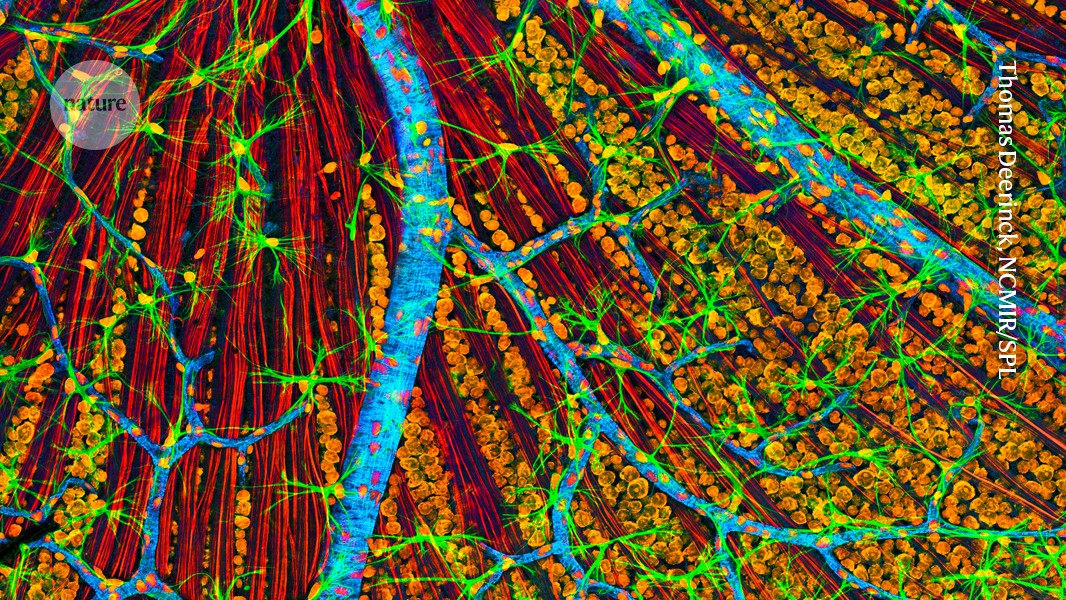

Scientists are attempting to rejuvenate cells in the optic nerve (nerve fibres in red), which channels information from the retina to the brain.Credit: Thomas Deerinck, NCMIR/Science Photo Library
Test time has arrived: the first person has been treated in a highly anticipated gene therapy trial that aims to coax aged cells to take on a younger identity.
The clinical trial will test a novel approach that involves turning on three genes that seem to “partially reprogram” old cells, allowing them to behave as if they were young again. Some scientists argue that partial reprogramming could rejuvenate old organs. But this trial will test activation of the three genes as an approach for treating disease — in this case, a form of glaucoma, a disease that can cause blindness.
The hope is that the proteins encoded by these genes will enable regeneration of neurons in the optic nerve, which connects the eye to the brain and can be damaged in people with glaucoma. These neurons do not normally regenerate in adults. The company sponsoring the trial, Life Biosciences in Boston, Massachusetts, announced on 9 June that it had treated its first participant.

Is ageing a disease? The debate that could reshape medicine
The stakes are high. The trial will test the safety of the reprogramming approach, which is a lingering concern for the field. Animal studies in several labs have suggested that partial reprogramming can be done safely, but there are fears that it could tip some cells into a cancerous state.
“Reprogramming has a big upside if it can be used safely in people,” says Matt Kaeberlein, co-founder of Optispan, a longevity-focused preventative medicine company in Seattle, Washington. “The technology is still really early, and the potential for catastrophic side effects is high.”
As a result, the eye is likely a good first place to try the technique, says Kaeberlein, because the chances of life-threatening side effects are lower with changes to the eye than to some other organs.
Turn back the clock
The goal of partial reprogramming is to nudge aged adult cells back in time, restoring features of young cells without pushing the old cells so far back that they lose their specialized identity — and function — entirely. To do so, Life Biosciences harnesses three of the four genes that, in the laboratory, can be manipulated to reprogram adult cells to a stem-cell like state.
In 2020, researchers in David Sinclair’s lab at Harvard Medical School in Boston, Massachusetts, and their colleagues, found that activating these three genes in mice with damaged optic nerves promoted neuron regeneration and reversed vision loss in aged mice and mice with glaucoma1. Since then, Life Biosciences has studied the approach in rodents and monkeys and has not seen serious adverse effects of the treatment, says Sharon Rosenzweig-Lipson, chief scientific officer at the company.

This method to reverse cellular ageing is about to be tested in humans

