


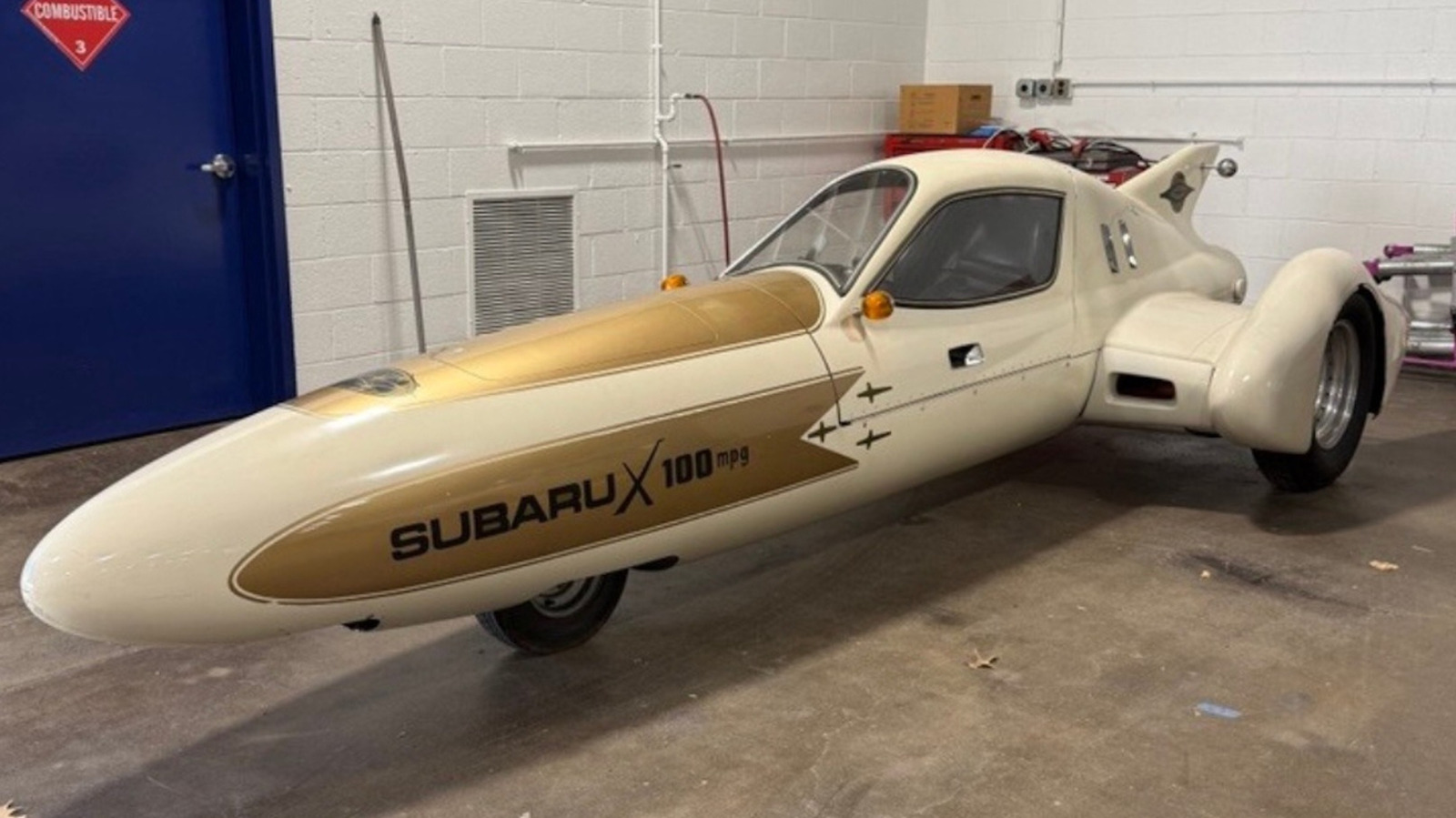
Subaru posted a few pictures of vintage models on Facebook for Throwback Thursday, including the Subaru 360 in sedan and van form as well as the BRAT. These are all cool cars, but the one that caught my eye was something I’d never seen before, an off-white and gold three-wheeler that reminded me of a Colonial Viper. It was the Subaru X-100, a one-off concept built with one purpose in mind: to drive across the U.S. on a single tank of gas, getting 100 MPG in the process.
The 1973 oil embargo was the first time Arabian countries turned off the taps, causing gas prices to skyrocket, in retaliation for U.S. support of Israel. (This may sound familiar.) Suddenly, everyone cared about fuel economy. But auto designer Alex Tremulus had always cared about efficiency and aerodynamics. This is clear in looking at his designs for the Cord 812 Phaeton, the 1956 Ford Thunderbird Mexico concept, and, most famously, the Tucker 48.
Tremulis was consulting for Subaru of America in the late ’70s, according to Japanese Nostalgic Car. He would design the BRAT’s graphics while he was there. But before that, Tremulis approached CEO Harvey Lamm with a bold concept project: an extremely efficient three-wheel car “eliminating the sadistic torture of innocent air.” Lamm agreed, seeing the enormous publicity potential in a 100 MPG car that could cross the 2,500 miles between California and Florida on just one tank of gas, especially at a time when everyone was trying to conserve fuel any way they could.
Design and engineering combine
Tremulis had been saving an old airplane wing tank to use as the basis for an efficient car body, and the X-100 was the perfect opportunity. That also led to its heavily airplane-inspired design, including a tail that served no functional purpose and wings extending to the two rear wheels. It bears a passing resemblance to Tremulis’ Gyro-X, a narrow two-wheeled car balanced by gyroscopes. It was a neat concept but didn’t really work in practice, leading to the X-100’s three-wheel design. The only part of the car not made by Subaru was a single 1955 Ford Thunderbird tail light. It not only resembled a jet engine exhaust, as it did on the Thunderbird, but also linked back to Termulis’ work on the Thunderbird Mexico concept.
A pretty design is all well and good, but to achieve its goal, the X-100 needed great engineering as well. That task fell to Ron Jones. He describes his part of the project on his website:
Subaru offered the prospect of a suitable powerplant – a 500cc engine/powertrain package used on FHI’s Kei class car in Japan, the Rex. A rear drive unit completely mounted on a subframe with the suspension, it was perfect.
Alex had the concept and a outline drawing of the car but they needed someone who could design and build a real car. Walt [Biggers, director of Subaru’s Technical Center] asked me (well maybe I asked him) to design the “running gear” for the car. Light weight was important, so I developed a chassis that was light, simple and strong. Because of the limited space in the front, I had to design a unique suspension and steering system to fit. I decided to use the Subaru subframe without modification, so special spun aluminum wheels were made to obtain the required track width. I brought John McCollister, and experienced fabricator, into the team and we built the rolling chassis of the car in my shop.
The resulting chassis weighed only 70 pounds, which would go a long way toward hitting the 100 MPG target. Jones’ complete description of the X-100 project is worth a read if you’ve interested in all the details, complete with photos of the build in progress.
An extended test drive
The X-100 was a bit of a skunkworks project, with Tremulis building the body in his shop while Jones built the chassis in his own shop. This took several years, and it wasn’t until August 1980 that the team brought the completed X-100 to Ontario Motor Speedway to prove it could achieve its goal. A special one-gallon gas tank was installed, and the car lapped the track at the national 55 mph speed limit until it ran out of gas to see how far it would go.
The first attempt fell just half a lap short of the 100-mile goal. The team made some adjustments to the car, and Ron Jones took the wheel for the second attempt, “since physically I’m a bit of a lightweight ‘myownself'” as he put it. This time, the car ran out of gas half a lap past the 100-mile mark. They’d done it. Now they could install the 25-gallon gas tank and embark on their one-tank cross-country trip, far more efficiently than the first one ever.
Except it was not to be. The car had achieved its 100 MPG goal, and both fuel crises of the 1970s were in the past. Subaru had already established itself in the U.S. by then, and didn’t need a publicity tour of a fuel efficient car customers couldn’t buy. It remained in storage most of its life, though it did spend several recent years on display at the Lane Motor Museum. Since gas prices aren’t coming down anytime soon, perhaps it’s time once again to consider a small three-wheeled car with excellent gas mileage.

