


At dawn in late January 1998, two men entered the home of Betty Black in Farmers Branch, a suburb of Dallas, Texas. They killed her in an apparent burglary gone wrong. A few hours later, an eyewitness — Black’s neighbour — described what she had seen to police. She said that two white men with long hair had got out of a car and walked towards Black’s house in the early morning light.
The neighbour, Jill Barganier, went to the police station the next day and identified Richard Childs, a white man with long hair, as the car’s driver. Childs would later confess to his involvement and serve 16 years in prison.
She was convicted of killing her four children. Could a gene mutation set her free?
Over the next week, the police homed in on 28-year-old Charles Don Flores as the second suspect. Flores had been seen with Childs on the morning of the murder, but he was a Latino man with short hair. On 4 February, Barganier was called to the police station. There, in an attempt to jog her memory, an officer used ‘forensic hypnosis’, a discredited practice that has since been discontinued in Texas and many other jurisdictions. During the session, he suggested to Barganier that one of the men might have had “neatly trimmed” hair. She once again described the passenger as a white man with long hair and then helped police to produce a composite sketch that looked nothing like Flores. She studied another photo line-up consisting of Flores and five other Latino men with short hair; she didn’t recognize any of them.
More than a year later, however, in March 1999, Barganier’s memory had changed. She testified in court that Flores was in the car, saying that she was “over 100 percent” sure that he was the man she had seen. In the absence of DNA evidence connecting Flores to the crime, this testimony became the cornerstone of the prosecution’s case. A jury convicted Flores of capital murder, and he is currently on death row.
For decades, researchers have raised concerns about the reliability of eyewitness testimony in criminal cases. Memories can be flawed, degraded, biased and contaminated. These problems are often intensified by unsound or inconsistent methods used by the police when eyewitness accounts are first taken. For many scientists in the field, memory is simply not to be trusted.
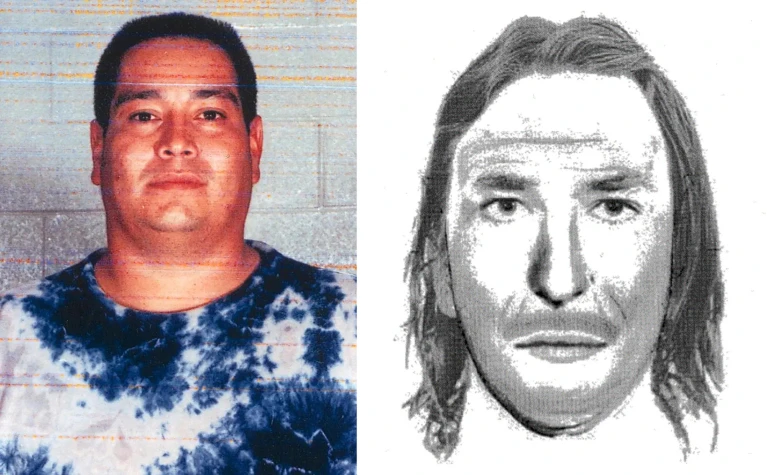
An eyewitness to a murder rejected a photo line-up that included a picture of Charles Don Flores (left); they then helped to create a composite sketch of the suspect (right). Flores was convicted of the crime.
But the science of memory has been shifting. A re-evaluation of real-world criminal cases and laboratory experiments suggests that an eyewitness’s confidence in a specific memory can be a strong indicator of the veracity of their account, at least in certain circumstances. Flores’s case reveals chronic issues with how eyewitness testimony is used. Scientists argue that some memories — such as Barganier’s initial rejection of the line-up that contained Flores’s picture — should be considered more reliable than others.
Some jurisdictions in the United States and elsewhere have begun to adopt methods that take this shifting science into account. But the research faces an uphill struggle. The criminal-justice system can be notoriously slow to change practices, and eyewitness testimony, despite its known flaws, carries considerable weight. “This is the huge problem,” says John Wixted, a memory researcher at the University of California, San Diego.
Although judges, jurors and the public will defer to experts on DNA evidence and fingerprint analysis, everyone has experience with memory. “Our false memories feel true,” Wixted says. Now, he is hoping that his arguments will help in a petition to the US Supreme Court to reconsider Flores’s conviction.
The usual suspects
Questions about the reliability of witness testimonies have circulated since at least the 1970s, when Elizabeth Loftus, then a psychologist at the University of Washington in Seattle, conducted experiments that showed how easy it was to manipulate memories or create entirely fake ones1. The introduction of DNA evidence in legal proceedings in the 1980s and 1990s helped to show the scale of the problem for the criminal-justice system. As dozens — eventually hundreds — of convictions were overturned as a result of incontrovertible DNA evidence (see ‘Mistaken identities’), it became clear that faulty eyewitness testimony was often to blame.
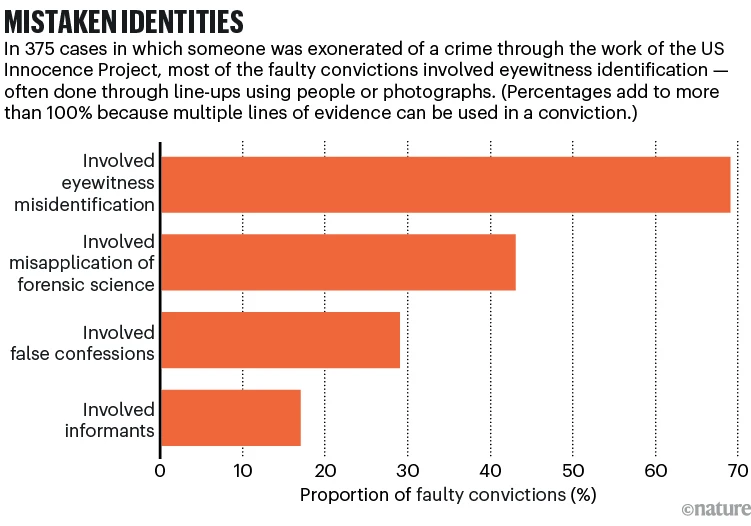
Source: Innocence Project (go.nature.com/42jhxtb)
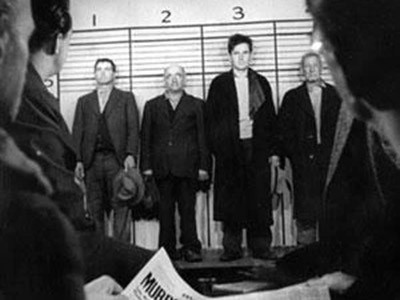
Many scientists focused on the police line-up as a place where biases can creep into investigations. Done either with photographs or in person, these place a suspect alongside others with similar features, who serve as fillers. If a witness to a crime picks the suspect out of the line-up, that’s considered a strong piece of evidence as to their guilt. But if officers presenting the line-up know who the suspect is, it can unduly influence the witness’s decision. And if the same suspect is placed in multiple line-ups, that can eventually trigger a recall.
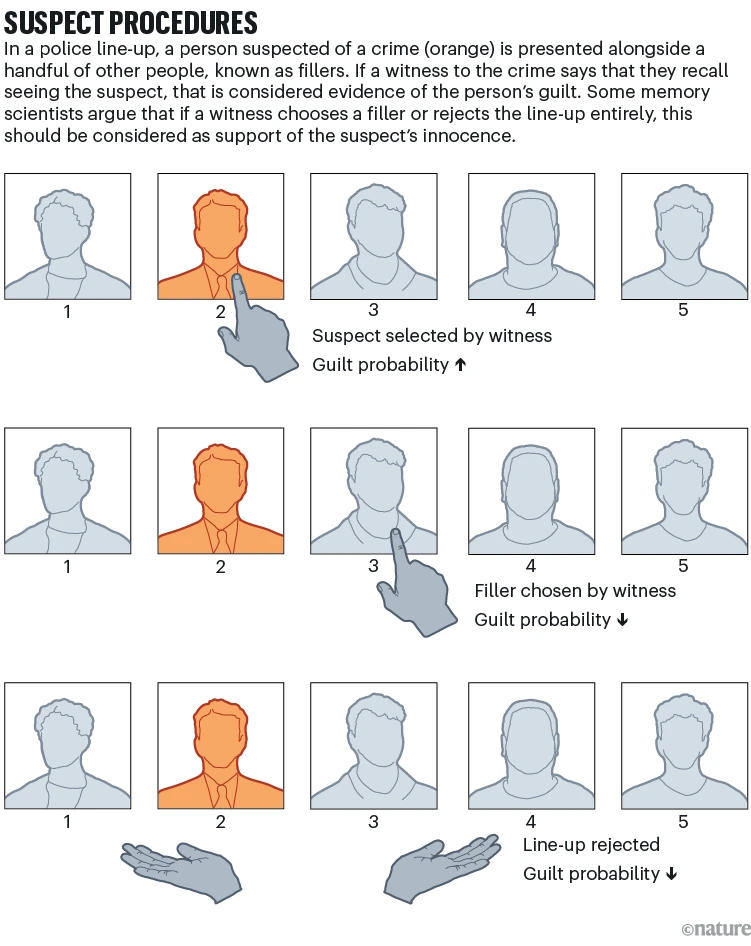
Memory researchers such as Gary Wells, a psychologist at Iowa State University in Ames, were at the forefront of efforts to improve line-ups. Beyond issues with the way the process is run, Wells saw a fundamental problem with how the evidence was treated. In 1980, he wrote a paper with Canadian psychologist Rod Lindsay about negative results in police line-ups2. They noted that although a positive identification is considered a strong indicator of guilt, when a witness chooses a filler or rejects the line-up, police typically assume that it is an error. Wells argued that such negative choices should be considered to reduce the likelihood of a suspect’s guilt (see ‘Suspect procedures’).
But Wells’s paper was highly technical. It was based on Bayesian models of information gain, and Wells says it didn’t get much traction in the legal system. “Mathematical proofs don’t do much to the general public, and they don’t do anything for police and prosecutors and defence attorneys.” The paper also hinged on the idea that initial recollections by an eyewitness were reliable.
Meanwhile, over the next two decades, the main message coming out of memory science was just the opposite: that memory is malleable and fragile. It “begs to be altered”, says Nancy Franklin, a retired cognitive scientist at Stony Brook University in New York.
Witnesses also tend to become more confident as their memories are contaminated, producing in-court testimonies that can be highly misleading, adds Franklin. In a 2001 survey of 64 psychologists with expertise in eyewitness phenomena, 87% backed the idea that a witness’s confidence in a memory did not predict its accuracy3.
A question of confidence
In 2011, Henry Roediger, a psychologist at Washington University in St. Louis, Missouri, asked Wixted for help in writing a book chapter on confidence in eyewitness memory4. Wixted had built a career in basic memory research and was reluctant to get involved in the messier real-world applications. But Roediger “didn’t take no for an answer”, says Wixted.
When Wixted immersed himself in the literature, he says, he realized that the models the applied field had used to identify best practice were very different from those in basic memory science. This included the techniques that researchers studying eyewitness memory use to measure confidence.
In Wixted’s field, a concept called signal detection theory is used to link confidence and recognition memory. A scientist might test recognition memory by showing volunteers a list of words, half of which are ‘old’ words they have seen before and half of which are previously unseen ‘new’ words. The researchers will ask volunteers whether they have seen each individual word before, and ask them how confident they are in their decision. If volunteers have seen a word before, the trace of that memory, called a signal, will be encoded in their brains. Old words are much more likely to produce strong signals than are new words, and a volunteer is more likely than not to say that they recognize the word if it produces a strong signal. This will also boost their confidence about that decision, meaning that confidence and accuracy are tightly linked.
Given that a line-up is essentially a test of how well an eyewitness recognizes a face that they’ve seen before, Wixted reasoned that the link between confidence and accuracy should be strong in that case as well.

Corrupted memory
Wixted, along with his colleague Laura Mickes, now a psychologist at the University of Bristol, UK, analysed a corpus of lab studies on eyewitness memory from the 1990s. These experiments involved staged crimes observed by volunteer eyewitnesses, and they suggested that an eyewitness’s confidence rarely predicted the accuracy of their memory.
But Wixted, Mickes and their colleagues found that these studies had lumped together different types of error made by eyewitnesses5. If a person identified a suspect in a line-up but the suspect hadn’t committed the crime, this error was treated essentially the same as if a person had identified a filler. In the real world, wrongly identifying a suspect could result in a miscarriage of justice, whereas identifying a filler would simply be discounted. This conflation had made the link between confidence and accuracy seem weaker than it truly was.
By following the same Bayesian logic as Wells, Wixted inferred that each outcome of a line-up — picking a suspect, picking a filler or rejecting the line-up entirely — alters the probability that a suspect is guilty in different ways. Picking a filler, for example, should show that the suspect’s face didn’t activate the witness’s memory enough to elicit a recall. This should be considered evidence of innocence for the suspect.
Wixted and Mickes proposed a new measure called confidence-accuracy characteristic (CAC) analysis. CAC analysis6 aimed to answer the question that Wixted felt previous work had overlooked. And, they argued, this was what should really matter to jurors in court: if a witness identifies a suspect with a given level of confidence, how likely is that identification to be accurate?
Using CAC analysis, data from previous lab studies now showed that highly confident witnesses were up to 97% accurate7. This was a seismic and controversial finding, says Thomas Albright, a neuroscientist at the Salk Institute for Biological Studies in La Jolla, California. Wixted “came into the field and turned it topsy-turvy”, he says. Accordingly, “there was a tremendous amount of pushback”, says Andrew Smith, a memory researcher at Iowa State University. Wixted says that critics were evenly split between the argument that eyewitness memory could never be reliable and others who said that the relationship between confidence and accuracy was already common knowledge.
Line-ups on trial
Real-world data supported Wixted’s arguments, too. He had collaborated with the Houston Police Department in Texas on a study examining nearly 350 photo line-ups8. The department had adopted procedures that created fair line-ups, such as double-blinding — making sure that the person administering the process didn’t know who the suspect was. Wixted also asked the Houston officers to record their eyewitnesses’ confidence immediately after the identification process.

