


You have full access to this article via your institution.

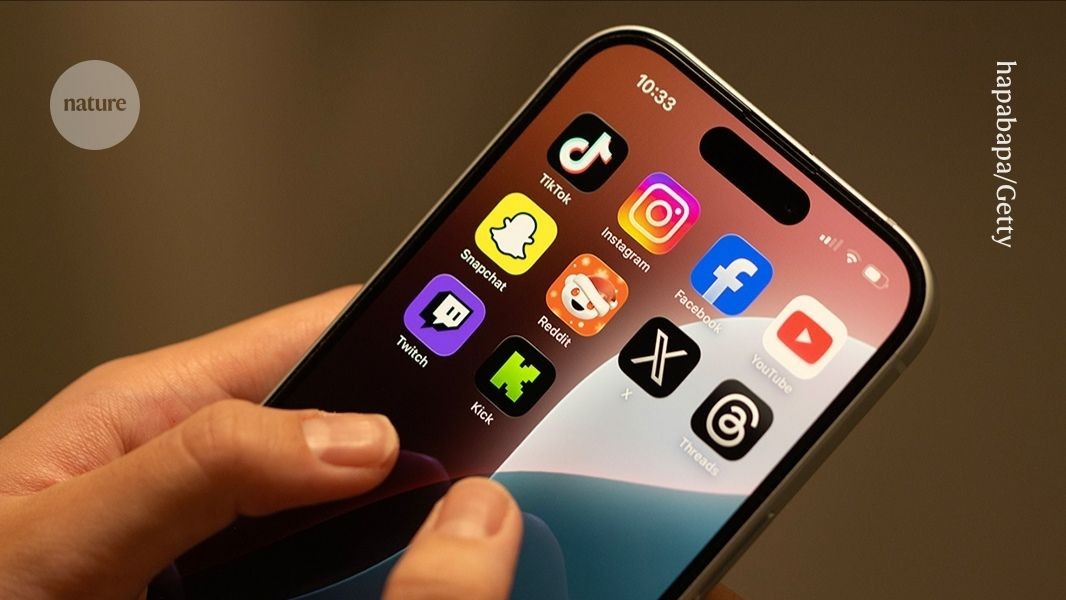
Video-first social-media platforms such as Instagram, TikTok and YouTube are replacing those that are based mainly on written content.Credit: hapabapa/Getty
The world is undergoing a generational shift in the way in which news is being reported and disseminated. Social-media platforms have upended who can make news content and at what cost. Information exchange is becoming faster, more visual and more personal. Short bursts of content compete for people’s attention in algorithmically curated feeds, increasingly generated by artificial-intelligence tools. The boundaries between news, opinion and entertainment content are becoming blurred — as is the dividing line between fact and fiction.
The ‘PhD influencers’ logging lab life on TikTok and Instagram
This could be one of the most marked shifts in how people access news since radio and television journalism emerged alongside that in printed media in the twentieth century. Researchers and scientific publishers need to better understand what is happening and engage and respond appropriately. The future of fact-based communication — including science communication — is at stake.
The speed and scale of the shift is being monitored by the Reuters Institute for the Study of Journalism at the University of Oxford, UK, among others. For the past 14 years, the institute has produced a respected Digital News Report that tracks global trends in news consumption. In March, it examined more than a decade’s worth of findings to better understand one demographic: people aged between 18 and 24 years (see go.nature.com/4dhn96t). Individuals in this group are now more likely to get news through social media, rather than through news websites and apps. Video platforms — mainly Instagram, TikTok and YouTube — have displaced the likes of Facebook as the media platform of choice. Individual news creators are favoured over established news brands — some of which are perceived by this demographic to be “irrelevant, difficult to understand, or unfairly biased”, according to the report.
In this increasingly competitive environment, it is essential that credible science broadcasts a strong signal. There are many content creators doing excellent work. But, as Nature’s news team reported in a News feature in February, many influencers with large followings are promoting misinformation — for example on climate change, vaccines and health and wellness (see Nature 650, 542–544; 2026).
The science influencers going viral on TikTok to fight misinformation
Last year, public-health researcher Brooke Nickel and her colleagues reported an overwhelming amount of misleading information about medical screening tests from an analysis of nearly 1,000 Instagram and TikTok posts. They also found that the people who produced these posts often had financial interests in the tests (B. Nickel et al. JAMA Netw. Open. 8, e2461940; 2025). In February, humanities scholars Ricardo Morais and Clara Fernandes found that videos produced by science influencers on TikTok tend not to credit sources — including for images — making it difficult to assess the accuracy of their posts (R. Morais and C. E. Fernandes J. Sci. Commun. 25, A03; 2026).
These are among the reasons why more researchers and science communicators, those who have the knowledge and skills to convey science in line with research integrity principles, need to be on these platforms (see Nature 635, 8; 2024). As our News feature shows, many scientists are. Nature has a well-established presence on Instagram and YouTube; a few months ago, we also joined TikTok.
Short videos have their strengths and limitations. An average three-minute video could contain up to 650 words of script and captions. In a sense, that is not a lot of time to convey the content of a finding or news event, including sources, significance, context, caveats and limitations. But done well, narrative storytelling, infographics, animation and video are all incredibly compelling and popular ways to engage people with science.
How to speak to a vaccine sceptic: research reveals what works
But improving science communication shouldn’t be the responsibility of only those in front of the camera. Platforms need to be doing much more to curb misinformation. They should provide information for creators on good practice in science communication, including how to navigate possible conflicts of interest, and flagging claims that have not been verified to users.
Morais and Fernandes also recommend that trusted science organizations should work with social-media companies to improve platforms’ policies. The World Health Organization and TikTok partnered up in such a way during the COVID-19 pandemic to reduce misinformation about the SARS-CoV-2 virus.
Barring unforeseen developments in media technologies — which cannot be discounted — social-first and visual content is likely to become the dominant form of news. If science communicators want to remain relevant, they need to embrace this change.

