


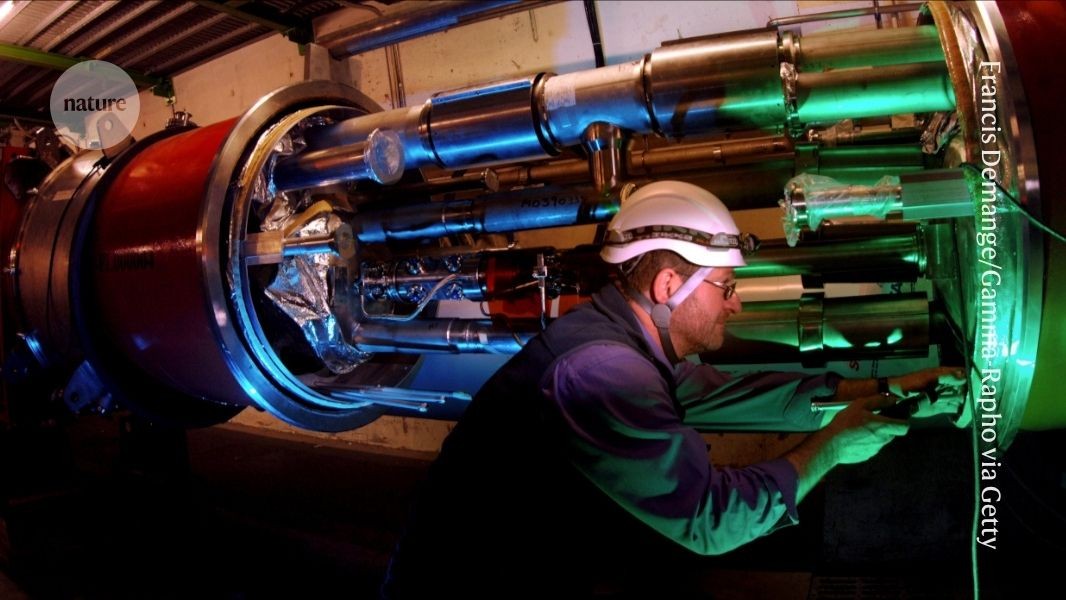
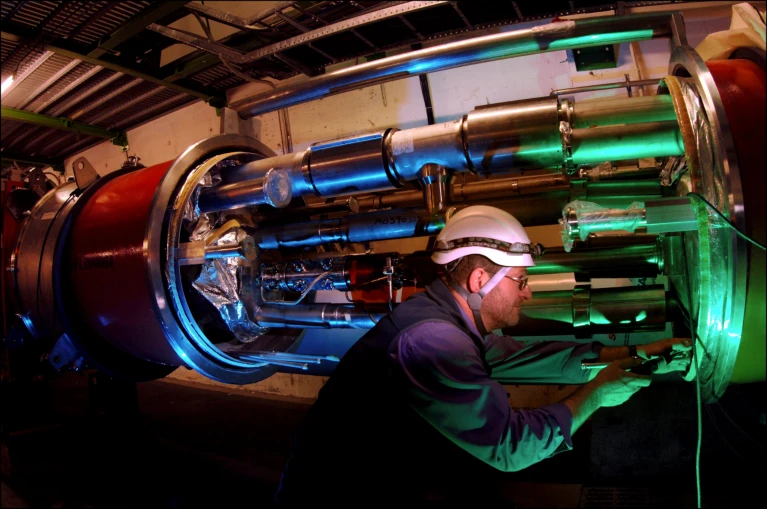
An engineer works on equipment for the LHCb experiment inside the tunnel of the Large Hadron Collider.Credit: Francis Demange/Gamma-Rapho via Getty
Physicists know that their elegant theoretical description of forces and particles – the Standard Model – must be incomplete, because there are a host of phenomena it cannot explain, such as the existence of dark matter.
But observations continue to confirm the model’s accuracy with ever greater precision. Even measurements that seemed to break the mould, such as a discrepancy in the mass of a particle called the W boson, have evaporated under further investigation.
Now, an analysis from an experiment at the Large Hadron Collider (LHC) at CERN, Europe’s particle physics laboratory near Geneva, Switzerland, suggests that one deviation from the Standard Model has grown. It concerns the decay of particles called B mesons into other particles. The result, which has been accepted for publication in Physical Review Letters, is one of the last remaining anomalies for particle physicists, who look for new physics in the debris from proton-proton collisions that turn energy into matter.
Nature explores the latest findings from CERN’s LHCb experiment, and the exotic particles that could explain them.
What did the experiment find?
Rather than looking for new, heavy particles directly, LHCb looks indirectly for their subtle effects, including when they pop up fleetingly as “virtual particles” that influence decays. To look for these effects, researchers analyzed the frequency and angle at which particles emerge from decays, to check if they match with those predicted by the standard model. The new analysis looks at when a B meson — a particle composed of a bottom quark and another lighter quark — decays into another meson containing a strange quark, known as a kaon, as well as two muons (heavier cousins to the electron). They found that the angle at which the final products emerge from the decay disagree with those predicted by the Standard Model. Evidence for this anomaly has been growing since 2015.
How does this point to new physics?
Physicists think that this B meson decay — known as a penguin decay — should be particularly sensitive to as-yet undiscovered physics. (In 1977, British theorist John Ellis coined the term, owing to the resemblance of the decay’s diagram to a penguin, after losing a bet which forced him to include the word in his next paper1). The decay involves a quantum loop — in which a bottom quark changes into a strange quark, via a temporary transition into ‘virtual’ particles that pop in and out of existence. Quantum physics allows even heavy, non-Standard-Model particles, to fleetingly enter this loop and leave the final products with properties not possible from only known particles.
As this decay is so rare — around one in a billion B mesons decaying in this way — the impact of new particles should be easier to spot than in other, more common decays, where the signal would be drowned out.
Should we be excited?
The analysis includes around 650 billion decays amassed at the LHC during two runs between 2011 and 2018. Measurements of the angles of the particles emerging disagree with the standard model with a significance of around 4 sigma. This means that the chance that random noise from regular standard model processes would produce this signal is around 1 in 16,000, says William Barter, a particle physicist at the University of Edinburgh, UK, who works on LHCb. “This is among the most significant results of the last few years at the LHC,” says Barter. Particularly exciting is that the finding seems to be tentatively corroborated by another LHC experiment, CMS, which has observed a discrepancy in this B meson decay, albeit with lower statistical significance.
But excitement is tempered, he adds, because a rival decay involving particles called charm quarks can create the exact same products as the bottom-to-strange transition, and it is hard for theorists to predict precisely how these “charming penguins” would impact the angles of the final decay products. Theory suggests that this decay is unlikely to explain the full deviation from the standard model, but its existence gives room for caution.
If the signal is real, what new particles could explain it?
One possibility that could explain the discrepancy is if a particle known as Z’ (pronounced Z prime) is a virtual particle involved in breaking up the B mesons as part of the bottom-to-strange quark transition. Physicists hypothesize that this particle — which would be associated with a brand new, as-yet undiscovered force — would be similar to the Z boson, one of the two particles that mediates the weak nuclear force. But Z’ would heavier, and with a preference to interact with certain families of particles, says Ben Allanach, a theoretical physicist at the University of Cambridge, UK. The Z’ would mediate a force that discriminates between different “flavours” of particle, he adds. This theory could also help to explain why masses of particles in the standard model can be so radically different.
Another possibility is the existence of a leptoquark, a short-lived particle that, at high energies, is theorized to take on the properties of two families of particles — leptons and quarks. Leptoquarks provide another way in which bottom quarks could transition to strange quarks, and could also cause the decay angles observed, says Barter.

