


You have full access to this article via your institution.

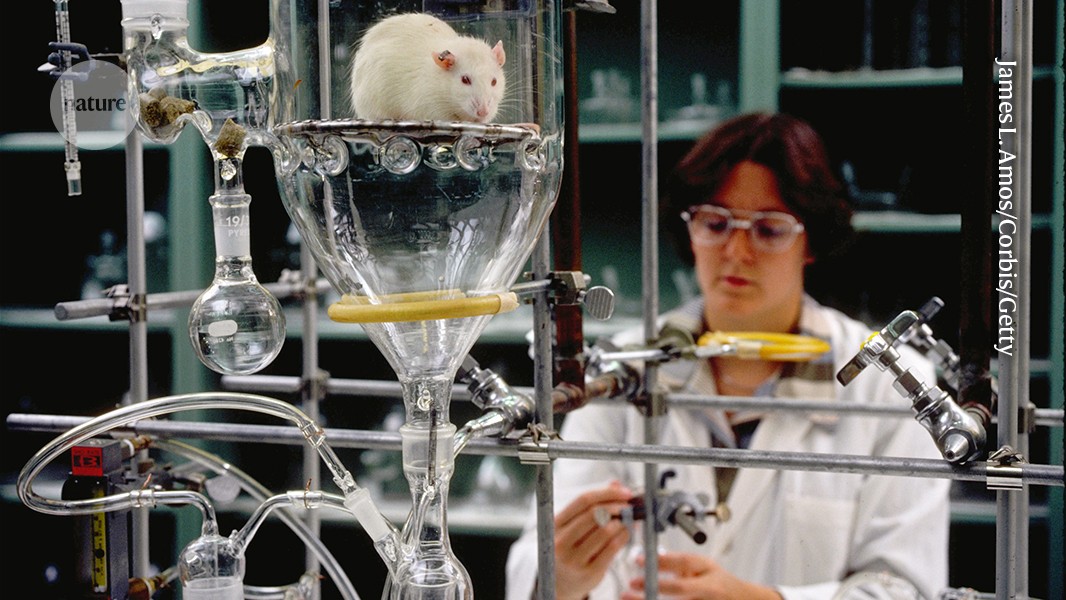
A toxicology test in the late 1970s using a live rat.Credit: James L. Amos/Corbis/Getty
Article 13 of the Treaty on the Functioning of the European Union proudly states that animals are sentient beings and that full regard should be paid to their welfare. And yet, in 2015–23, more than 15 million animals were used in the EU for regulatory testing. Of those, almost 40% were used to assess whether chemical products in industry, pharmaceuticals and agriculture are safe for human health and the environment. (This is separate to the use of animals in scientific research procedures: the dominant application of animal testing, for which numbers are much higher.) Although the number of animals used for chemical safety testing is declining, overall progress in reducing and eventually replacing animals, while refining procedures to minimize their suffering (known as the 3Rs framework), is by all accounts too slow.
In 2023, animal-welfare organizations in Europe, backed by more than one million citizens, urged the European Commission, the EU’s executive arm, to accelerate the use of non-animal alternatives in chemical safety testing. This was partly in response to concerns that EU countries are not fully implementing a 2013 law that prohibits animals being used for testing ingredients in cosmetics.
But this ban does not extend to animals that are used to test the environmental impact of chemicals or the safety and toxicology of chemical products that workers encounter. Currently, the main requirement from regulators of human and veterinary medicines and food safety is that applicants requesting permission for testing in animals consider the 3Rs framework and use the minimum number necessary.
The commission responded in 2023 with a commitment to produce a road map towards an “animal-free regulatory system”, which was published earlier this month (see go.nature.com/4vhcbfa). The commission cannot be faulted for a lack of ambition: it wants EU countries to end animal testing in 15 legislative domains, including industrial chemicals, pharmaceuticals and feed and food products. This will mean changes to hundreds, perhaps thousands, of individual regulations.
The road map consists of three overlapping elements: the first is about identifying regulatory needs to speed up the application of non-animal approaches. This is to be achieved in part through the second component, by boosting research and innovation in non-animal approaches. The third is all about collaboration for implementation, for which the importance of working together cannot be overstated. Among other things, the EU will need its relevant regulatory agencies — from the European Food Safety Authority in Parma, Italy, to the European Medicines Agency in Amsterdam and the European Chemicals Agency in Helsinki — to collaborate on a shared approach to chemical safety testing.
That said, calling the proposals a road map might be a bit of a stretch: it includes milestones towards the destination but no indication of how long it might take to get there. The commission is proposing to establish a steering team for the road map, comprising individuals from different sectors and countries. These representatives from industry, policymaking, research and EU member states have work to do in turning the commission’s ambition into reality.
To guide them, the beginnings of an agenda for research has been published as part of the road map. Within this, representatives of regulatory bodies have contributed perspectives on the desirability and effectiveness of existing practices — not least about the accuracy of test results that rely on a relatively small number of species, the widespread approach of testing pesticides on birds, and whether it is necessary to continue testing in dogs and rabbits. They also plan to further investigate computational methods and artificial intelligence in the search for non-animal alternatives.
But looming large over the whole process is the thought that, in some cases, a non-animal alternative might simply not exist. In such a scenario, ensuring safety without the use of animals will require going back to first principles and, possibly, entirely new scientific frameworks.
Funding for change
The commission recognizes that its research agenda will need to be financed — but it must also recognize that the sums of money needed will greatly exceed what is currently on offer for research into non-animal alternatives. Over the past two decades, this has averaged around €50 million (US$58 million) annually for all member states. If the EU is serious about ending animal testing, it will have to provide much more cash in its next research-funding round.
There is also an important international context: countries outside the EU are moving to reduce or entirely replace the use of animals in chemical safety assessments, and it will be important for the EU to work in concert with them. This month, the US Environmental Protection Agency added 13 non-animal methods that it will accept in chemical assessments. The agency is urging all relevant stakeholders to propose other non-animal tests or ideas that it can then evaluate.
The EU’s road map is an important statement of intent, and underscores its commitment to animals as sentient beings. But EU leaders must reconsider the level of their funding commitment if they want to achieve their ambition, and the milestones must have timelines attached. That will enable them to be held to account, including by those whose advocacy set them on the current path.

