


New integration brings LiDAR mapping and radiation detection together across air and ground platforms
Teledyne FLIR Defense has expanded its Third-Party Payload Integration Program with the addition of Emesent’s Hovermap LiDAR payload. Announced at Modern Day Marine 2026, the certification allows the Hovermap system to operate across Teledyne FLIR’s unmanned aerial systems (UAS), ground robots, and radiation detection platforms.
The integration focuses on a common operational challenge: environments where GPS signals are unavailable or unreliable. These conditions often occur in tunnels, dense urban areas, and hazardous CBRN (chemical, biological, radiological, and nuclear) environments. By combining LiDAR-based mapping with existing platforms, the companies aim to improve situational awareness without relying on external infrastructure.
Addressing GPS-Denied Environments
Emesent’s Hovermap uses LiDAR-based Simultaneous Localization and Mapping (SLAM) technology to generate accurate 3D maps without GPS. This capability allows operators to navigate and map complex environments in real time.
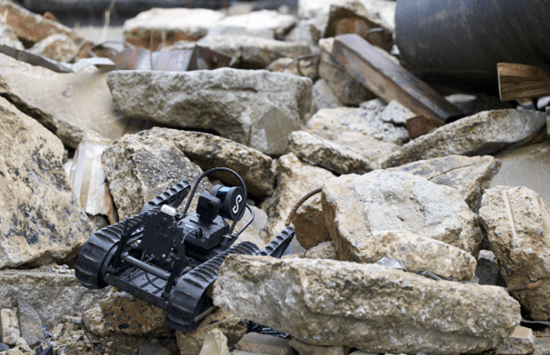
The system is now compatible with several Teledyne FLIR platforms. On the SkyRanger® R70 and R80D SkyRaider® drones, Hovermap enables aerial mapping in GPS-denied conditions. When mounted on the SUGV™ 325 ground robot, it provides continuous 3D awareness in enclosed or obstructed spaces.
The integration also extends to radiation detection. When paired with the MUVE™ R430 payload on the SUGV platform, Hovermap allows operators to visualize radiation levels within a mapped environment. This creates a combined spatial and hazard picture for CBRN teams operating in the field.
“Knowing the shape of a space is powerful. Knowing where the radiation is within that space, in real time, without putting a person in harm’s way, is an operational game-changer,” said Stefan Hrabar, co-founder and chief strategy officer at Emesent. “Our partnership with Teledyne FLIR Defense brings together GPS-denied mapping and radiation detection in a way that directly addresses what CBRN operators need in the field.”
Expanding Multi-Sensor Capabilities
Teledyne FLIR says the integration reflects a broader shift toward combining multiple sensing technologies into a single operational view. The company’s open-architecture approach allows third-party payloads to be certified for compatibility across its platforms.
“Teledyne FLIR builds platforms trusted for the most demanding CBRN missions in the world,” said Tung Ng, vice president of Unmanned Systems North America for Teledyne FLIR Defense. “Working with Emesent, we’ll be able to give operators a fused, spatial picture of the threat environment they simply haven’t had access to before.
“This is the direction the whole field is heading in, and we’re delivering it now through certified third-party payloads like Hovermap,” Ng added.
Certified payloads undergo testing for mechanical fit, electrical integration, software compatibility, and flight performance. This process is designed to ensure that new capabilities can be deployed reliably across existing systems.
Foundation for Future Development
Both companies indicate that the partnership will extend beyond current capabilities. Ongoing development efforts include autonomous navigation and expanded sensor fusion across additional CBRN detection technologies.
The integration highlights a growing focus on systems that combine mapping, detection, and real-time data into a single operational workflow. For public safety and defense users, this approach may reduce the need for multiple separate tools in complex environments.
The integrated systems are on display at Teledyne FLIR Defense booth #1724 at Modern Day Marine 2026, held April 28–30 at Marine Corps Base Quantico.
Read more:

Miriam McNabb is the Editor-in-Chief of DRONELIFE and CEO of JobForDrones, a professional drone services marketplace, and a fascinated observer of the emerging drone industry and the regulatory environment for drones. Miriam has penned over 3,000 articles focused on the commercial drone space and is an international speaker and recognized figure in the industry. Miriam has a degree from the University of Chicago and over 20 years of experience in high tech sales and marketing for new technologies.
For drone industry consulting or writing, Email Miriam.
TWITTER:@spaldingbarker
Subscribe to DroneLife here.

