


Small infrastructure company offers new twist on drone shelters
By DRONELIFE Features Editor Jim Magill
For people in the commercial drone industry, most of their attention is quite naturally turned to the sky. But a small, private company is hoping to shift some of that focus of UAV operators in the opposite direction – in fact underground.
SYNDÉO, a 10-year-old infrastructure company based in Verona, Wisconsin, is promoting the idea of establishing permanent hardened subsurface homes for drones, especially those designed to perform critical missions, such as infrastructure inspection and border security.
“We know that there are drone docks out there, and drone pods, but ours is a little different. We’re not looking to compete with those. We’re looking for the mission-critical opportunities whereby you need to have a permanent location,” Gary Henshue, SYNDÉO founder and CEO, said in an interview with DroneLife.
The company’s flagship product, the SmartVault Drone Base, is a subsurface drone station with a load-bearing lockable hatch at street or grade level. “It is built to support drone charging, secure storage, communications gear, backup power, thermal management and an onboard edge AI [artificial intelligence] ‘brain’ capable of supporting AI inference and remote decision-making for the drone,” Henshue said in an email statement.
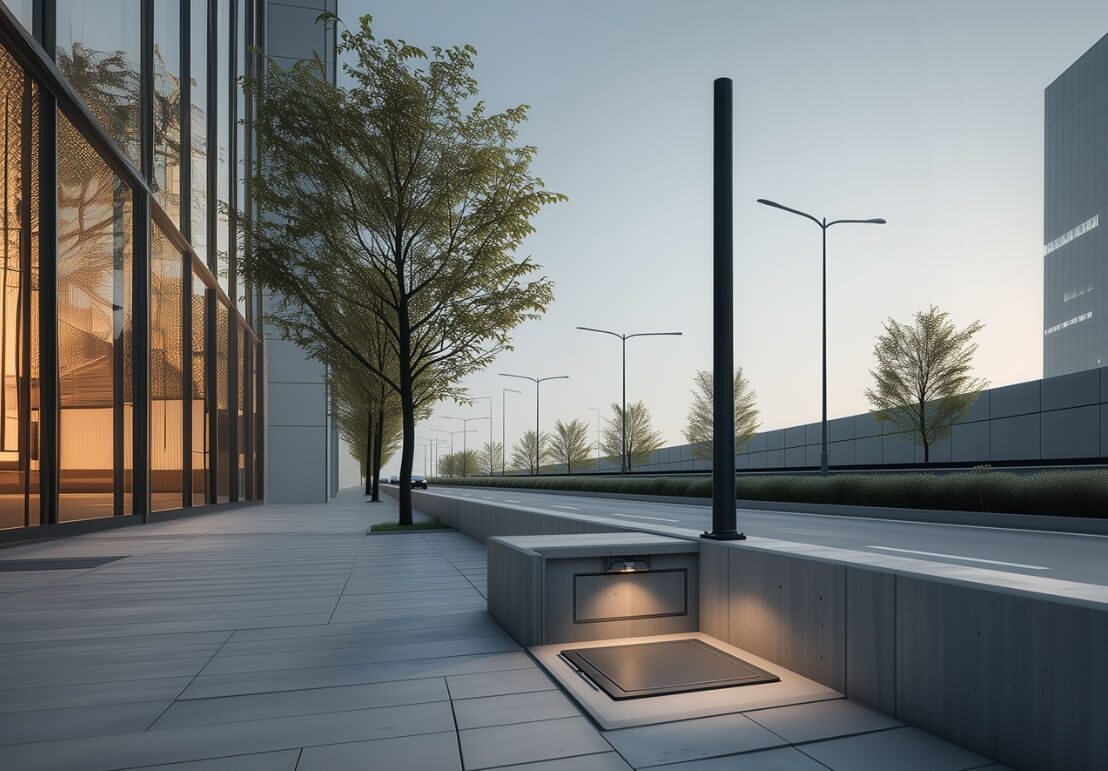
Henshue said the SmartVault has a number of features that distinguish it from conventional above-ground drone docks or pods. “Those systems may store and charge the drone, but they are not designed to house mission-critical edge AI infrastructure, thermal systems, backup power, communications and secure field computing in the same protected platform,” he wrote.
Although SYNDÉO has been around for about a decade, the company only recently began marketing its SmartVault technology to the drone industry. The company had its genesis in the smart-cities movement, which aimed to improve urban areas by optimizing their use of civic-service infrastructure and reducing resource consumption.
“My family has been in the infrastructure business since the mid-1930s, doing mostly underground construction, whether that be sewer, water, telecom or electric. We’ve done a lot of design build-out and telecom work,” he said.
Over the course of time, Henshue estimated that his family’s various business enterprises have been responsible for installing millions of miles of pipeline and fiber-optic cable among other infrastructure products. Gary and his son, Chris, launched SYNDÉO in 2015 to help promote the smart-cities agenda.
Syndéo is a Greek word for connect, so when we wanted a name for our company, we wanted it to mean something,” Henshue said. The company’s website is syndeocities.com, a reflection the founders’ desire to connect a city’s various services with one another.
Working with the city of Austin, Texas, SYNDÉO participated in the Smart City Challenge in 2016, a competition established by the U.S. Department of Transportation to come up with innovative solutions to improve urban infrastructure. In the first demonstration of its technology, the company installed several SmartVaults in the city, to house battery backup technology for Austin’s traffic-signal system.
Although Austin did not win the Smart City Challenge, the city did win an International Data Corporation award for its SmartVault installation in 2018. SYNDÉO also worked the installation of its SmartVault technology in the city of Herndon, Virginia.
Smart cities efforts slowed
However, around the time of the COVID 19 epidemic of 2020, some of the impetus for the Smart Cities initiative slowed down, and fewer cities showed an interest in the SmartVault technology, he said.
“The challenge we’ve had with cities is they don’t have the funds to build out some of the smart-city stuff,” Henshue said. He predicted that in the future the build-out of smart infrastructure across the United States would more likely be funded by private money and by public-private partnerships than by the cities themselves.
Meanwhile, SYNDÉO has continued to work on developing and perfecting its SmartVault systems. The company has secured 10 patents for its underground enclosure technology. “We’re probably on generation five now; it’s come a long way.”
One of the most important innovations was the introduction of AI technology to its product, Henshue said.
“AI wasn’t a big issue or big deal back 10 years ago, and the market has now finally come to us, whereby we have the critical piece of the infrastructure, we think, for this AI build-out in the United States,” he said. Adding an AI component to its waterproof, temperature-controlled vaults makes them the perfect base-station home for drones, he said.
“We’ve worked on the infrastructure product and patenting it and so forth and are really just now beginning to look at commercializing it and rolling it out,” Henshue said.
Offered as an add-on service
The current version of the SmartVault measures eight-feet by six-ft with an eight-foot-tall ceiling. Upon being called into service, the hatch at the top opens up, allowing the drone to ascend to perform its mission. In addition to providing electricity for charging, the temperature-controlled vault can shelter the drone for extended periods of time between launches even in the midst of harsh exterior climate conditions.
“So, it’s an ideal application for the southern border, or the northern border, where you’re going to have drones positioned every few miles to just do surveillance and look after things,” Henshue said.
The vaults could also be positioned along busy highway corridors where they could be dispatched by first responders in the event of an accident, or at the site of a piece of critical infrastructure, such as a bridge or a dam, which requires periodic inspections.
Henshue said that within the past several weeks, SYNDÉO has reached out to several well-known companies that already have prominent positions in the drone-sheltering business, such as Skydio, Anduril Industries and Shield AI, to offer them the opportunity to make use of the SmartVault technology.
“What we’re looking for is an execution partner that can take this and have it as a service offering in their portfolio, he said. “If they needed a really mission-critical, secure site, a permanent site, they would look at the SmartVault.”
Read more:

Jim Magill is a Houston-based writer with almost a quarter-century of experience covering technical and economic developments in the oil and gas industry. After retiring in December 2019 as a senior editor with S&P Global Platts, Jim began writing about emerging technologies, such as artificial intelligence, robots and drones, and the ways in which they’re contributing to our society. In addition to DroneLife, Jim is a contributor to Forbes.com and his work has appeared in the Houston Chronicle, U.S. News & World Report, and Unmanned Systems, a publication of the Association for Unmanned Vehicle Systems International

