


Protein expression and purification
HpaII methyltransferase (MH), ORC, Cdc6, Mcm2–7–Cdt1, DDK, CDK, (yeast-expressed) Sld3/7, Cdc45, GINS, (yeast-expressed) Pol ε, Mcm10, RPA, topoisomerase I (TopoI), Pol α and Rad53 were expressed and purified as previously described24,30,40,46,66,67,68,69. All mutant constructs were expressed and purified following the same protocol as was used for the wild-type protein unless stated otherwise. All buffers described below are also reported in Supplementary Table 1.
Cell lines
Sf21 insect cells were obtained in-house from the Cell Services Science and Technology Platform. These cells were not authenticated and tested negative for mycoplasma contamination.
Cloning, expression and purification of Twin-Strep-tagged Sld3/7
Codon-optimized gene blocks (IDT) encoding Saccharomyces cerevisiae Sld3 in-frame with a tobacco etch virus (TEV) protease cleavage site and a C-terminal Twin-Strep-tag (TST) as well as S. cerevisiae Sld7 were inserted into GoldenBac shuttle vectors pGB-01;02 and pGB-02;03. Subsequently, Sld3-TEV-TST and Sld7 expression cassettes were subcloned into pGB-dest using GoldenBac assembly70 and transformed into electrocompetent EMBacY cells (Geneva Biotech). Cells were screened by blue–white selection for successful bacmid integration and selected colonies were grown overnight at 37 °C. Cells were collected by centrifugation and bacmids were purified by isopropanol precipitation. A total of 45 µg bacmid DNA was mixed thoroughly with 13.5 µl FuGENE HD Transfection Reagent (Promega) and 450 µl Sf-900 III SFM medium and incubated for 30 min at room temperature. Two hundred microlitres of transfection mix was added dropwise to 2 ml Sf21 insect cells seeded at 0.5 million cells per ml in a six-well plate. Plates were incubated for 3–5 days at 27 °C in a wet-towel box. Efficient transfection was monitored through YFP fluorescence. Adherent cells were resuspended and supernatant containing P0 baculovirus was collected. To increase the multiplicity of infection, 46 ml Sf21 insect cells at 0.5 million cells per ml were inoculated with 4 ml P0 baculovirus in suspension and cultured at 27 °C shaking at 120 rpm. After viability had dropped below 90%, cells were pelleted by centrifugation at 380g for 15 min at 4 °C, and supernatant containing the amplified P1 virus was sterile-filtered (0.22 µm pore size) and stored at 4 °C. One litre of Sf21 insect cells were seeded at one million cells per ml in Sf-900 III SFM medium and infected with 0.5 % v/v P1 virus. Cells were collected 48 h after baculovirus-induced cell-cycle arrest by centrifugation for 15 min at 180g at 4° C, and pellets were flash-frozen in liquid nitrogen and stored at −80 °C.
Cells were thawed and resuspended in 50 ml buffer A (25 mM HEPES-KOH pH 7.5, 500 mM KCl, 10% v/v glycerol, 0.02% w/v NP-40, 1 mM EDTA and 1 mM DTT) supplemented with one cOmplete EDTA-free protease inhibitor tablet (Merck) and 0.7 mM phenylmethylsulfonyl fluoride (PMSF), then lysed by sonication on ice for 2 min (1-s pulse-on, 4-s pulse-off). The lysate was clarified by ultracentrifugation for 1 h at 45,000 rpm in a Ti45 rotor (Beckman) at 4 °C, and the supernatant was mixed with 2.4 ml Bio-Lock (IBA) reagent and applied onto 1 ml pre-equilibrated Strep-Tactin XT Superflow HighCapacity resin in a gravity column. The resin was washed with 100 ml buffer A and 10 mL buffer A supplemented with 2 mM ATP and 10 mM MgCl2. Protein was eluted with 10 ml buffer A supplemented with buffer BXT (IBA). The eluate was pooled, concentrated and loaded onto a Superdex 200 Increase 10/300 GL column (Cytiva) equilibrated in buffer A. Gel-filtered Sld3/7 was concentrated to approximately 1.5 mg ml−1, aliquoted and flash-frozen in liquid nitrogen.
Cloning, expression and purification of Dpb11
Codon-optimized S. cerevisiae Dpb11 followed by a 3C protease cleavage site and a C-terminal 3×Flag tag was subcloned into a pGB-04;05 shuttle vector and subsequently transformed into electrocompetent EMBacY cells. Bacmid and baculoviruses were prepared as described above; 1 l Sf21 insect cells at one million cells per ml were infected with 0.5% v/v P1 virus and collected 48 h after cell-cycle arrest.
The cell pellet was resuspended in 50 mL buffer A supplemented with one cOmplete EDTA-free protease inhibitor tablet (Merck) and 0.7 mM PMSF, lysed by sonication on ice for 2 min (1-s pulse-on, 4-s pulse-off) and ultracentrifuged at 45,000 rpm at 4 °C for 1 h. The soluble phase was mixed with 2.4 ml Bio-Lock Reagent and passed through 1 ml pre-equilibrated anti-Flag M2 Affinity Gel (Sigma) in a gravity column. The column was washed with 150 ml buffer A and 10 ml buffer A supplemented with 2 mM ATP and 10 mM MgCl2. To elute bead-bound protein, the beads were resuspended in 5 ml buffer A supplemented with 0.5 mg ml−1 3×Flag peptide and incubated for 5 min, after which the flow-through was collected. The eluate was diluted to 150 mM KCl and loaded onto a 1 ml Mono S 5/50 column (Cytiva) equilibrated in buffer B (25 mM HEPES-KOH pH 7.5, 150 mM KCl, 10% v/v glycerol, 0.02% w/v NP-40, 1 mM EDTA and 1 mM DTT). After washing the column with 10 ml buffer B, Dpb11 was eluted with a linear gradient of 150–1,000 mM KCl in buffer B over 20 column volumes. Fractions containing pure Dpb11 were pooled and dialysed against buffer C (25 mM HEPES-KOH pH 7.5, 300 mM KOAc, 10% v/v glycerol, 0.02% NP-40, 1 mM EDTA and 1 mM DTT) at 4 °C overnight while stirring. Subsequently, Dpb11 was concentrated to approximately 0.5 mg ml−2, aliquoted and flash-frozen in liquid nitrogen.
Dpb11 mutants containing charge-reversal substitutions (Dpb11(3E), Dpb11(3X) and Dpb11(3E/3X)) were purified using gel filtration instead of cation-exchange chromatography. The reason for this alteration was the predicted isoelectric point of the mutant proteins, which matches the pH of buffers B and C. After Flag affinity purification, the eluate was concentrated and loaded onto a Superdex 200 Increase 10/300 GL column equilibrated in buffer C. Dpb11-containing fractions were pooled, concentrated to approximately 0.5 mg ml−1, aliquoted and flash-frozen in liquid nitrogen.
Cloning, expression and purification of Sld2
An expression cassette encoding S. cerevisiae Sld2 in-frame with an N-terminal VNp6 peptide tag71 and a retro-protein XXA solubility tag72, as well as a C-terminal Twin-Strep-tag, was subcloned into a pET303 backbone and transformed into bacterial T7 Express cells. Multiple colonies were picked to inoculate 4× 1 l LB + 100 µg ml−1 carbenicillin and incubated static overnight at 37 °C. The next morning, cultures were transferred to 30 °C and grown to an optical density at 600 nm (OD600 nm) of 0.8, shaking at 200 rpm. Isopropyl β-d-1-thiogalactopyranoside (IPTG; 80 µM) was added to each flask to induce the expression of Sld2 for 21 h at 30 °C at 200 rpm. Subsequently, cells were pelleted by centrifugation at 4,000g for 10 min at 4 °C, flash-frozen and stored at −80 °C.
Cells were thawed and resuspended in 100 ml buffer D (25 mM HEPES-KOH pH 7.5, 800 mM KCl, 10% v/v glycerol, 1 M sorbitol, 2 mM ATP, 10 mM MgCl2, 0.02% v/v NP-40, 0.1% w/v Tween-20, 1 mM DTT) with two cOmplete EDTA-free protease inhibitor tablets (Merck) and 0.7 mM PMSF, then sonicated on ice for 2 min (5-s pulse-on, 5-s pulse-off). The lysate was clarified by centrifugation in a JA-25.50 rotor at 18,000 rpm for 20 min at 4 °C, and the supernatant was applied onto a gravity column packed with 1 ml Strep-Tactin XT Superflow High Capacity Resin equilibrated in buffer D. The resin was washed with 75 ml buffer D followed by 25 ml buffer E (25 mM HEPES-KOH pH 7.5, 500 mM NaCl, 10% v/v glycerol, 0.02% w/v NP-40, 1 mM EDTA and 1 mM DTT), after which Sld2 was eluted by passing 10× 1 ml buffer E supplemented with buffer BXT through the resin. The highest-concentration fraction was identified by SDS–PAGE (Coomassie staining) and dialysed in buffer F (25 mM HEPES-KOH pH 7.5, 700 mM KOAc, 40% v/v glycerol, 0.02% w/v NP-40, 1 mM EDTA and 1 mM DTT) for 4 h at 4 °C. Sld2 was aliquoted at approximately 0.8 mg ml−1 and flash-frozen in liquid nitrogen. For the phosphomimetic Sld2(8D) variant, aspartate substitutions were introduced at the following residues: threonine 84, serine 100, serine 128, serine 138, threonine 168, serine 172, serine 188 and serine 208.
Cloning, expression and purification of ALFA-tagged Pol ε
Codon-optimized S. cerevisiae Pol2-3×Flag, Dpb2, Dpb3 and Dpb4-ALFA were subcloned into GoldenBac shuttle vectors and assembled into a co-expression plasmid, pGB-dest-PolE, as described above for Sld3/7. Similarly, electrocompetent EMBacY cells were transformed with pGB-dest-PolE to prepare bacmids and generate a P1 baculovirus as described above. One billion Sf21 insect cells were seeded in 1 l Sf-900 III SFM medium and infected with 0.5% v/v P1 baculovirus, incubated at 27 °C at 120 rpm and collected 48 h after cell-cycle arrest by centrifugation at 180g at 4 °C for 15 min. The cell pellets were flash-frozen in liquid nitrogen and stored at −80 °C. To purify ALFA-tagged Pol ε, the cell pellets were resuspended in 50 ml buffer G (25 mM HEPES-KOH pH 7.6, 400 mM KOAc, 10% v/v glycerol and 2 mM DTT) supplemented with one cOmplete EDTA-free protease inhibitor tablet (Merck), and lysed by sonication on ice for 2 min (1-s pulse-on, 4-s pulse-off). The lysate was clarified by ultracentrifugation at 45,000 rpm for 45 min at 4 °C in a Ti45 rotor, and the supernatant was passed twice through a column packed with 1 ml anti-Flag M2 affinity gel equilibrated in buffer G. The column was washed with 150 ml buffer G and 20 ml buffer G + 2 mM ATP and 10 mM Mg(OAc)2. Protein was eluted by incubating the resin three times in 5 ml buffer G + 0.5 mg ml−1 3× Flag peptide for 5 min and collecting the flow-through. The eluate was loaded onto a 5-ml Heparin HP column (Cytiva) and eluted over 25 column volumes with a linear gradient of 400–1,000 mM KOAc in buffer G. Fractions containing Pol ε were concentrated and gel-filtered onto a HiLoad 16/60 Superdex 200-pg column (Cytiva). Pol ε was concentrated to approximately 1 mg ml−1, aliquoted and flash-frozen in liquid nitrogen.
Cloning, expression and purification of Sic1
T7 Express cells (NEB) were transformed with hexahistidine-tagged S. cerevisiae Sic173. Transformant colonies were incubated overnight in 100 ml LB supplemented with 100 µg ml−1 carbenicillin at 37 °C shaking at 200 rpm. Two litres of LB medium and 100 µg ml−1 carbenicillin were inoculated with 1% v/v dense overnight culture and grown to an OD600 nm of 0.6 at 37 °C and 200 rpm. Expression of Sic1 was induced by adding 0.5 mM IPTG, after which the cultures were incubated for 3 h at 37 °C at 200 rpm. Cells were collected by centrifugation at 4,000g for 10 min at 4 °C, and the cell pellet was flash-frozen in liquid nitrogen and stored at −80 °C.
The pellet was dissolved in 100 ml buffer H (25 mM HEPES-KOH pH 7.5, 500 mM NaCl, 10% v/v glycerol, 1 mM EGTA, 0.2% w/v Triton X-100, 0.5 mM TCEP, 10 mM Imidazole) with two cOmplete EDTA-free protease inhibitor tablets (Merck) and 0.7 mM PMSF in a beaker. Lysozyme (0.2 mg ml−1) was added and incubated with the cell suspension for 10 min while stirring. Cells were then sonicated on ice for 5 min (2-s pulse-on, 5-s pulse-off), and the debris was removed by centrifugation at 20,000 rpm in a JA-25.50 rotor for 30 min at 4 °C. Two millilitres of Ni-NTA beads (QUIAGEN) were equilibrated in buffer H and rotated with the clarified lysate for 1 h at 4 °C. Subsequently, beads were collected in a gravity column and washed with 150 ml buffer H and 20 ml buffer H supplemented with 2 mM ATP and 10 mM MgCl2. Protein was eluted with 15 ml buffer H supplemented with 250 mM imidazole, concentrated and gel-filtered on a HiLoad 16/60 Superdex 75-pg column (Cytiva) equilibrated in buffer I (25 mM HEPES-KOH pH 7.5, 5% v/v glycerol, 5 mM MgCl2, 0.5 mM EDTA and 0.5 mM TCEP) supplemented with 200 mM NaCl. Gel filtration did not yield pure Sic1. Consequently, peak fractions were loaded onto a 1-ml Mono S column (Cytiva) and washed with 10 column volumes of buffer I supplemented with 50 mM NaCl. Sic1 was eluted with a linear gradient of 50–1,000 mM NaCl in buffer I over 30 column volumes, and fractions containing pure Sic1 were dialysed at 4° C in buffer I + 200 mM NaCl for 3 h under agitation. Sic1 was concentrated to 10.8 mg ml−1 and flash-frozen in liquid nitrogen.
Cloning, expression and purification of Twin-Strep-tagged SUMO-Mcm10
S. cerevisiae Mcm10 was cloned in-frame with an N-terminal 10×His-SUMO cassette and a C-terminal Twin-Strep-tag, and transformed into Rosetta 2 pLysS cells. Multiple colonies were picked and grown overnight at 37 °C in 100 ml LB supplemented with 100 µg ml−1 carbenicillin and 33 µg ml−1 chloramphenicol. Then, 6× 1 l LB supplemented with 100 µg ml−1 carbenicillin and 33 µg ml−1 chloramphenicol were each inoculated with 10 ml dense overnight culture and grown to an OD600 nm of 0.7 at 37 °C and 200 rpm. Overexpression was induced by the addition of 0.5 mM IPTG and continued for 16 h at 16 °C. Cells were collected by centrifugation at 4,000g for 10 min at 4 °C, flash-frozen in liquid nitrogen and stored at −80 °C. The cell pellet was resuspended in 230 ml buffer J (25 mM HEPES-KOH pH 7.6, 500 mM NaCl, 10% v/v glycerol, 1 mM EDTA, 0.05% w/v Tween-20 and 1 mM DTT) supplemented with four cOmplete EDTA-free protease inhibitor tablets (Merck), then lysed by sonication on ice for 5 min (2-s pulse-on, 5-s pulse-off). The lysate was clarified by centrifugation in a JA-25.50 rotor at 20,000 rpm for 30 min at 4 °C, and the supernatant was loaded onto a 1-ml cOmplete His-Tag Purification column (Merck) installed in tandem with a 1-ml Strep-Tactin XT 4Flow High Capacity column (IBA), both pre-equilibrated in buffer J. The columns were washed with buffer J until the absorbance at 280 nm returned to its baseline signal, after which protein was eluted from the His-Tag Purification column into the connected Strep-Tactin XT column with 9 ml buffer J supplemented with 200 mM imidazole. The His-Tag Purification column was disconnected, the Strep-Tactin XT column was washed with 9 ml buffer B, and this was finally followed by elution with 9 ml buffer K (25 mM HEPES pH 7.6, 300 mM NaCl, 10% v/v glycerol, 0.05% w/v Tween-20, 1 mM DTT and 5 mM desthiobiotin). Mcm10-containing fractions were pooled and dialysed overnight into buffer L (25 mM HEPES pH 7.6, 200 mM NaCl, 20% v/v glycerol, 0.05% w/v Tween-20, 1 mM EDTA and 2 mM DTT) at 4 °C while stirring. Mcm10 was aliquoted at a concentration of approximately 0.5 mg ml−1 and flash-frozen in liquid nitrogen.
Preparation of an MH-conjugated ARS1 DNA template
A 168-bp DNA template containing the S. cerevisiae origin of replication ARS1, flanked by two MH recognition sites, was generated by PCR and purified as previously described74,75. The DNA template was covalently tethered to either Twin-Strep-tagged MH or tandem ALFA/Twin-Strep-tagged MH using previously established protocols30.
S-CDK prephosphorylation of Sld3/7
Sld3/7 prephosphorylation by S-CDK was modified from previous protocols24. In brief, 900 nM Twin-Strep-tagged Sld3/7 was phosphorylated by 100 nM S-CDK in buffer M (40 mM HEPES-KOH pH 7.5, 310 mM potassium glutamate, 10 mM Mg(OAc)2, 10% v/v glycerol, 0.02% w/v NP-40, 1 mM DTT, 2 mM ATP and 0.4 mg ml−1 BSA) in a total volume of 100 µl for 8 min at 24 °C and 1,250 rpm. Phosphorylation was stopped by adding 2.2 µM Sic1 to the reaction and incubating it for 2 min at 24 °C and 1,250 rpm. Then, 500 mM KCl was added to the reactions, which were then bound to 10 µl MagStrep ‘type3’ XT slurry (IBA) equilibrated in buffer N (25 mM HEPES-KOH pH 7.5, 500 mM KCl, 5 mM Mg(OAc)2, 10% v/v glycerol, 0.02% w/v NP-40 and 1 mM DTT). After 30 min of incubation at 24 °C and 1,250 rpm, beads were washed five times with 200 µl buffer K, and ppSld3/7 was eluted in 10 µl buffer N + 25 mM d-biotin for 10 min at 24 °C and 1,250 rpm, aliquoted, flash-frozen in liquid nitrogen and stored at −80 °C. Successful phosphorylation and approximate yield were estimated by SDS–PAGE. For cryo-EM experiments, ppSld3/7 was prepared in parallel and not flash-frozen before use.
Rad53 prephosphorylation of Sld3/7
Rad53-prephosphorylated Sld3/7 was prepared by incubating 700 nM Twin-Strep-tagged Sld3/7 with 356 nM Rad53 in 100 µL buffer M for 30 minutes at 30 °C and 1,250 rpm. Subsequently, Rad53-prephosphorylated Sld3/7 was purified by Strep-Tactin XT affinity purification exactly as described above for CDK-prephosphorylated Sld3/7.
In vitro ATP–dCMGE assembly
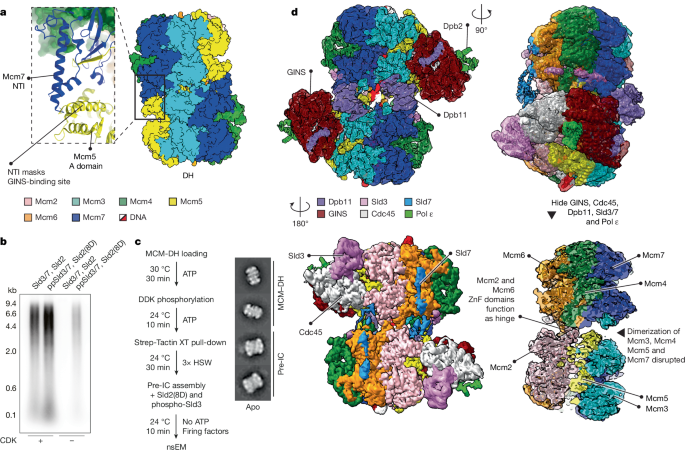
ATP-bound dCMGE complexes were assembled as previously described30,47 with minor modifications. First, MCM-DHs were loaded for 30 min at 30° C and 1,250 rpm by co-incubating 20 nM MH-conjugated ARS1 with 52 nM ORC, 52 nM Cdc6 and 110 nM Mcm2–7–Cdt1 in 100 µl buffer O (25 mM HEPES-KOH pH 7.5, 100 mM potassium glutamate, 10 mM Mg(OAc)2, 1 mM ATP and 0.02% w/v NP-40). Afterwards, loaded MCM-DHs were phosphorylated with 80 nM DDK at 24 °C and 1,250 rpm for 10 min, then bound for 30 min at 24 °C and 1,250 rpm to 5 µl MagStrep ‘type3’ XT slurry equilibrated in buffer P (25 mM HEPES-KOH pH 7.5, 100 mM potassium glutamate, 10 mM Mg(OAc)2 and 0.02% w/v NP-40). The beads were washed three times with 200 µl buffer Q (25 mM HEPES-KOH pH 7.5, 500 mM NaCl, 5 mM Mg(OAc)2 and 0.02% w/v NP-40) and once with 200 µl buffer P, then eluted in 20 µl buffer O + 25 mM d-biotin for 15 min at 24 °C and 1,250 rpm. S-CDK (200 nM) was added to DDK-phosphorylated MCM-DHs, and dCMGE assembly was then started by further addition of 40 nM Dpb11, 32.5 nM Pol ε, 133 nM GINS, 106 nM Cdc45, 40 nM Sld3/7 and 67 nM Sld2. After 12 min of incubation at 30 °C and 1,250 rpm, the reactions were immediately used for negative-stain grid preparation. Wild-type proteins were substituted with mutant constructs or omitted as specified. To split dCMGEs into sCMGEs, 100 nM Mcm10 and 300 nM RPA were added at the same time as the other firing factors.
In vitro pre-IC assembly
To assemble the pre-IC, DDK-phosphorylated MCM-DHs were prepared as described above, but eluted in the absence of ATP. Sld3/7 and Sld2 were replaced by equimolar amounts of ppSld3/7 and phosphomimetic Sld2(8D), and no CDK was added. DDK-phosphorylated DHs were incubated with ppSld3/7, Sld2(8D), Dpb11, Pol ε, GINS and Cdc45 in the absence of ATP and CDK for 10 min at 24 °C and 1,250 rpm, after which reactions were either negatively stained, applied to cryo-EM grids and plunge-frozen using a Vitrobot, or further purified.
ALFA pull-down of pre-IC and dCMGE complexes
To purify either pre-IC or dCMGE, phospho-DH formation and respective complex assembly was done on an ALFA-tagged 2×MH-ARS1 DNA template. Twenty microlitres of assembly reaction prepared as described above was added to 15 µl ALFA PE Selector slurry (NanoTag Biotechnologies) equilibrated in buffer P and bound for 5 min at 24 °C and 1,250 rpm.
For pre-IC maturation reactions, beads were washed with 3× 150 µl buffer P and eluted for 5 min at 24° C and 1,250 rpm in 20 µl buffer P + 200 µM ALFA peptide (NanoTag Biotechnologies). Pre-IC to dCMGE conversion was triggered by adding 1 mM ATP per reaction and analysed by nsEM.
To assay for the high-salt stability of the pre-IC and dCMGE, beads were washed with 3× 150 µl of buffer R (25 mM HEPES-KOH pH 7.5, 5 mM Mg(OAc)2, 10% v/v glycerol and 0.02% w/v NP-40) and either 250 mM potassium glutamate (low-salt wash) or 300 mM KCl (high-salt wash). Elution was performed in 20 µl buffer P + 200 µM ALFA peptide (no nucleotide for pre-IC reactions; 1 mM ATP for dCMGE reactions) for 5 min at 24 °C and 1,250 rpm.
In vitro DNA replication assay
DNA replication was performed at 30 °C and 1,250 rpm following previous protocols76. In brief, MCM-DHs were loaded for 20 min using 40 nM ORC, 40 nM Cdc6, 60 nM Mcm2–7–Cdt1 and 4 nM 10.6 kb pJY22 plasmid template DNA in buffer S (25 mM HEPES-KOH pH 7.6, 100 mM potassium glutamate, 10 mM magnesium acetate, 5 mM ATP, 0.02% NP-40-S and 2 mM DTT). Loaded MCMs were phosphorylated with 50 nM DDK for 15 min. DNA replication was performed for 30 min by adding final concentrations of 40 nM Dpb11, 20 nM Pol ε, 20 nM GINS, 80 nM Cdc45, 20 nM CDK, 25 nM Sld3/7, 50 nM Sld2, 200 nM RPA, 20 nM TopoI, 50 nM Pol α, 20 nM Mcm10, 200 μM each of CTP, GTP and UTP, 80 μM dNTP and 33 nM ɑ32P-dCTP. When specified, Dpb11, Sld3/7 and Sld2 proteins were excluded from reactions or substituted by mutant versions. In the CDK bypass experiment, reactions contained either 10 nM wild-type Sld2 and 5 nM Sld3/7 or 50 nM Sld2(8D) and 25 nM phosphorylated Sld3/7.
Reactions were stopped with 85 mM EDTA, cleared over an Illustra MicroSpin G-50 column, denatured in 2% sucrose, 0.02% bromophenol blue, 60 mM NaOH and 10 mM EDTA, separated on 0.8% agarose gels in alkaline conditions containing 30 mM NaOH and 2 mM EDTA at approximately 1 V per cm for 17 h, fixed in cold 5% trichloroacetic acid, dried, exposed to phosphor screens and scanned using a Typhoon phosphor imager.
Sample preparation and data collection for nsEM
Carbon-coated 300-mesh copper grids (EM Resolutions) were glow-discharged at 25 mA for 1 min in a GloQube Plus (Quorum) in ambient air. Four-microlitre samples were incubated for 2 min on a glow-discharged grid, blotted and negatively stained by two applications of 4 µl 2% uranyl-acetate for 20 s, after which the grid was blotted dry. nsEM micrographs were acquired using a Rio16 camera (Gatan Digital Micrograph) on a FEI Tecnai G2 Spirit Twin microscope operated at 120 kV. Approximately 50–150 micrographs were collected per dataset at 3.1 Å per pixel (px) (29,000× magnification) at −1 to −2 µm defocus.
nsEM image processing
Micrographs were imported in RELION-477 and contrast transfer function (CTF) was estimated using Gctf78. MCM-containing particles were picked using crYOLO (v. 1.9.2)79, imported into RELION and extracted with a 144-px box size. Extracted particles were 2D-classified in either RELION-4 or cryoSPARC (v.4.4.1)80. Interpretable class averages were categorized (DH, pre-IC, cis– or trans-dCMGE, sCMGE) and particles were quantified. Complex assembly efficiency was calculated as the number of all detected target particles divided by the number of all licensed replication origins. For example, the number of pre-IC particles was divided by the sum of DHs and pre-IC particles. For Mcm10-dependent CMGE splitting experiments, all sCMGEs were multiplied by a factor of 0.5, to account for the fact that sCMGEs originate from a single, licensed replication origin.
Cryo-EM sample preparation for the pre-IC
MCM-DHs were loaded onto an ALFA-tagged 2×MH-ARS1 template and phosphorylated by DDK as described above. One hundred microlitres of DNA-loaded, phospho-DHs were purified on 15 µl ALFA PE Selector beads for 10 min at 24 °C and 1,250 rpm. Subsequently, beads were washed three times with 200 µl buffer Q and once with 200 µL buffer O and eluted for 10 min in 20 µl buffer O supplemented with 200 µM ALFA peptide at 24 °C and 1,250 rpm. Given that ALFA elution yielded a higher number of phospho-DHs than Strep-Tactin XT purification did, the eluted phospho-DHs were incubated with a four times higher molar amount of firing factors (Dpb11, Pol ε, GINS, Cdc45, ppSld3/7 and Sld2(8D)) at 24 °C and 1,250 rpm for 10 min.
Graphene-oxide-coated 300-mesh UltrAuFoil R1.2/R1.3 grids were prepared on the day according to a previously published protocol47. Four microlitres of sample was applied per grid in a Mark IV Vitrobot (FEI), followed by incubation for 60 s at 24 °C and 90% humidity. Grids were blotted for 3–4.5 s at blot force 0 and plunge-frozen in liquid ethane.
Cryo-EM data collection for the pre-IC
A total of 59,347 movies were collected on a 300-kV FEI Titan Krios G3i at a nominal magnification of 130,000× (0.95 Å px−1 physical pixel size) using a Falcon IV direct electron detector in counting mode and a Selectris energy filter with a slit width of 10 eV using EPU v.3.2. Three shots were acquired per hole at spot size 9 with a beam diameter of 660 nm, a 100-µm objective aperture inserted and a defocus range from −2.0 to −3.0 µm. Each movie was recorded with 1,674 electron event representation (EER) frames for 5.44 s with a total fluence of 39 electrons per Å2 (Extended Data Table 1).
Cryo-EM image processing for the pre-IC
A total of 59,347 EER movies were aligned and dose-weighted with 5 × 5 patches using RELION’s own implementation of MotionCor281. Fifty-four internal frames were grouped into 31 fractions resulting in a dose per frame of 1.26 electrons per Å2. Motion-corrected micrographs were imported into cryoSPARC (v.4.4.1)80 and CTF estimation was done using Patch CTF. Initial particle picking was performed using Blob Picker with a diameter range of 200–350 Å and circular blobs. A total of 5,149,760 particles were extracted, fourfold binned to 3.8 Å px−1 with a 150-px box size and cleaned up with multiple rounds of reference-free 2D classification with 400 classes and an uncertainty factor of 2. A total of 62,192 MCM-DH and pre-IC particles were selected from 2,867 micrographs containing more than 20 particles per micrograph in a defocus range from −1.5 to −2.5 µm, and used to train a Topaz network with 75 expected particles per micrograph82. After Topaz picking at an extraction threshold of −6 with an extraction radius of 28 px, 1,572,464 particles were extracted and Fourier-cropped to 3.8 Å px−1 with a box size of 150 px and subjected to 3 rounds of 2D classification yielding 302,557 DHs and 345,093 pre-ICs.
Ab-initio reconstructions of both DHs and pre-ICs were generated independently in C1. The initial volumes of each complex were used as 3D references for heterogenous refinement to further separate DHs and pre-ICs from each other and remove low-quality particles. A total of 279,730 DH particles were separated into 20 classes by alignment-free 3D classification in cryoSPARC. A total of 162,764 high-quality DH particles were selected, unbinned to 0.95 Å px−1 and refined to a final resolution of 2.8 Å with C2 symmetry applied. After separating pre-IC particles from DH particles through heterogenous refinement, 335,896 binned pre-IC particles were non-uniform-refined with C2 symmetry applied, unbinned to 0.95 Å px−1 with a 600-px box size and 3D-classified without alignment, yielding 290,496 particles that were non-uniform-refined to 3.72 Å. This first unbinned reconstruction of the pre-IC was subjected to further classification in cryoSPARC to remove low-quality particles, resulting in a stack of 151,175 pre-IC particles exhibiting improved density quality. After homogenous refinement, symmetry expansion was performed. Local C1 refinement yielded a 3.4-Å-resolution map of the pre-IC dimer, with some residual anisotropy visible. To improve the reconstruction further, refinement of a signal-subtracted monomer was performed. To generate the best possible mask for subtraction, a double-subtraction strategy was implemented. First, one asymmetric unit was locally refined using a soft mask around the top pre-IC monomer. The resulting, improved, reconstruction was used to generate a new soft mask for signal subtraction, which was used to accurately remove the signal from the top pre-IC monomer. The remaining pre-IC monomer was reconstructed and locally refined to 3.3-Å resolution, and showed improved isotropy. This map was used to generate a third soft mask for a second signal subtraction of the bottom monomer. This allowed us to determine the structure of the top monomer using local refinement to a resolution of 3.2 Å.
Cryo-EM sample preparation for phospho-DH-3745
DDK-phosphorylated, DNA-loaded MCM-DHs were eluted from MagStrep ‘type3’ XT beads in buffer T (25 mM HEPES-KOH pH 7.5, 100 mM KOAc, 0.02% w/v NP-40 and 25 mM d-biotin) and incubated with 32 nM (yeast-expressed) Sld3/7 and 127 nM Cdc45 for 10 min at 30 °C and 1,250 rpm. To stabilize the phospho-DH-3745 complex, the sample was cross-linked with 0.05% w/v glutaraldehyde for 5 min and quenched with 25 mM Tris-HCl pH 7.5. For the first dataset, the reaction was vitrified without further purification as described for the pre-IC. For the second and third dataset, the reaction was purified after cross-linking through ALFA pull-down. Five cross-linked and quenched reactions were pooled and bound to 1.5 µl ALFA Selector PE resin through the ALFA-tagged 2×MH-ARS1 DNA template for 1 h at 24 °C and 1,250 rpm, washed once with 50 µl buffer O and eluted for 30 min at 24 °C and 1,250 rpm in 12 µl buffer O + 200 µM ALFA peptide. Cryo-EM grids were prepared as described for the pre-IC.
Cryo-EM data collection for phospho-DH-3745
Three datasets of 31,794 (dataset 1), 32,200 (dataset 2) and 41,658 (dataset 3) movies were acquired on a 300-kV FEI Titan Krios G3i using a Gatan K2 Summit direct electron detector in counting mode and a BioQuantum energy filter with a slit width of 20 eV at a nominal magnification of 130,000× (1.08 Å px−1) using EPU v.3.2. Per hole, two shots were recorded with a 100-µm objective aperture inserted, a defocus range from −1.1 to −2.5 µm and a total fluence of 49.1–50.4 electrons per Å2.
Cryo-EM image processing for phospho-DH-3745
Each dataset was preprocessed separately. First, cryo-EM movies were motion-corrected in RELION-4 using its own implementation of MotionCor281 and CTF estimation was done with Gctf78. A Topaz picking network82 was iteratively trained on the first dataset using a selection threshold of −3, a scale factor of 8 and 30 expected particles per micrograph. Picked particles were extracted, 2× binned (2.16 Å px−1) with a 360-px box size and cleaned up by reference-free 2D classification. Noise and low-quality averages were discarded. The remaining particles were used as input for the next round of Topaz training. Ultimately, particles were unbinned (448-px box size) and transferred to cryoSPARC80 to generate an initial volume, and subjected to non-uniform refinement with C2 symmetry applied. A total of 100,495 particles from dataset 1, 184,975 particles from dataset 2 and 239,120 particles from dataset 3 were then joined for downstream processing, yielding 524,590 particles. After another round of 2D classification, 359,025 particles underwent 2 rounds of CTF refinement (beam-tilt, anisotropic magnification, per-particle defocus and per-micrograph astigmatism) and Bayesian polishing in RELION83, resulting in a 3.1-Å reconstruction of the consensus phospho-DH bound to Sld3 after non-uniform refinement in cryoSPARC with C2 symmetry applied.
To isolate Cdc45-bound phospho-DHs, particles were first C2-symmetry-expanded in cryoSPARC. An AlphaFold-Multimer84 prediction of an Sld3-CBD–Cdc45 complex was aligned with the map of the phospho-DH by docking an atomic model of a CMG ring30 (PDB: 7QHS) into one MCM ring and superimposing the prediction via Cdc45. A volume of the aligned Sld3-CBD–Cdc45 prediction was generated at 10-Å resolution through the ‘molmap’ command in ChimeraX85 and used as input to prepare a soft mask in RELION. Using this mask, 718,050 C2-symmetry-expanded phospho-DH particles were subjected to 2 rounds of focused 3D classification without alignment and a T-value of 20 into 8 classes. A total of 72,693 particles exhibiting proteinaceous features inside this mask were selected and refined in RELION in C1 local searches restricted to 1.8° while masking out Sld3-CBD–Cdc45 signal from the opposite MCM hexamer. Subsequently, the masked out Sld3-CBD–Cdc45 density was signal-subtracted in RELION. The Cdc45-bound DH was then imported into cryoSPARC and locally refined, yielding a final reconstruction at 3.7 Å.
In parallel, C2-symmetry-expanded Sld3-bound phospho-DHs were subjected to signal subtraction within cryoSPARC. Cdc45 and Sld3-CBD density associated with one of the two MCM hexamers was masked out and subtracted. A total of 718,050 particles of the remaining phospho-DH bound to a single Sld3-CBD–Cdc45 complex were subjected to 2 rounds of 3D classification without alignment in cryoSPARC. Ten classes were chosen, with a class similarity of 0.25, and resolution was limited to 15 Å. A total of 96,027 particles were selected, from 3D classes displaying featured Cdc45 density, and locally refined using C1 symmetry in cryoSPARC to a resolution of 3.5 Å. This approach yielded a map of the Sld3–Cdc45-bound phospho-DH, also featuring Sld7 density.
Cryo-EM sample preparation for sCMGE assembled with Sld2 and RPA
sCMGE complexes on double-roadblocked ARS1 DNA (168 bp) were prepared essentially as described above (‘In vitro ATP–dCMGE assembly’). After dCMGE splitting, 20-µl assembly reactions were further purified on paramagnetic ALFA beads as described above (‘ALFA pull-down of pre-IC and dCMGE complexes’). Cryo-EM grids were prepared as described for the pre-IC, with three applications of 4 µl eluate per grid.
Cryo-EM data collection for sCMGE assembled with Sld2 and RPA
A total of 50,060 movies were collected at a nominal magnification of 130,000× (0.95 Å px−1 physical pixel size) on a FEI Titan Krios G3i using a Falcon IV direct electron detector in counting mode and a Selectris energy filter with a slit width of 10 eV using EPU v.3.2. Per hole, three shots were acquired with a defocus range from −2.0 to −2.9 µm and a 100-µm objective aperture inserted. Movies were recorded with 31 frames and a total dose of 38.6 electrons per Å2 (Extended Data Table 2).
Cryo-EM image processing of sCMGE assembled with Sld2 and RPA
A total of 50,060 EER movies were motion-corrected using RELION’s own implementation of MotionCor281 and CTF-estimated with CTFFIND (v.4.1.13)86. 1,940 particles were manually picked from 20 micrographs and used as input for Topaz training82. Using Topaz, 4,827,716 particles were picked and extracted at 3.8 Å px−1 (4× binning) and a 108-px box size, and cleaned up with multiple rounds of 2D classification in cryoSPARC (v.4.4.1)80. A subset of clean sCMGE and MCM-DH classes were selected to generate initial 3D models, which were used in heterogenous refinement of a total of 3,801,543 sCMGE and MCM-DH particles. This yielded 1,125,095 sCMGE particles, which were unbinned with a 432-px box and homogeneously refined (with global CTF correction) to a final resolution of 2.7 Å.
Cryo-EM sample preparation for sCMGE assembled without Sld2 and RPA
sCMGE complexes were assembled as described above, with one notable exception: the omission of Sld2. After dCMGE splitting, 13 20-µl reactions were pooled and jointly purified on 60 µl ALFA beads. Binding and washing steps were performed as described, and DNA-bound complexes were eluted in 50 µl buffer O + 200 µM ALFA peptide. Lacey cryo-EM grids (400-mesh Cu; TAAB) were coated with graphene oxide by first hydrophilizing the grid surface with 4 µl 300 nM DDM and side-blotting, followed by two rounds of on-grid incubation with 4 µl of a 20 µg ml−1 graphene oxide suspension in 300 nM DDM. Grids were washed with three 5-µl droplets of Milli-Q H2O from the backside, and blotted dry from the backside. Cryo-EM grids were vitrified as described before for the pre-IC, with two applications of 4 µl eluate per grid.
Cryo-EM data collection for sCMGE assembled without Sld2 and RPA
A total of 70,337 movies were recorded on a FEI Titan Krios G3i at a nominal magnification of 130,000× (0.95 Å px−1 physical pixel size) using a Falcon IV direct electron detector in counting mode and a Selectris energy filter with a slit width of 10 eV using EPU v.3.2. Shots were acquired in a 0.7-µm spacing, with a 100-µm objective aperture inserted and a defocus range from −1.4 to −2.4 µm. Per movie, 29 frames were recorded with a total fluence of 42.0 electrons per Å2 (Extended Data Table 2).
Cryo-EM image processing for sCMGE assembled without Sld2 and RPA
A total of 70,337 EER movies were preprocessed using RELION’s own implementation of MotionCor281 and imported into cryoSPARC (v.4.4.1)80 for CTF estimation using PatchCTF. A total of 4,579 particles were manually picked from 134 micrographs and used to train a Topaz model87 with 75 expected particles per micrograph. A total of 2,390,783 particles were extracted with 8× binning at 7.6 Å per px and a 70-px box size, and subsequently cleaned up with multiple rounds of reference-free 2D classification, removing well-averaging MCM-DHs as well as noise, ultimately yielding 162,691 CMG-like particles. Initial 3D references were generated with clean subsets of sCMGE- and dCMGE-like classes (orange and purple outlines, respectively; Extended Data Fig. 8c) using cryoSPARCs ab-initio reconstruction. These volumes were subsequently used to separate sCMGEs from contaminating dCMGE-like particles through multiple rounds of heterogenous refinement (C1 symmetry; one sCMGE reference and two dCMGE references). A total of 72,370 cleaned-up sCMGE particles were then unbinned in RELION-5.0 with a box size of 512 px, subjected to 2 rounds of Bayesian polishing and 3 rounds of CTF refinement (each round correcting separately: fourth-order aberrations, tilt and trefoil; anisotropic magnification; per-particle defocus and per-micrograph astigmatism) and 3D-refined using Blush88 to a nominal resolution of 3.4 Å.
Atomic model building and refinement
The structure of the pre-IC complex was built to a locally refined monomeric pre-IC cryo-EM map density-modified with EMReady89. A single CMGE complex extracted from PDB 7PMK (ref. 48) was first docked into the cryo-EM density. After this initial placement, individual domains were then docked as rigid bodies into the cryo-EM density using UCSF Chimera90. Because they matched the cryo-EM density closely, the structure predictions of Dpb11–Mcm7, Dpb11–GINS, Cdc45–Sld3, Mcm4–Sld3 and Mcm7–Sld7 generated with AlphaFold 337 were also used as starting models for building these interaction interfaces. Each chain or pair of chains was flexibly fit after generating self-restraints in Coot91 using density maps of varying blurring. Fragments mapping outside the visible density were deleted. The entire model was then manually adjusted with real-space refinement in Coot, using varying whole-molecule restraints depending on the local quality of the density. Automated real-space refinement was then performed in PHENIX (v.1.21)92 against the non-postprocessed map.
The pre-IC dimer complex structure was built to a C2-symmetric cryo-EM map density modified with EMReady. First, two refined pre-IC monomers were rigid-body-docked into the cryo-EM density map in ChimeraX. DNA chains from each monomer were trimmed at the overlapping region and were merged. Finally, the protein–protein interface between the monomers was adjusted using real-space refinement in Coot. Automated real-space refinement was then performed in PHENIX (v.1.21)92 against the non-postprocessed map.
The DH–Sld3-MBD and DH-3745 complex was built starting from a previously published MCM-DH structure bound to duplex DNA (PDB: 7P30; ref. 14), combined with the structure predictions of Mcm4–Sld3, Sld7–Mcm6 and Cdc45–Sld3 produced using AlphaFold 2 (v.2.3.4)84. Initial docking was performed in ChimeraX93. The density fit of protein regions except zinc fingers was first adjusted using molecular-dynamics-based real-space refinement in Isolde94. Next, the positions of all atoms were adjusted with flexible fitting and real-space refinement (sphere refinement) in Coot91. Fragments mapping outside the visible density were truncated from the atomic coordinate file. Automated real-space refinement was performed against the non-postprocessed map.
The structure of sCMGE assembled on ARS1 DNA with RPA and Sld2 was modelled into a cryo-EM map density modified with EMReady, using PDB 7PMK (ref. 48) as an initial template. The starting model was rigid-body-docked in UCSF Chimera, followed by flexible fitting of individual chains in Coot using chain restraints. Where density permitted, the model was expanded manually or guided by AlphaFold 2 predictions. Because the resolution was insufficient for base identification, an arbitrary repetitive DNA sequence was modelled. To account for the bases that stretch between the modelled double-stranded and single-stranded DNA stretches and could not be built owing to poor density, we maintained the nucleotide numbering from PDB 6SKL (ref. 95). Final automated real-space refinement was performed using PHENIX (v.1.21) against the non-postprocessed map. For all structures, the quality of the resulting atomic models was evaluated with MolProbity96 (Extended Data Tables 1 and 2). Structures in figures are displayed using EMReady-postprocessed maps.
Reporting summary
Further information on research design is available in the Nature Portfolio Reporting Summary linked to this article.

