


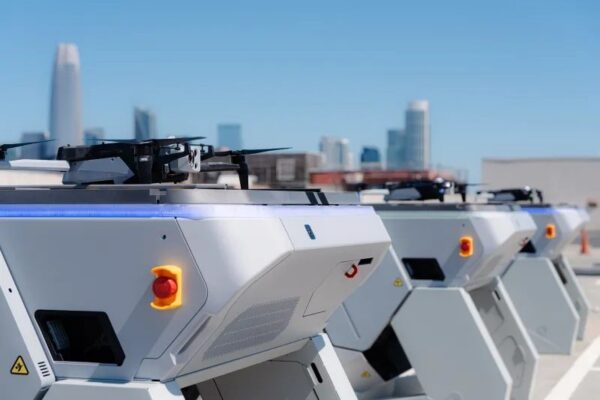
CEO Adam Bry highlights reduced capital needs as company expands production and commits billions to domestic manufacturing
Skydio has raised $110 million in Series F financing, led by existing investors, bringing the company’s valuation to $4.4 billion. In a LinkedIn post from co-founder and CEO Adam Bry, the leader emphasized a notable shift in the company’s financial position.
“The most significant fact in our Series F is how little we are raising,” Bry wrote. “Despite investor demand to put substantially more into the company… our capital needs are rapidly decreasing.”

Strong Core Business Drives Growth
Bry attributed this reduced reliance on outside capital to Skydio’s operational performance. According to the post, the company has reached a point that is uncommon among AI and robotics firms.
“We are in the hard-earned and extremely rare position… of having a strong core business generating hundreds of millions in annual revenue, with strong unit economics and hypergrowth, that is funding more and more of our ongoing operations and future bets,” he said.
Skydio, based in California, develops autonomous drone systems powered by AI. Its platforms are widely used in public safety, defense, and infrastructure inspection. The company has focused on building drones with advanced onboard computing and autonomy, reducing the need for manual piloting and enabling operations in complex environments.
This approach has helped position Skydio as a key supplier to U.S. government and enterprise customers, particularly as demand grows for domestically produced alternatives to foreign-made systems.
Scaling Production Across Key Markets
The new funding will support continued expansion across multiple sectors. Bry noted that the company is seeing strong demand from public safety agencies, defense organizations, and infrastructure operators.
“This additional capital gives us the room to move even faster to scale production to meet demand across public safety, defense, critical infrastructure, and site security customers,” he said.
He added that the company is focused on delivering “end-to-end category-defining products” tailored to each of these markets.
Recent product development has centered on fully autonomous drone operations, including systems designed for persistent monitoring and rapid deployment. These capabilities align with broader industry trends toward Drone as First Responder (DFR) programs and automated inspection workflows.
$3.5 Billion Commitment to U.S. Manufacturing
The Series F announcement came in the same week as a separate commitment from Skydio to invest $3.5 billion in U.S. drone manufacturing. According to a recent company statement, the initiative aims to expand domestic production capacity and strengthen the American industrial base for uncrewed systems.
The investment is expected to support new manufacturing facilities, supply chain development, and workforce expansion. It also reflects increasing policy and market pressure to localize drone production, particularly for government and critical infrastructure applications.
Skydio has positioned itself as a U.S.-based alternative in a market long dominated by foreign manufacturers. Its products are compliant with federal procurement requirements, including NDAA restrictions, making them eligible for use by government agencies.
Long-Term Vision for Autonomous Infrastructure
Bry’s post also outlined a broader vision for the role of drones in modern infrastructure.
“We are all in on building the flying robot infrastructure our civilization needs, and building world-leading drone manufacturing in the U.S. while we’re at it,” he wrote.
This concept of “flying robot infrastructure” reflects a shift in how drones are being deployed. Rather than standalone tools, they are increasingly integrated into larger systems that support public safety, security, and industrial operations.
As Skydio continues to scale both its technology and manufacturing footprint, the company’s strategy highlights two key trends shaping the drone industry: the move toward autonomy at scale, and the growing importance of domestic production.
The relatively modest size of the Series F round, combined with strong revenue growth, suggests that Skydio may be entering a new phase. In this phase, operational performance plays a larger role in funding expansion than venture capital alone.
Read more:

Miriam McNabb is the Editor-in-Chief of DRONELIFE and CEO of JobForDrones, a professional drone services marketplace, and a fascinated observer of the emerging drone industry and the regulatory environment for drones. Miriam has penned over 3,000 articles focused on the commercial drone space and is an international speaker and recognized figure in the industry. Miriam has a degree from the University of Chicago and over 20 years of experience in high tech sales and marketing for new technologies.
For drone industry consulting or writing, Email Miriam.
TWITTER:@spaldingbarker
Subscribe to DroneLife here.

