


When clinical scientist Grace Hallinan relocated from Ireland to the United States in 2018 for a postdoctoral position, she immediately felt that something was missing.
“I moved to the US, and the apartment was just lonely and sad,” recounts Hallinan, who worked at Indiana University in Indianapolis. She had always been surrounded by pets, and had left her family dog back in Dublin. “Within a week of living there, I went to the shelter and got a cat, Franklin, and it was the best thing ever.”
She went on to adopt two more cats — a tabby named Rosie and a Russian blue called Vicenzo — to keep Franklin (a Siamese cat with lynx point patterning) company. But they were her companions just as much as they were Franklin’s, especially during the COVID-19 pandemic. “During COVID, it was so good for my mental health,” she says. “Otherwise, it would have just been me rattling around in an apartment, talking to myself, instead of having my little buddies with me.”
She’s not alone. Some research suggests that dogs and other pets can improve their owners’ well-being and reduce anxiety1. This can be especially helpful for people with stressful academic careers. But pets, too, have psychological, physical and emotional needs that have to be fulfilled. Combining the many commitments that come with working in academia — such as teaching, attending conferences and conducting research — with caring for a pet can be a tricky balancing act. For Hallinan and many others, it’s well worth it.
“It’s just this furry bundle of joy that lives in your house,” Hallinan says.
The pawsitives of pets
Like Hallinan, Danielle Ulrich also grew up alongside pets and knew that she wanted a dog as soon as she could meet its needs. She and her then-boyfriend adopted Opie, a border collie cross, when she was a graduate student at Oregon State University in Corvallis. It seemed like the right time, with the right support and a schedule that would make owning a dog feasible, she says.

Plant physiologist Danielle Ulrich’s border collie cross Opie has accompanied her throughout her PhD and postgraduate research.Credit: Danielle Ulrich
“There are some set things, like teaching commitments, or classes, that kept us on campus, but oftentimes, it was easy to work from home and make sure that we could support Opie as much as possible,” says Ulrich, who is now a plant physiologist at Montana State University in Bozeman.
Opie’s companionship has been crucial throughout her career. He has accompanied her through her PhD, her postdoctoral work and now her professorship.
“Having a long-lasting, consistent support system is especially helpful in an academic track that can be challenging and uncertain,” she adds. “It’s nice to have that certainty of this creature who just supports you, and brings you joy, and vice versa, no matter what.” He consistently gives her warm greetings at the door, complete with lots of tail-wagging and sniffing. “His affection is directly linked to how close it is to mealtime and walk time rather than my highs or lows of the day,” says Ulrich. “That consistency is lovely.”
Dogs might have evolved to read your emotions
Jordan Hill, a research scientist at Indiana University in Bloomington, also has a dog who has been with her through thick and thin during her academic career. She adopted Rue, an almost 12-year-old greyhound lurcher, when she was a graduate student. Her work was not laboratory-based, so she could spend her days working from home. Rue was an uplifting presence when Hill was drafting her graduate dissertation.
“I would be writing on my couch, and she would just have her little head next to me, and it was just really comforting,” she says. “Your grad-student dissertation team is pretty much a team of one,” Hill says. “It can feel lonely sometimes, so it’s nice to have a little friend along the way.”
Rue also helped Hill to maintain a good work–life balance. By looking after her dog, she says, she looks after herself better. “You have this other little thing to care for,” she notes. “It forces you to get outside three times a day,” which she says has been good for her health.
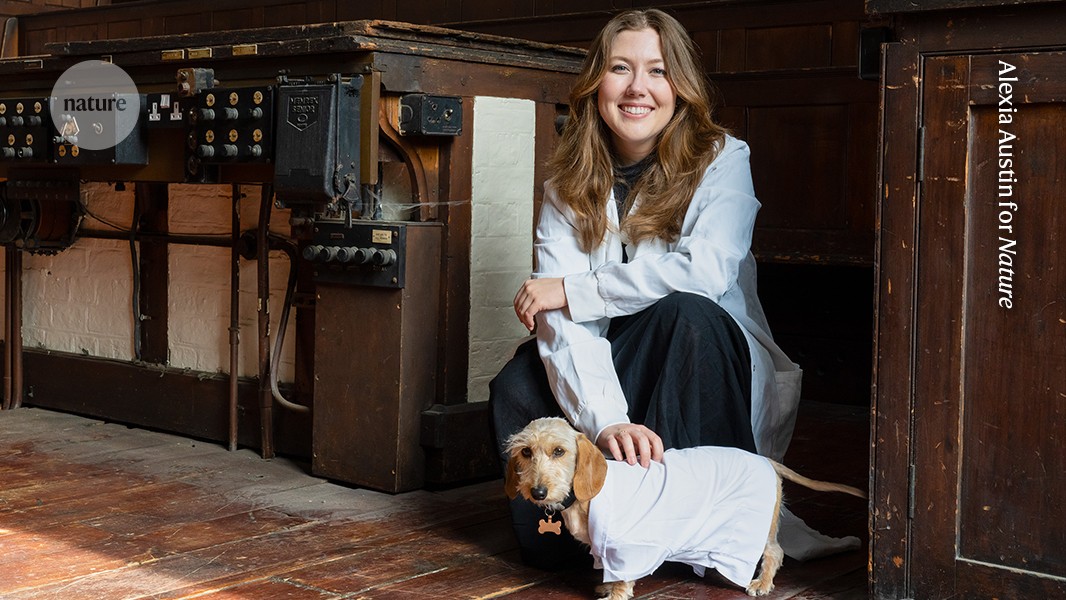
María López Cavestany also says that caring for her dog — a five-year-old miniature dachshund named Kika — has made her more responsible and better at balancing her commitments. “I find it super helpful knowing that Kika’s waiting for me at home and that I need to be home at a certain time,” she says. Cavestany is currently a researcher at the University of Cambridge, UK, but she got Kika during her PhD in biomedical engineering at Vanderbilt University in Nashville, Tennessee.

María López Cavestany brought her dog Kika with her from the United States when she moved to the University of Cambridge, UK.Credit: Alexia Austin/Nature
In an academic career, “it’s so easy to get into a routine where you’re staying really late and trying to push through”, she explains. But knowing that Kika needed time outside pushed Cavestany to get more organized, which she found “really, really helpful”, especially during the stressful parts of her PhD.
Even though she has had kids since getting Franklin, Hallinan still likes to say that he is her firstborn and will always be her baby. Ulrich, too, now has a child, and found that looking after Opie was a good stepping stone to parenthood. “A dog is a little more independent than a child,” she says.
But, of course, caring for a child is a completely different ball game to looking after a dog. Hill says that having a kid is an order of magnitude harder, and balancing both is one of the many potential challenges of pet ownership.
Not a purrfect match
Pets are not always compatible with a career in academia. Between unpredictable late nights at the lab, travelling to conferences and relocating internationally for new positions, owning a pet requires coordination, patience and flexibility (see ‘So you want to adopt a pet?’).

