


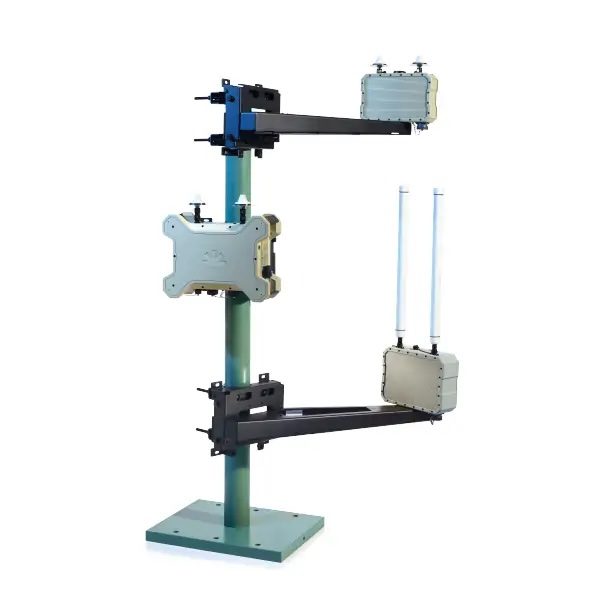
Sentrycs systems to protect skies in U.S., Mexico, Canada
By DRONELIFE Features Editor Jim Magill
(Editor’s note: This is part of a series of stories on efforts to establish new counter-UAS protocols in the U.S. to protect high-profile sporting events and critical infrastructure from the potential threats posed by drones flown by careless or hostile actors.)
North American cities hosting FIFA World Cup matches and events surrounding America’s 250th birthday, are actively working to find companies that provide effective counter-UAS technology. Many cities are seeking to pursue a multi-level approach – combining detect-and-identify technology with drone-mitigation solutions — to deal with all the problems associated with unwanted UAS incursions.
One technology company, Sentrycs, is offering an inexpensive counter-UAS system that includes both aspects of counter-UAS technology; it can spot and identify approaching drones and take over their radio signals to bring them safely to earth.
Sentrycs, a subsidiary of Florida-based Ondas Inc. recently announced it had secured multiple contracts, valued at several million dollars, to support airspace security operations during the 2026 FIFA World Cup, in a number of the 16 cities across the U.S., Canada and Mexico where matches will be held this summer.
Although the company declined to reveal which cities it had contracted with, in an interview, U.S. Sentrycs Lead Jason Moore, told DroneLife that Sentrycs has contracts with about 70% of the U.S. states that are set to host FIFA events this year. In addition, the company also will be deploying its counter-UAS systems in cities in Canada and Mexico, the other two North American nations co-hosting the big soccer tournament.
“We have hundreds of customers around the world in different countries, so our experience of working in airports and stadiums and police forces and on the front lines in some conflict zones, borders and prisons … gives us the ability to make sure that we’re doing everything in our power to support the U.S. and Canada and Mexico,” he said.
Working through multiple contracts with federal, state and local public safety agencies and security organizations, Sentrycs will deploy its field-proven Cyber-over-RF (CoRF) technology. Its systems offer passive detection, tracking and identification of unauthorized drones, as well as the capability for controlled UAS mitigation.
Moore said Sentrycs is one of a handful of counter-UAS companies that stand to benefit from federal grant moneys, including a $250 million FEMA grant allocated to U.S. cities hosting World Cup matches, and to the Washington D.C.-based region, which will be the center of America250 celebrations.
Systems handle all aspects of counter-UAS
Counter-UAS operations are typically divided into four components: detection, tracking, identification and mitigation. Moore said the company’s CoRF systems perform all four aspect of that paradigm and are effective in countering the operations of most drones available on the market today.
Faced with growing challenges of unwanted drones intruding on their airspace, some private sports and entertainment organizations such as the NFL have invested in drone-detection and -identification technologies. But no private entity has been allowed to operate drone-mitigation equipment, which until very recently has been the sole responsibility of a handful of federal law enforcement agencies.
That situation changed somewhat last December with the passage of the Safer Skies Act, which gave limited authorities to state, local, tribal and territorial law enforcement agencies to conduct drone mitigations, provided their officers attended an FBI training course in Huntsville Alabama.
Yet, even before the adoption of the Safer Skies Act, the type of counter-UAS technology available to private venues such as NFL stadiums was of limited value in dealing with the entire threat matrix posed by unwanted drone incursions, Moore said.
“The challenge with it has been the effectiveness. How far out can you see? How much information can you gather and how quickly, in order to make decisions to ensure public safety and to disrupt threats?” he asked.
“Our solution is very different,” he said. For example, the company offers a compact portable system that can easily be transported in a single polypropylene-shell Pelican case. “A single person within five minutes can set up our system and have it operational and being able to detect drones as far out as 10 kilometers (6 miles) or more away from the location within seconds.”
The CoRF system enables the operator to look at the communication between the pilot and drone “at the bits and bytes level,” Moore said. “There’s no way to spoof that, manipulate it, or distort that information, because if you did, the drone wouldn’t fly properly.”
This communication link also gives the CoRF system operator a greater ability to identify the drone to a greater degree that is possible with other systems, such as those based on radar or conventional RF signal detection.
“We can identify drones down to the serial number of the drone, the operator of the drone’s location, the home location, even where the camera on the drone again is pointing, within seconds without any false positives,” he said.
The Sentrycs’s systems ability to communicate with the drone in the UAV’s own language also gives the CoRF operator the ability to take control of the drone’s operation, without the need of signal jamming or more kinetic mitigation methods, such as nets or projectiles.
“We can actually communicate with the drone and say, ‘Hey, disconnect from your original operator or controller and pair with me, the Sentrycs system,’” he said.
Once the drone’s connection to its original pilot is severed, the CoRF’s system’s operator, a law enforcement officer with the proper training and authorization, can allow it to fly back to its home point base, or he can take command of the rouge drone and safe land it at a safe location.
Alternately, the Sentrycs system can be used to track the drone’s outgoing signals to zero in on the location of the pilot, Moore said.
“Because our system will tell you everything you need to know about where the operator is — they’ll send the police unit to the operator’s location within a minute. If the operator moves, every few seconds the system will refresh where the operator is,” he said. “That’s a very effective way of mitigation.”
Effective against almost all drones
Because the system relies on reading a drone’s RF signals, it is effective against most UAVs, which rely on such signals for navigation. Moore said it can even be effective against most fully autonomous drones that operate on preprogrammed flight instructions rather than being controlled by a human pilot.
“What we’ve seen in practice, very few drones are set to purely be dark drones. They always have a fallback channel, a kill switch. And if there’s a kill switch there, then we absolutely have the ability to intervene,” he said.
Another advantage of Sentrycs’ technology is its affordability, Moore said.
“The technology is evolving and we are evolving with it. We are about to release a system that will price out at around $65,000 for a handheld solution that’s coming to the market,” he said.
The company’s long-range systems are priced in the range from $250,000 to around $400,000, which makes them very affordable compared with competitors’ counter-UAS systems, which can range in a price of anywhere from $200,000 to $2 million, he said.
Read more:
 Jim Magill is a Houston-based writer with almost a quarter-century of experience covering technical and economic developments in the oil and gas industry. After retiring in December 2019 as a senior editor with S&P Global Platts, Jim began writing about emerging technologies, such as artificial intelligence, robots and drones, and the ways in which they’re contributing to our society. In addition to DroneLife, Jim is a contributor to Forbes.com and his work has appeared in the Houston Chronicle, U.S. News & World Report, and Unmanned Systems, a publication of the Association for Unmanned Vehicle Systems International.

