


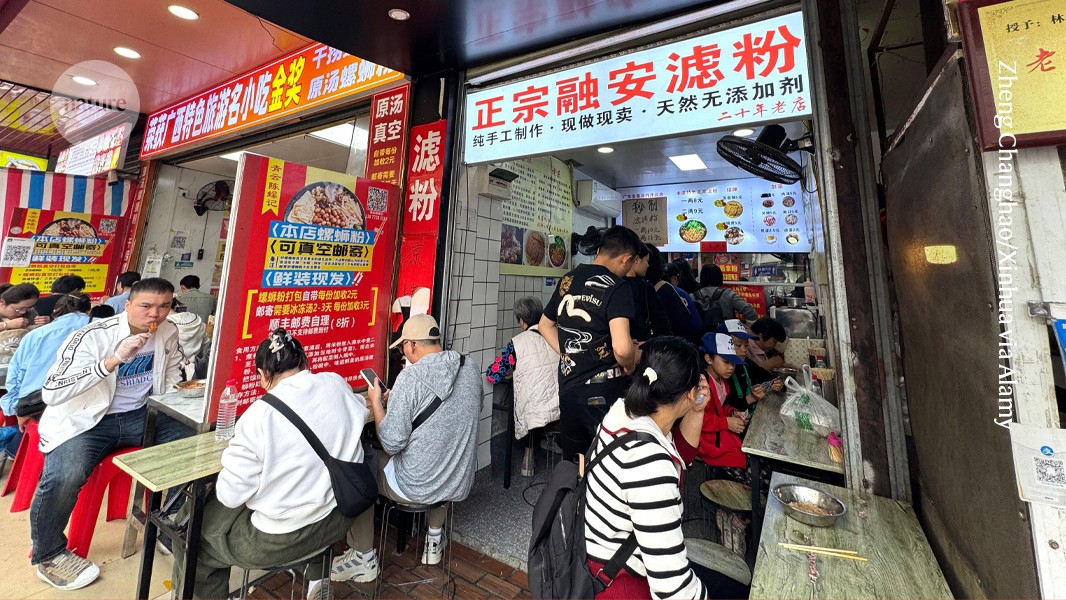

The locations of Chinese noodle shops were assessed in one essay published in a ‘bottom’ journal.Credit: Zheng Changhao/Xinhua via Alamy
The image of a failed laboratory experiment posted on Chinese social media in February has sparked an academic trend in the country: junior researchers setting up and contributing to satirical journals. The photograph, posted by a biology master’s student on the networking and e-commerce site RedNote, showed the result of a blunder in a western blot (WB), an experiment used to detect and identify proteins.
The test went so wrong that instead of showing the standard few horizontal dashes, the image resembled a panda’s face: round blobs on blobs.
“A person left a comment under the photo, jokingly suggesting that the student should publish his result in Rubbish,” says Li, a first-year master’s student in biomedical engineering in Beijing who saw the photo online in early February and asked to be known only by his surname to protect his identity.
Rubbish is a concept familiar to postgraduate students and junior researchers in China. It refers to an imaginary journal that publishes research deemed to be a failure or useless by mainstream academic criteria.
“I thought, why don’t I start a Rubbish journal in real life,” says Li,. Hours after seeing the post, he set up Rubbish on RedNote.
The satirical journal would “welcome a wide range of submissions, which can be about unexplainable experiment results, anecdotes that happened during your research or gossip within your research group”, read Rubbish’s inaugural post on 12 February.
Submissions could take the form of photos or a few paragraphs about any academic topic, the post said. Once deemed rubbish, these would be published for free. The journal’s impact factor “is expected to be zero”, the post added. In terms of the impact Rubbish would have on researchers, Li was about to be proved wrong.
Going viral
Li says he set up Rubbish just for fun, but the account went viral immediately, attracting nearly 10,000 followers in 24 hours. The next day, he wrote Rubbish’s first article — ‘The result of my WB looks like a panda’ — and published it on RedNote, after securing permission to use the photo.
A few hours later, the article was read by Chan Tung, a first-year PhD student of biomedical engineering based in Wuhan, China. Chan was writing his first essay and felt frustrated by the changes he had been asked to make.
China’s research clout leads to growth in homegrown science publishing
“I liked the article so much that I decided to start a sub-journal called Rubbish Communications,” Chan says. “I am familiar with Nature Communications, so I wanted to start a journal that sounded like it.”
Rubbish Communications was one among many that popped up on China’s social media after Rubbish spearheaded the trend. Some of them satirically reference established journals, with names such as Call, Notrue and Silence.
Others ridicule disciplines through a play on words, such as S.H.*.T. (standing for science, humanities, information and technology) and SHITORY, which focuses on history. Social-media users refer to such publications as bottom journals, in contrast to the ‘top journals’ that academics should strive to be associated with.
More than 200 bottom journals have been established since February, according to Web of Absurd, a website that lists them and assigns them impact factors.
At the height of the trend, dozens of submissions poured into Rubbish’s inbox every day. Rubbish needed more editorial staff. A group of students started to work alongside Li as reviewers and editors to publish readers’ essays as quickly as possible. Although the journal titles often pun on real English-language publications, the papers in Rubbish and other Web of Absurd-indexed journals tend to be available in both Chinese and English.
In Li’s view, the popularity of Rubbish reflects the intense competition in Chinese academia.
“Supervisors face immense pressure to publish papers in top journals and to secure funding, and they pass that pressure to their students and subordinates,” Li says. Postgraduate students and entry-level researchers need a way to release tension and mock this deeply competitive, publish-or-perish culture, he adds.
‘Ridiculous’ essays
The essays published by bottom journals often use academic methods to address light-hearted topics. One, for example, assesses the locations of 198 rice-noodle shops in the Chinese city of Liuzhou with a geographical information system. It gives a detailed analysis of which area has the most rice-noodle shops and which of those should be considered authentic.
Another investigates the psychological motivation of two types of supervisor: those who like to say “last slide” when their students make presentations in front of them and those who like to say “next slide”.

From Togo to China: growing abroad as a PhD student
One reason these essays have become so popular is exactly because “they are ridiculous”, says the founder of SHITORY, Shi, a history master’s student who requested anonymity.
“Often, people automatically think that anything academic is serious and watertight, so when you read a ridiculous topic in the form of an academic essay, you will feel a strong contrast,” Shi adds.
The frustration embodied by bottom journals partly stems from the fact that students must face repeated rejections from established journals, says Li Jizhen, a researcher of industrial policy at Tsinghua University in Beijing.

