


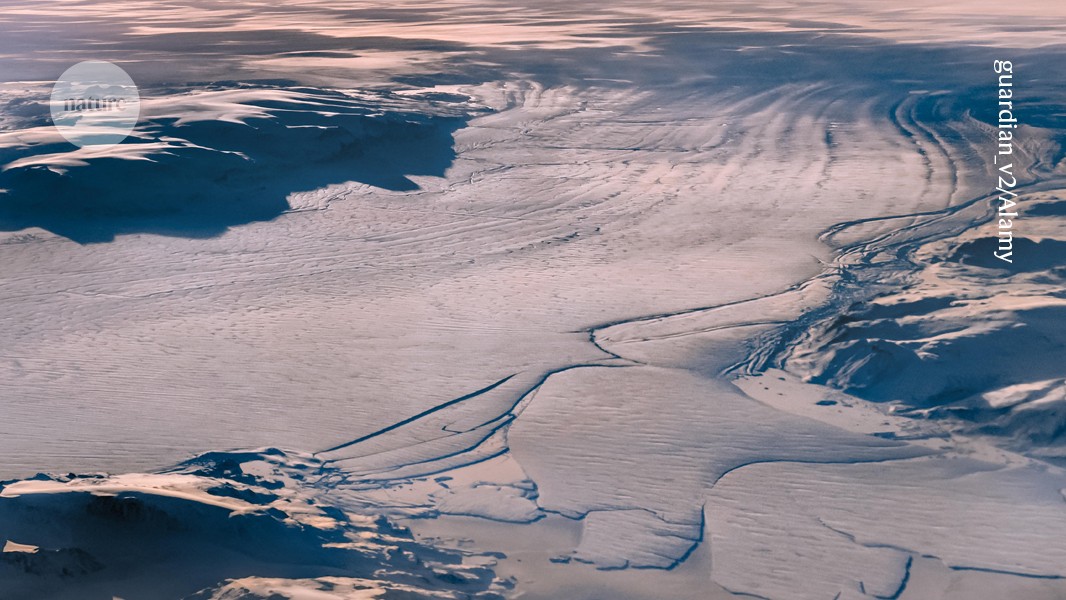

The Nioghalvfjerdsfjorden glacier picked up stones in Greenland that later turned up at the bottom of the sea as new housing for marine creatures.Credit: guardian_v2/Alamy
In an extraordinary climate-change twist, marine creatures are gaining new homes on the Arctic sea floor, thanks to glaciers breaking up hundreds of kilometres away.
Hello puffins, goodbye belugas: changing Arctic fjord hints at our climate future
The number of stones at the bottom of an Arctic strait has been growing, providing habitat for corals, sponges and other animals, according to a paper published today in Nature1. Scientific sleuthing has detailed how the rocks got there: they were swept up by glaciers in Greenland and Russia and carried to the coast. There, the glaciers spit out icebergs that drifted south, melted and dropped their load of rocks. These ‘dropstones’ sank to provide deepwater oases of biodiversity. Climate change played a part by accelerating the pace of the glaciers’ flow and the icebergs’ melting, the paper says.
“Climate change impacts our world in ways we never even thought of,” says co-author Kirstin Meyer-Kaiser, a marine biologist at the Woods Hole Oceanographic Institution in Massachusetts.
The work “is a ‘wow’ example for how incredibly connected different parts of our planet are”, says Bodil Bluhm, a marine biologist at UiT The Arctic University of Norway in Tromsø, who was not involved with the research.
Rubbishy glaciers
Dropstones occur in many polar regions2 but are understudied because they are hard to find and collect. In 2021, Meyer-Kaiser’s team got a rare opportunity when they were in the Fram Strait, between Greenland and the Arctic archipelago of Svalbard, aboard the German research icebreaker RV Polarstern. Helicopter pilots who had been reconnoitering the sea ice around the ship told scientists onboard that they had found a new ‘island’.
It turned out to be an icy hill of black stones emerging from the sea ice — an enormous iceberg, laden with debris from when it had been part of a glacier grinding across Arctic rocks. The scientists took ice and rock samples from the iceberg and began to wonder what would happen to it.

Melting icebergs dropped these stones onto the seabed off Greenland.Credit: T. Krumpen et al./Nature (CC-BY-4.0)
Serendipitously, the Polarstern was working near a site where researchers had been photographing the ocean bottom for years. Those images showed an increase in dropstones at the site between 2015 and 2017. The scientists found another clue in the Polarstern’s logbooks, which revealed that icebergs had become more common in the Fram Strait starting around 2000.

