


You have full access to this article via your institution.
Source research: Schmuck, A. et al. Analysis of trade-offs of post-sorting plastic packaging. Nature https://doi.org/10.1038/s41586-026-10606-4 (2026).
Messages for policy
• Prioritize improving separate collection systems for recyclable plastic, because most recyclable plastics are currently lost before reaching the sorting or recycling stages.
• Use post-sorting (the recovery of recyclable plastic from mixed waste) to complement, not to replace, pre-sorting by households and businesses, to maximize recovery, especially in regions where participation is low and/or where mixed, unsorted waste is common.
• Prevent non-packaging waste from entering packaging-recycling streams, to reduce contamination risks from hazardous substances and batteries.
• Require advanced purification and strict quality standards for plastics sourced and recycled from post-sorted bales, to ensure that the quality of recycled plastic is equivalent to that from pre-sorting streams, especially for use in food packaging.
The policy problem
The amount of plastic packaging waste is rising quickly, but recycling systems are not keeping pace. As a result, most of this waste is still incinerated, placed in landfill or released into the environment. Plastic production therefore continues to depend mainly on virgin fossil-based inputs1, instead of recycled materials.
Governments worldwide are setting targets to increase recycling and use more recycled plastic, with source separation — in which recyclable materials are separated from other materials by households or businesses — being the main approach to the collection and sorting of plastic waste in much of Europe2 and the United States3. However, large amounts of recyclable plastics are still thrown away in mixed household waste, owing to mis-sorting and non-participation, making it hard to hit these government targets4.
A key question is whether post-collection recovery of plastics from mixed household waste can meaningfully expand the amount of material available for recycling. Policymakers therefore need clear evidence on whether such ‘post-sorting’ can complement existing systems without reducing the quality and safety of recycled plastics5.
The findings
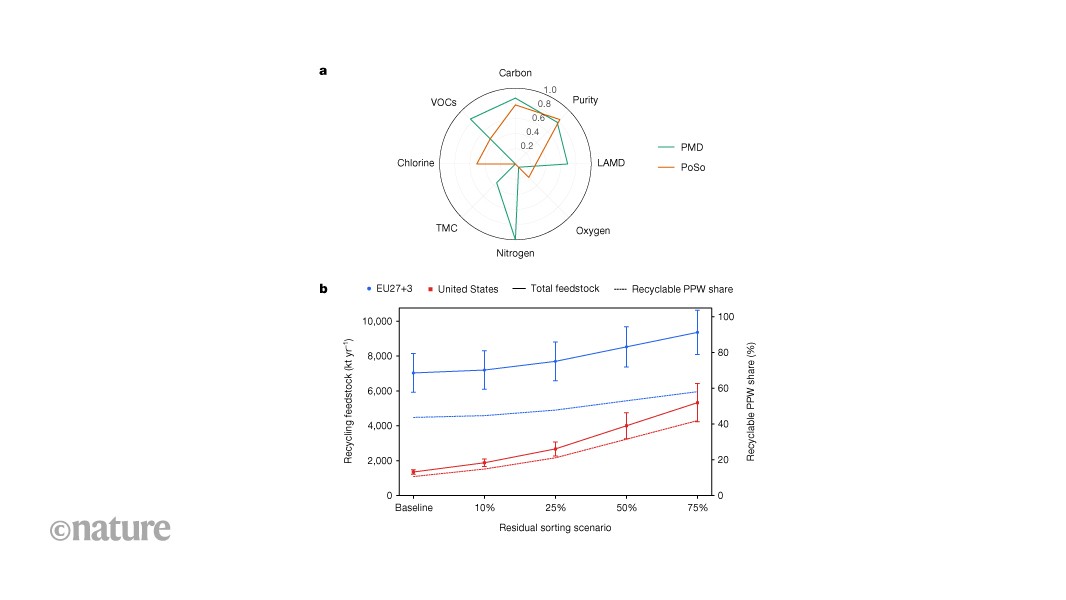
Our results reveal a trade-off between increasing recycling volumes and the quality of material separated for recycling. Although advanced sorting technologies can recover plastic packaging from mixed household waste with efficiencies similar to those of source-separated systems, the resulting bales of materials to be recycled are of lower quality than are bales of pre-sorted materials. Plastics from mixed waste are typically more contaminated — dirtier, wetter and with more odour — and are more likely to include non-packaging items, leading to higher levels of hazardous substances (Fig. 1a). Thus, although the complementary recovery of plastic from mixed waste could increase recycling volumes in regions with differing levels of pre-sorting in Europe and the United States (Fig. 1b), further sorting, cleaning and quality control are needed to ensure safe reuse.

Figure 1 | Trade-offs between quality and quantity in plastic recycling. a, The quality of flexible plastic packaging from ‘source-separated’ waste sorted at the point of generation (PMD) and from materials separated from mixed waste after collection (post-sorted; PoSo), assessed across eight indicators (higher values indicate better quality). LAMD, level of attached moisture and dirt; TMC, total metal content; VOCs, volatile organic compounds. b, Estimated plastic packaging waste (PPW, in kilotonnes per year; kt yr–1) available for recycling in the EU27+3 countries (the 27 member states of the European Union plus Norway, Switzerland and the United Kingdom) and the United States when different percentages of mixed waste are directed to post-sorting to recover plastics (and other recyclables) in addition to current pre-sorting streams. Solid lines show total recovered volumes (left axis); dashed lines indicate the share of collected and sorted material as a percentage of total PPW (right axis). Error bars show variability across estimates.Credit: Schmuck, A. et al./Nature (CC BY-NC-ND 4.0).
We predict that the benefits of post-sorting would be greatest in regions with large streams of residual (non-separated) waste or low participation in household sorting. Our findings are based on a limited regional data set and should be confirmed using other facilities, other scenarios of improved source separation and future developments of waste-sorting technologies.
The study
We examined bales of material for plastic recycling prepared in a Dutch recycling facility that processes both separately collected and mixed household waste using the same sorting equipment at dedicated operating schedules. This enabled the collection methods to be compared directly while keeping the sorting process constant. We assessed the quality of bale materials by measuring composition, contamination, moisture, odours and the presence of metals and other unwanted substances for four types of common packaging plastic. We used washing tests to distinguish between surface contamination and substances embedded in the sorted plastic material.
To evaluate the broader implications of our findings, we combined the measurements with a model of material flow to estimate how much extra plastic could be recovered through post-sorting in Europe and the United States. This links the observed material quality with potential increases in recycling volumes across different waste systems.
Funding statement We acknowledge the support of Attero (the Netherlands). The original research was funded by grants from the European Union’s Horizon Europe research and innovation programme; the EU’s Horizon 2020 research and innovation programme under a Marie Skłodowska-Curie grant; the European Research Council under the Horizon 2020 programme; Catalisti; the Ghent University academic chair on Dissolution Recycling of Plastic Waste; Provincie Zeeland (the Netherlands) and PSLoop; and the Fund for Scientific Research Flanders (FWO).
Figure 1 is published under a CC BY-NC-ND 4.0 licence.
Competing Interests
The authors declare no competing interests.

