


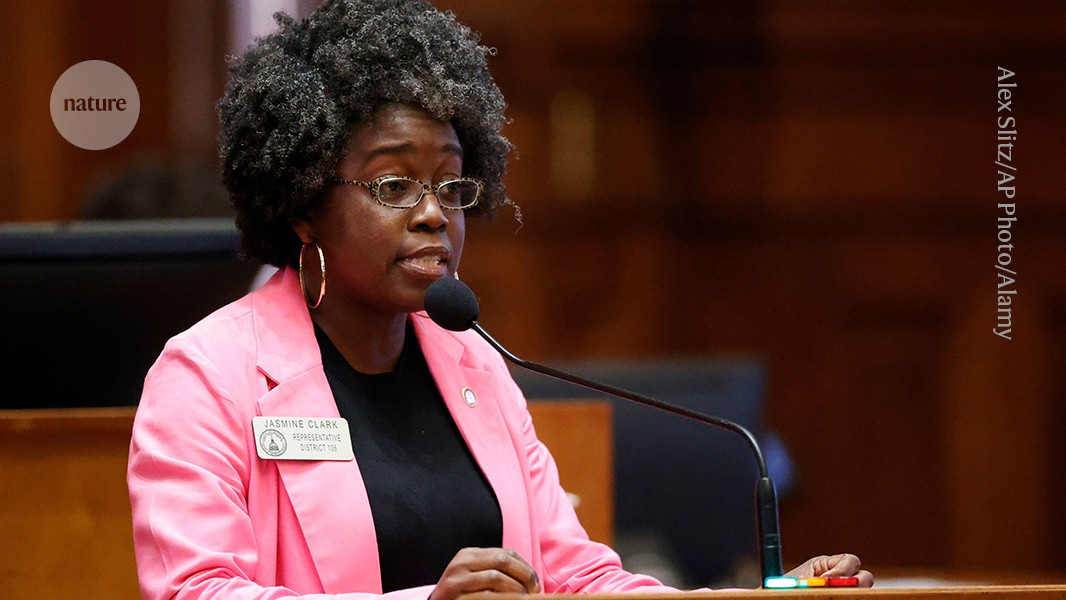

Microbiologist Jasmine Clark is running to become a Democratic representative of Georgia’s 13th district.Credit: Alex Slitz/AP Photo/Alamy
An unprecedented number of US scientists are trading in their lab coats to run for office in the US mid-term elections in November. Many running as Democrats are motivated by the actions of President Donald Trump and his Republican allies to delay and terminate research funding and redefine the goals of government-funded science. Different issues tend to galvanize the scientists running as Republicans, including the artificial-intelligence driven demand for more energy — along with a desire to play a part in science-backed solutions.
The organization 314 Action, which recruits and backs Democratic scientists, engineers and health-care specialists to run for office, has received more than 700 applications from potential candidates seeking support during this election cycle — nearly triple its usual volume (see ‘Political push’). The organization funds candidates to win seats in their state and federal legislatures, with the aim of building “pro-science power at the ballot box”.

Source: 314 Action
For decades, the prevailing wisdom among researchers was that science should be separate from politics. The current political reshaping of US science should drive scientists to realize that this idea “is really a failed business model”, says Shaughnessy Naughton, president of 314 Action, which is based in Washington DC and named after the first three digits of π.
“We scientists are used to sticking to our knitting,” says Sam Wang, a neuroscientist at Princeton University in New Jersey who is running to become a Democratic member of the US House of Representatives for the state’s 12th district. “But I began realizing that science needed defending.”
Running motivations
Wang is one of the candidates who decided to run because of the Trump administration’s actions. He watched last year as his colleagues’ research grants were abruptly cancelled or delayed, and as trainees, such as postdoctoral fellows, had to be let go because of a lack of funding.

‘Shattered’: US scientists speak out about how Trump policies disrupted their careers
He likens the frantic process of establishing a political campaign to setting up a research laboratory — only ten times faster. And he’s hoping to bring some of his knowledge from the lab into politics, by applying the scientific method to what he calls a broken system. In 2024, he used statistics to argue before a federal court that the design of some of New Jersey’s election ballots was giving an unfair advantage to certain candidates. (The federal judge later struck down the design.) If he wins during the mid-terms, Wang says, he’ll continue using evidence and data to fight for fairness.
Jasmine Clark, a microbiologist at Emory University in Atlanta, Georgia, already serves on her state’s legislature, but the reshaping of US science over the past year has motivated her to run for an even higher political office in 2026. She is now campaigning to become a Democratic congressional representative for Georgia’s 13th district.
During the year after Trump took office, some 10,000 PhD-level scientists left the US government as, in an effort to downsize the federal workforce, the administration fired them or encouraged them to retire early. One US agency that lost many scientists was the Centers for Disease Control and Prevention (CDC), headquartered in Clark’s home state of Georgia. Health secretary Robert F. Kennedy Jr, who has called the agency corrupt, drove much of that exodus while also taking actions that many scientists oppose, such as changing vaccine recommendations without consulting specialists.
In response, Clark wants to bring data and science to the policymaking table. “We need people who actually care about the truth sitting in these seats.”
A science wave?
The number of people with a scientific background running for office has historically been very low, says Kristoffer Shields, a political scientist at Rutgers University in New Brunswick, New Jersey.

Trump’s new science advisers include 12 technology chiefs — and one academic
His team found in 2025 that only about 3% of the seats in state legislatures across the country are filled by people with training in science, engineering or health care. But with issues such as climate change, artificial intelligence and public health dominating legislative agendas, Shields expects this number to grow.
One hot-button topic for which scientific expertise is useful is energy, says Jeff Wilson, a retired nuclear engineer and US Navy veteran who is running to become a Republican representative of Illinois’s 13th district. Wilson wants to ensure that the United States becomes energy-independent. If elected, he says, he will help to build more nuclear power plants in the state. His district “needs someone that’s articulate, scientific-minded, practical-minded”, and “that can provide common-sense solutions, particularly with energy”, he adds.

