


You have full access to this article via your institution.
Hello Nature readers, would you like to get this Briefing in your inbox free every day? Sign up here.

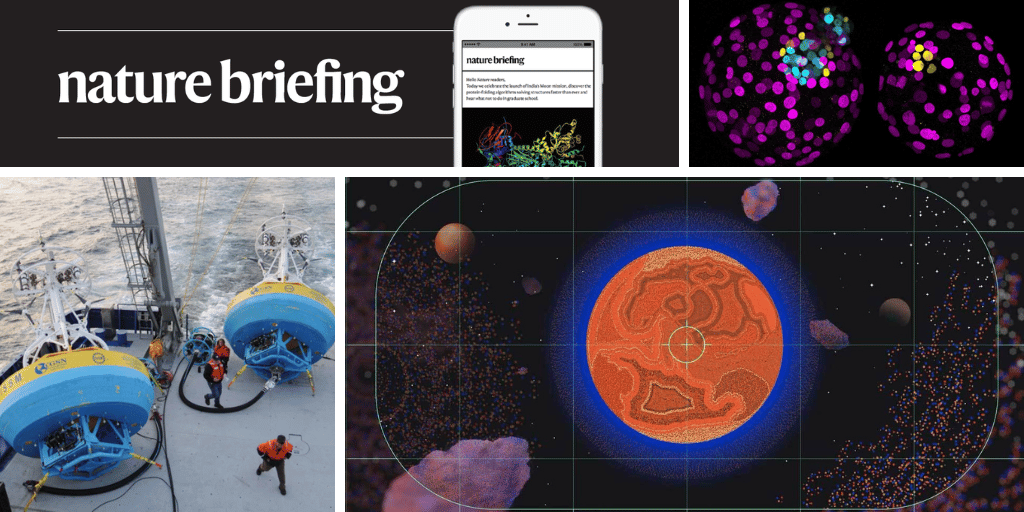
A human embryo ‘base edited’ so that it can’t produce a key protein (right), fails to form the mass of cells that gives rise to tissues and organs. A non-edited embryo (left) shows the cells (cyan). Credit: Katarina Harasimov, Oliver Bower and Kathy Niakan, Loke Centre for Trophoblast Research, Univ. Cambridge
For the second time this month, researchers have used base editing — a precise gene-editing technique — to alter the DNA of human embryos. The team found that a key protein called NANOG plays a part in embryo development that had not been seen in mouse studies. The finding highlights the need to study human embryos rather than relying on animal models, says developmental biologist Janet Rossant. But it has also renewed the urgency of ethical discussion over how base editing of embryos should be used.
The United States has historically led other nations in peppering the ocean with monitoring instruments and supporting cutting-edge oceanography research. Now cuts and threats of cuts have researchers worried it is no longer a reliable partner. The US National Science Foundation (NSF) has pulled back from a plan to dismantle an array of hundreds of marine instruments known as the Ocean Observatories Initiative. But another programme facing immediate crisis is a network of robotic floats dedicated to marine biogeochemistry, funded by the NSF and part of a global flotilla called Argo.
After the ovaries ramp down their reproductive role, releasing eggs and sex hormones, they might become more important to the immune system. Evidence from people and mice suggest that genes and proteins associated with immune activity are more active and prevalent in postreproductive ovaries — though it’s unclear whether it’s a beneficial change. “We really owe it to women’s health to study this period of time,” says reproductive biologist and study co-author Francesca Duncan.
Reference: Molecular Human Reproduction paper
Features & opinion

Illustrations by Petra Péterffy
For humans to make the leap to Mars full time, scientists first have to ‘terraform’ the red planet, altering the conditions step-by-step to make its environment habitable. The possibility of doing so is gaining traction among some scientists. Now, you too can try your hand at terraforming with Nature’s game. At each stage of this experimental adventure, you can try out different strategies to give the icy planet a glow up. But choose wisely, not all options lead to humanity’s home away from home.
The Universe is reset one too many times in the latest short story for Nature’s Futures series.
Andrew Robinson’s pick of the top five science books to read this week includes the natural history of dawn and dusk and the ethical complexities of working with lab animals.
Cyberattacks on medical AI systems could allow criminals to steal sensitive patient information from the systems’ underlying data sets. For example, researchers showed that a model, which makes cancer-related predictions from routine blood-test data, could reveal the cancer-diagnosis status of an individual in the training set. And people who are in a minority in the data — for reasons as varied as race, sex, or even how their medical image was taken — are at most risk of these kinds of ‘membership inference attacks’.
Nature Podcast | 20 min listen
Subscribe to the Nature Podcast on Apple Podcasts, Spotify or YouTube Music, or use the RSS feed.
Today Leif Penguinson is exploring the stunning geology of Mount Velebit, in Croatia. Can you find the penguin?
The answer will be in Monday’s e-mail, all thanks to Briefing photo editor and penguin wrangler Tom Houghton.
This newsletter is always evolving — tell us what you think! Please send your feedback to [email protected].
Thanks for reading,
Flora Graham, chief editor, Nature Briefing
With contributions by Jacob Smith
• Nature Briefing: Careers — insights, advice and award-winning journalism to help you optimize your working life
• Nature Briefing: Microbiology — the most abundant living entities on our planet — microorganisms — and the role they play in health, the environment and food systems
• Nature Briefing: Anthropocene — climate change, biodiversity, sustainability and geoengineering
• Nature Briefing: AI & Robotics — 100% written by humans, of course
• Nature Briefing: Cancer — a weekly newsletter written with cancer researchers in mind
• Nature Briefing: Translational Research — covers biotechnology, drug discovery and pharma


