


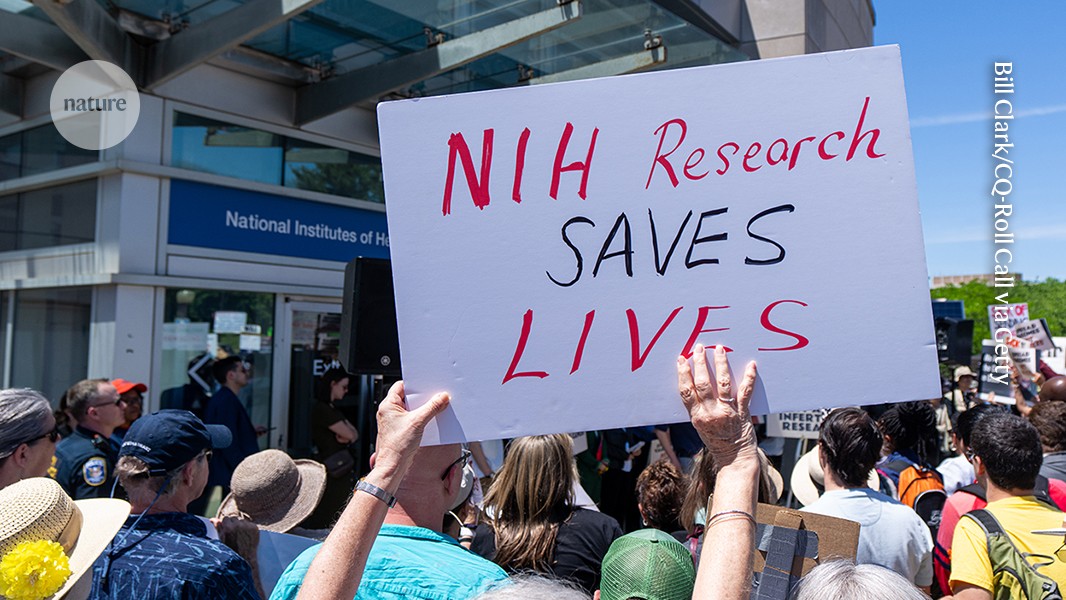

Protestors outside the US National Institutes of Health in Bethesda, Maryland, rallied last May to oppose cuts to staff members and funding made at the agency.Credit: Bill Clark/CQ-Roll Call via Getty
A staffing shortage is making it difficult for the US National Institutes of Health (NIH) to spend its US$47-billion budget by awarding research grants.
It is missing dozens of staff members, called grants management specialists (GMSs), who are crucial to handling the business and administrative aspects of issuing grants. Many GMSs either resigned or were laid off in 2025 by the administration of US President Donald Trump as it sought to downsize the federal workforce. Nearly 20% of the NIH’s employees left last year.
NIH pivots away from agency-directed science
At least one of the NIH’s 27 institutes and centres has lost so many GMSs that it has asked early-career researchers, including postdocs and graduate students, who work in the NIH’s own labs to consider working temporarily as a GMS on a volunteer basis, according to internal documents, meeting notes and e-mails that Nature has obtained. The institute, the National Institute of Mental Health (NIMH), projected in March that it would be able to issue only about 5% of the new awards it gives out in a typical year because of the personnel shortage, the documents reveal.
One senior official at the NIMH laid out the situation at a team meeting in March, according to notes from the gathering that were validated by multiple staff members who spoke to Nature and requested anonymity out of fear of reprisal. In fiscal year 2025, which was marked by grant-review delays and funding freezes, “I thought we were at rock bottom”, the official said. “We are below rock bottom now.”
The NIH, the world’s largest public funder of biomedical research, did not respond to Nature’s queries about the staffing situation and the agency’s ability to spend its budget by 30 September, the end of the fiscal year.
Robert F. Kennedy Jr, head of the US Department of Health and Human Services (HHS), which oversees the NIH, acknowledged a staffing shortage in his agency at a congressional hearing on 21 April. He said that the HHS plans to hire 12,000 new staff members, after about 20,000 people were laid off or resigned in 2025.
Spending struggle
So far this fiscal year, the NIH has awarded less than half the number of new grants it had handed out by this time compared with the average of the previous five years (see ‘Behind pace’). The NIMH has issued only about one-third of the new grants it normally would have. The delays have concerned both scientists who depend on the funding and NIH employees, some of whom worry that the agency will struggle to spend all its funds by the end of the fiscal year, as was the case in 2025. Any of the budget not spent by 30 September will have to be returned to the US Treasury.

Source: Grant Witness
The staffing shortage isn’t the only factor contributing to the grant-awarding slowdown. Others include a record-breaking 43-day government shutdown in 2025, which postponed grant-review sessions; a roughly 40-day delay by the White House in releasing the NIH’s budget once the US Congress had approved the funds and Trump signed off on them; and a review process put in place by the Trump administration that requires NIH employees to complete extra steps to screen grants for topics that the administration disfavours.
But the materials that Nature has obtained reveal that insufficient staffing is the main factor slowing down grant making at several institutes. It has forced NIH employees to prioritize approving and distributing funds for already-existing grants. The NIH is legally obligated to pay out these grants — which are usually awarded money annually for a set period of, say, 4 or 5 years — so there is less time to review and issue brand-new awards.

NIH races to spend its 2025 grant money — but fewer projects win funding
The situation at the NIMH seems particularly acute. In a meeting back in March, institute staff members were told that the “NIMH typically funds between 900 and 1,000 new awards yearly, and at current staffing levels, NIMH will be able to fund 50 for the entire [institute] for the entire fiscal year”, according to notes that Nature obtained. That would potentially mean leaving $500 million dollars unspent, the notes added.
With less than five months remaining in the current fiscal year, the NIMH has exceeded expectations — it has so far awarded about 133 new grants. This is mostly because dozens of volunteers have taken on GMS roles until the end of the fiscal year. The situation has become so dire that even the acting deputy director of the NIMH, who is the second in command for the institute, has been devoting half of her time to grants management, the notes say.
The NIH was under a hiring freeze in 2025, but some new jobs have started being posted. It will, however, take months for any new staff members to be hired and trained — probably too late to help with grant processing during this fiscal year, according to the notes.

