


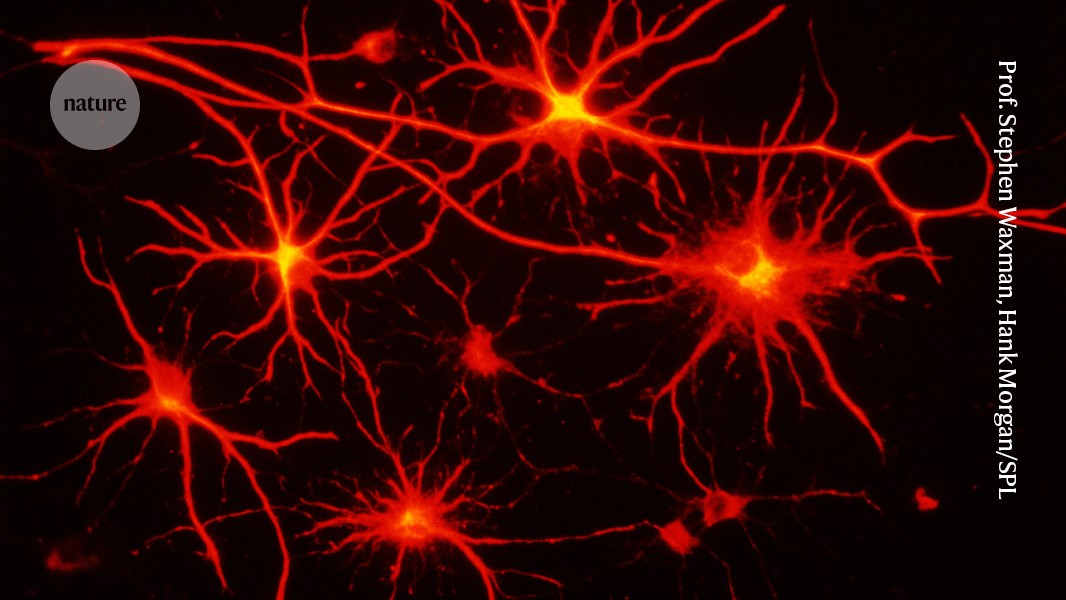
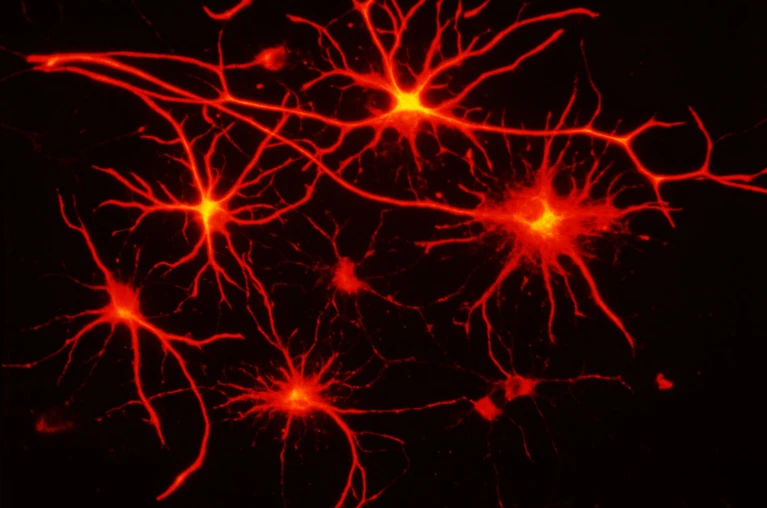
The lesser-known brain cells called astrocytes form their own networks in the brain.Credit: Prof. Stephen Waxman, Hank Morgan/Science Photo Library
Scientists have discovered that the unsung brain cells called astrocytes form extensive networks in the mouse brain1 — networks similar in some respects to the brain circuits formed by the more celebrated brain cells called neurons.
The researchers compiled a whole-brain, 3D map of astrocyte networks, which the authors say is the first of its kind. It , shows that webs of the cells connect far-flung regions of the brain, allowing the cells to exchange molecules with each other over long distances.
The ‘silent’ brain cells that shape our behaviour, memory and health
“It’s a secret subway system we didn’t know was there,” says Shane Liddelow, a neuroscientist at NYU Grossman School of Medicine in New York City and a co-author of a paper published today in Nature describing the work. “This opens up a whole new avenue of investigation.”
Astrocyte networks can bridge the brain’s hemispheres, and they display plasticity, reshaping their connections in response to sensory deprivation, the team found.
The work is “a fundamentally important advance in our understanding of nervous system structure”, says David Lyons, a neurobiologist at the University of Edinburgh, UK, who was not involved with the research. He adds that so far, this new evidence of complex astrocyte networks raises more questions than it answers. “Clearly we are some way from understanding what the functional relevance and role of such [networks] is, but there are a myriad of possibilities.”
Star cells
Astrocytes are known to support neurons: they clear out chemical ‘rubbish’ that builds up around the junctions between neurons and help to deliver valuable molecules to neurons. The spaces between neurons are packed with astrocytes, which “tile every nook and cranny of the brain”, says Liddelow.
Neurons have long arms called axons, which can be used to send messages across long distances. Astrocytes don’t have axons. Instead, they’re covered in much shorter arms that give them a star-like appearance. Where one astrocyte arm meets another, small channels called gap junctions connect the two cells, allowing them to exchange materials such as calcium and glucose.
Until now, scientists hadn’t traced how far chains of connected astrocytes could stretch. In the absence of anatomical data, some scientists thought that astrocyte networks were extremely localized.
Molecular stamp
A team that included Liddelow and co-author Melissa Cooper, a neuroscientist also at NYU Grossman School of Medicine, injected individual regions of the brains of living mice with a gene therapy that enabled astrocytes in that region to affix a kind of ‘stamp’ on molecules passing through their gap junctions. These stamps allowed the authors to image any astrocyte that was connected to others in that region.
This is the largest map of the human brain ever made

