


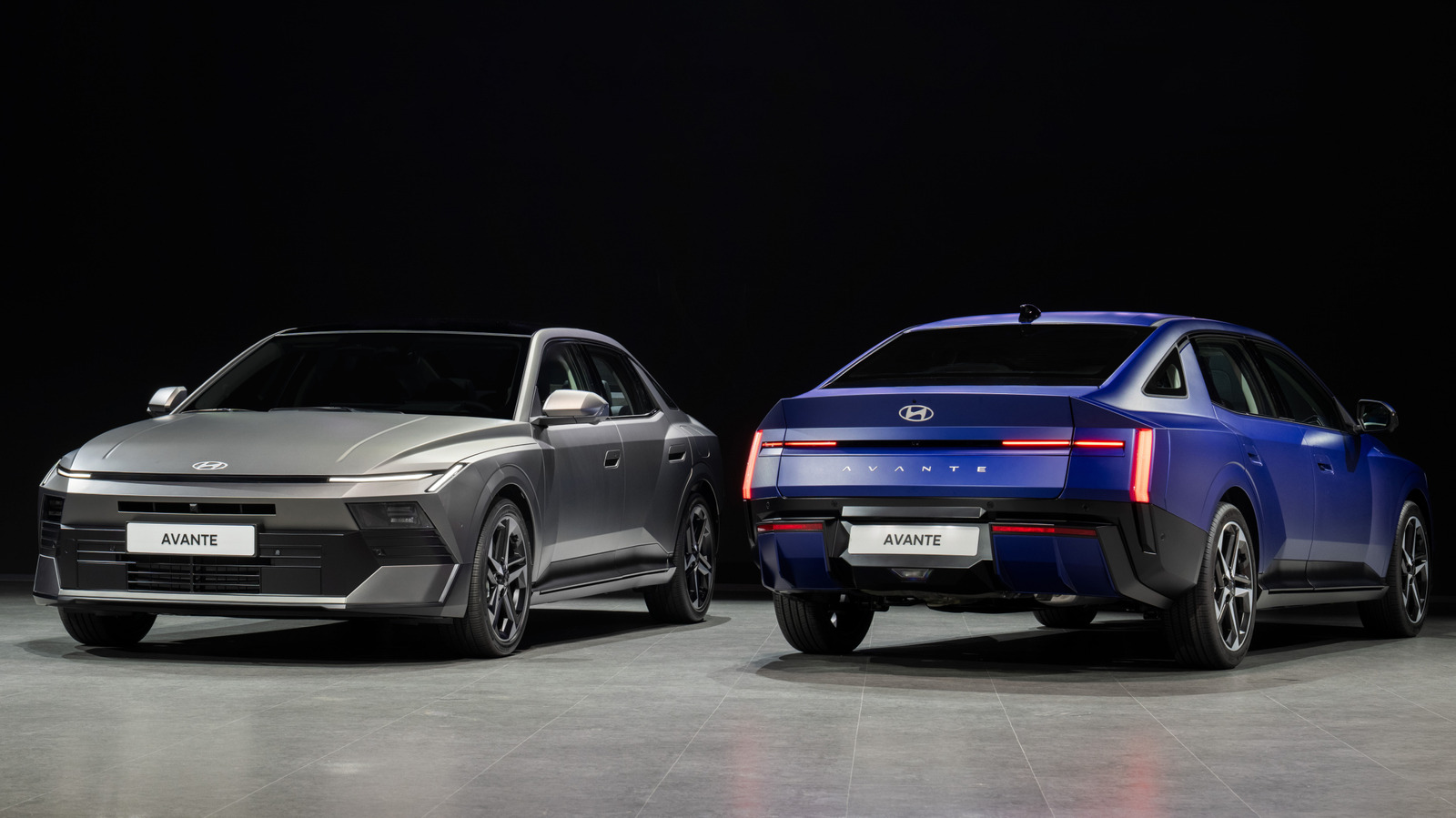
There are no automakers on Earth that are introducing new car designs even half as interesting and exciting as what’s coming from the Hyundai Motor Group’s three brands, with Hyundai itself probably being the most out-there of them all. You’d think that a car company might want to be evolutionary when introducing the next-generation version of one of its best-selling mainstream models, but not Hyundai. It just introduced the eighth-generation Elantra sedan at the Busan Mobility Show in South Korea (where it’s called the Avante), and it looks absolutely bonkers.
We’ve seen some of the Elantra’s design cues on recent Hyundai concepts like the Crater, and the China-only Ioniq V production car, but this is our first real look at the automaker’s evolved “Art of Steel” design language. It’s all about crisp lines, blocky surfaces, and high-end, intricate detailing, and the execution of it on the new Elantra has resulted in what might be the coolest compact sedan design… ever?
It’s longer and wider
The actual profile of the new Elantra is quite similar to the old one, down to the ducktail spoiler on the short trunk and the long overhang and shark nose up front. But that’s about all the two sedans have in common with each other. One of the biggest changes is with the greenhouse. The outgoing Elantra had nicely shaped side windows, but the plastic insert in the C-pillar that gave the illusion of longer windows always looked pretty cheap. On the new car, there’s an actual triangular quarter window flanked by C- and D-pillars. That’s a really expensive and complicated thing to pull off on a car in this class, and it makes the Elantra both look more traditionally sedan-y, and also calls back to the first-gen Grandeur of the 1980s.
Another absolutely wild aspect of the new Elantra are its ultra-boxy fender flares. I can’t think of any car this side of an RS Audi that has such prominently wide fenders, and there’s a lot of complex elements going on in them. The cutlines are well-resolved, there’s subtle accent creases just above the wheel arch, and the faceted surfaces catch the light really nicely. Along with over 2 inches more overall length and a 1.2-inch-increase in width and wheelbase, the Elantra’s flares and surfacing lines give it a really strong stance.
Does that look like an H?
The “H-edge” headlights and taillights of the Elantra will probably prove to be its most controversial features. At the edges of the front and rear end are vertical light strips, with horizontal strips placed slightly in board. When illuminated and seen from a distance, it kind of looks like the letter ‘H’ — for Hyundai, of course — an evolution of the motif on the Santa Fe. The actual headlights themselves are placed in the front bumper just below the running lights, integrated nicely with the angles of the bumper and intakes, while the taillight elements are thick enough that no separate brake lights are needed.
It’s got a really complex diffuser that wouldn’t look out of place on an electric performance car, and the front bumper is quite aggressive as well, even more futuristically fish-y than the current Elantra. The slim intakes up front are mirrored by lines in the tailgate. I like how sharp the edges are on the rear, particularly the spoiler area, and the creases in the hood. The upcoming next-gen Tucson’s design will be closely aligned with the Elantra, sharing the same light signatures and surfacing treatment.
The interior is meant to look like a sofa
The Elantra features Hyundai’s new Pleos Connect infotainment setup, which debuted on the Ioniq 3 and will spread across the rest of the lineup. There’s a large display in the center of the dashboard (either 12.9 inches or 14.6 inches), with a row of physical knobs and switches below that control some major climate functions. Instead of going full Tesla and eschewing a gauge cluster, there’s a slim display placed in the driver’s line of sight. Hyundai also redesigned its steering wheel controls, which now look pretty cool, as do the window switches and other buttons. As with its other models, Hyundai moved the shifter to the steering column.
As with other new Hyundais like the redesigned Palisade, the Elantra’s interior was inspired by fancy, plush sofas. That really comes through on the dashboard, where the passenger side has a rounded crash pad below a recessed area that has ambient lighting splayed onto the ribbed surface. The center console has a raised, rounded section for the driver to rest their arm on while using the screen, next to which is a pair of cupholders. Both halves have their own wireless charging pad, and the door cards have a similar rounded look. We don’t have any photos of the back seat or other parts of the Elantra’s interior yet, but given the sedan’s growth in size, it should be more spacious than the outgoing model. Hyundai says there will be three new interior colors: Chalk Beige, Cognac, and Ivory Rose, the last of which I can’t wait to see.
Gas and hybrid engines, with a new N coming
There aren’t full specs yet, and of course we have no details on the Elantra that will be coming to the U.S., but in Korea the Avante will be offered with two powertrains at launch. The base engine is a naturally aspirated 2.0-liter inline-4, which now makes 147 horsepower, an increase of 26 horses. Then there’s the 155-hp 1.6-liter hybrid, which is also a little more powerful thanks to optimization of the motor, transmission, and battery. The hybrid also has a new regenerative braking system, a predictive hybrid control system, and a Stay Mode feature that’ll let you use the climate control and infotainment while stopped, like in an EV.
Hyundai says the new Elantra’s structure is stronger and safer, it’ll come with a lot of new active-safety features like a Pedal Misuse Safety Assist system, and a bunch of smarter parking features. The Pleos system offers over-the-air software updates and a ton of different apps, and you’ll also be able to get fancy features like a Bang & Olufsen sound system.
The Avante will launch in Korea in the third quarter of this year, and we’ll probably have to wait until the Los Angeles Auto Show in November to get any U.S.-spec details on our Elantra. What probably won’t get revealed until next year is the next-gen Elantra N, which will get a completely new turbocharged 2.5-liter engine that Hyundai has already been testing in race cars. Just imagine how awesome this new design will look with the N treatment…

