




Earlier this month, Jalopnik reported that almost 25% of new car buyers had opted for 7-year (60-month) loans last quarter. It’s the result of Americans who have been forced into finding better ways to afford the transportation they desperately need as average new car payments reached an unlucky $777 and the average new vehicle price hit $52,000. What hasn’t helped the average loan get any smaller either, according to The Detroit Free Press, is the negative equity nearly a third of Americans are stuck with on their current cars. That whopping number reached over $6,800 this last quarter.
What got Americans stuck in this remarkable increase of upside-down loans and rising negative equity getting carried over into their next car payment is a little series of unfortunately timed events. And yes, it actually includes one of those “unprecedented” events we all seem to encounter more often lately. Ivan Drury, Edmunds’ director of insights, told the Free Press that a definite pain point was buyers who needed a car during the pandemic, when new cars were mostly unavailable due to supplier shortages when everything shut down and eventually got back online. That created a boon for selling your vehicle in the early years of the pandemic, but it also created a nightmare when buying one, where buyers ended up absorbing some of that “desperation tax.”
The indebted path of no returns
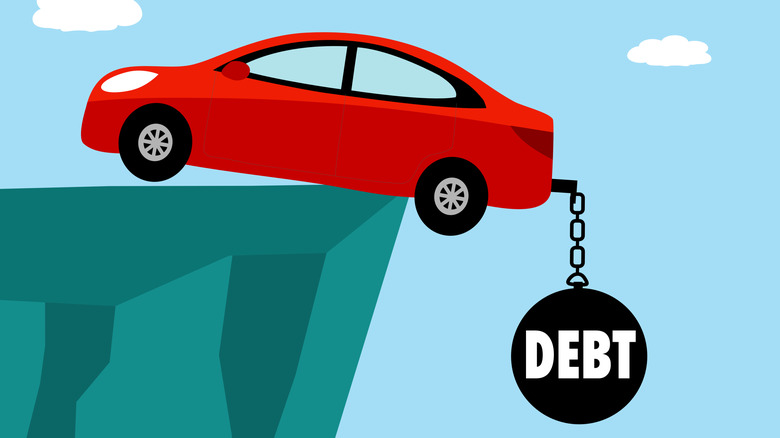
That extra cost — or rather the negative equity from purchasing those cars — has climbed to an average of $6,884, according to research from Edmunds. Knowing that’s an average, realize that some individuals might only be seeing a difference of a couple thousand dollars between their vehicle’s worth and what’s owed. But some of those individuals, including myself, have seen differences in value near or over $10,000. Insert the “Arrested Development” I’ve made a huge mistake meme here.
Edmunds’ research also found that the average age of underwater trade-ins reached four years, which isn’t the highest it has been; it reached 4.3 years in the first quarter of 2026. But it seems the method of holding out on trading in your car when it’s older to avoid negative equity issues is more difficult to achieve, especially if you’ve financed your car for six to seven years.
Auto debt isn’t holding up well either, as CNBC reported in May that Americans owe $1.68 trillion on their cars. That’s a 37% increase from where auto debt was back in 2018, a mere $1.23 trillion. The pandemic, vehicle shortages, technology, and inflation have all had a major part to play in the rising costs of vehicles, which unfortunately for most of America, remain a crucial way to get anywhere. With not much offered in alternative transportation, especially in rural areas, Americans may be forced to continue down the indebted path of literally no returns.

