


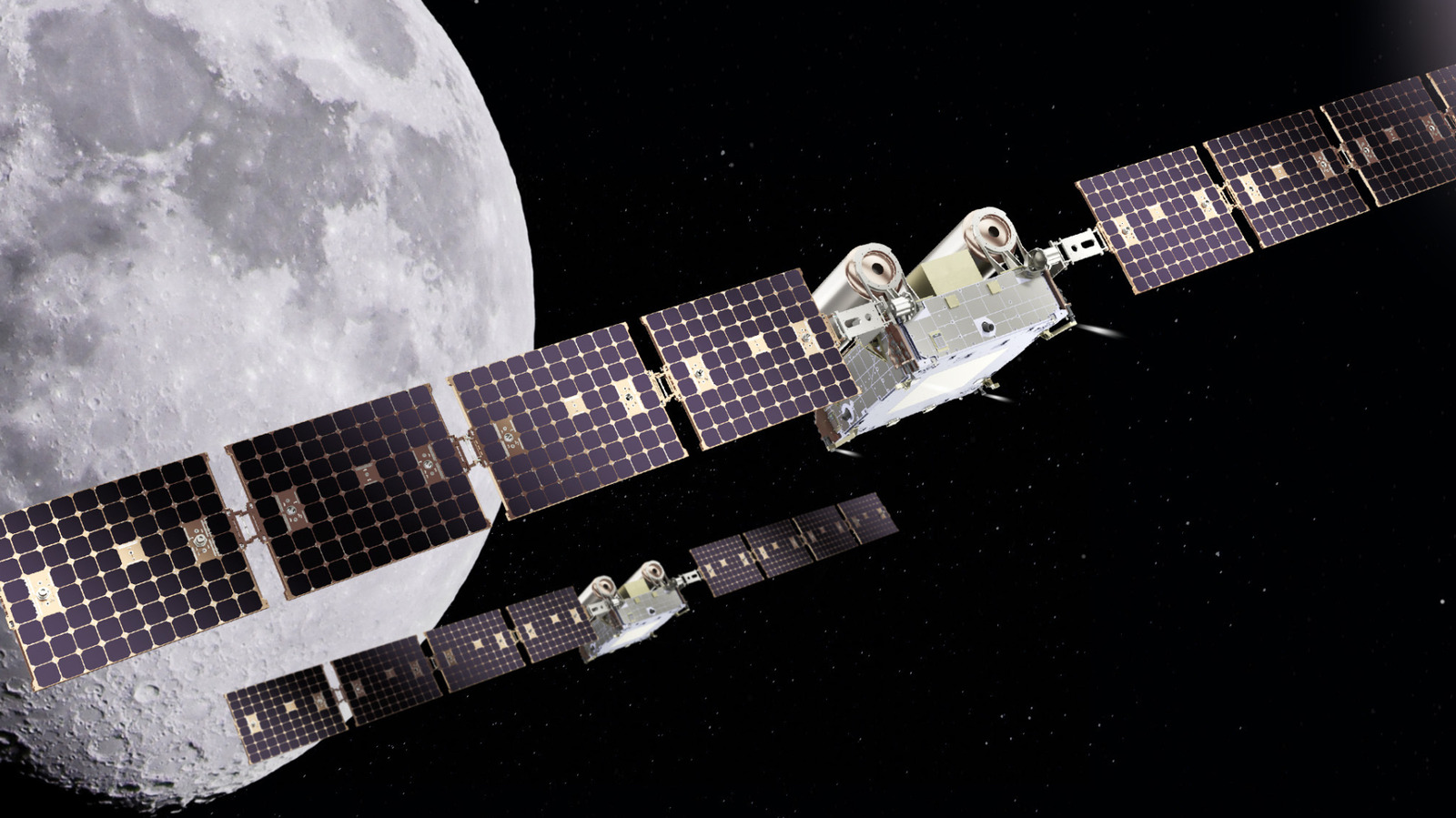
If NASA wants to land astronauts on the Moon again, it’s got three problems, and they’re all bodies. The space agency just completed the first Cislunar Autonomous Positioning System Technology Operations and Navigation Experiment (CAPSTONE), using two microwave-sized satellites. With that done, it has now awarded the same company, Advanced Space, a contract to perform the CAPSTONE 02 mission, which will test much more complex maneuvering and docking in three-body situations. These tests will teach NASA a lot about how to fly in the environments, which it will need to figure out both for the astronauts and also for all the supporting missions that a future Moon Base might require. The mission is scheduled to launch in 2027.
In astrophysics, a “three-body problem” refers to the difficulty of predicting how an object will behave if there are two other gravitational forces pulling on it, rather than just one. If you’re flying a plane, the only gravity you really have to worry about is the Earth’s. But if you’re flying a spacecraft towards the Moon, there’s a wide area where you have to worry about the influence of both the Earth and the Moon, called cislunar space. There’s no simple formula to calculate how this affects your spacecraft’s trajectory and momentum, which is why it’s a “problem.”
That makes lunar operations hard enough as it is, but what’s really cranked up the difficulty is the plan to land astronauts on the Moon. You might have watched the Artemis II mission, in which three Americans and one Canadian orbited our closest neighbor for the first time since 1972. They went in an Orion spacecraft. The crew that will attempt a landing, currently slated for Artemis IV in 2028, will also go in an Orion. The only problem: Orion was never designed to land anywhere. To reach white soil, Orion will have to dock with another spacecraft, two astronauts will have to transfer from one to the other, and then do it all over again when they return from the surface. So we really, really need to learn how to fly in that environment.
The future is cislunar
CAPSTONE 02 will send small twin satellites, under 900 pounds each, designed by Terran Orbital Systems and operated by Advanced Space. Once in lunar orbit, they will conduct formation flights and docking maneuvers, handling the gravitational influence of both the Earth and the Moon. These conditions can’t be reproduced anywhere else, so these missions are pivotal if NASA wants to understand them fully. The satellites will find their bearings the old-fashioned way, navigating visually by the stars and lunar terrain.
It’s not just NASA that wants to figure this out, though. Cislunar space will become important real estate for anyone trying to operate on the Moon, including SpaceX and China for a start. That’s why the Space Force wants to get more active about putting hardware in that region. Satellites, space stations, factories — don’t be shocked if any or all of those are in our near future there. As that commercial activity becomes more and more valuable, military activity will follow. So yes, CAPSTONE 02 is just two little guys trying to shake hands a long way away from home. They are also the shape of what’s to come.

