


You have full access to this article via your institution.
Hello Nature readers, would you like to get this Briefing in your inbox free every day? Sign up here.

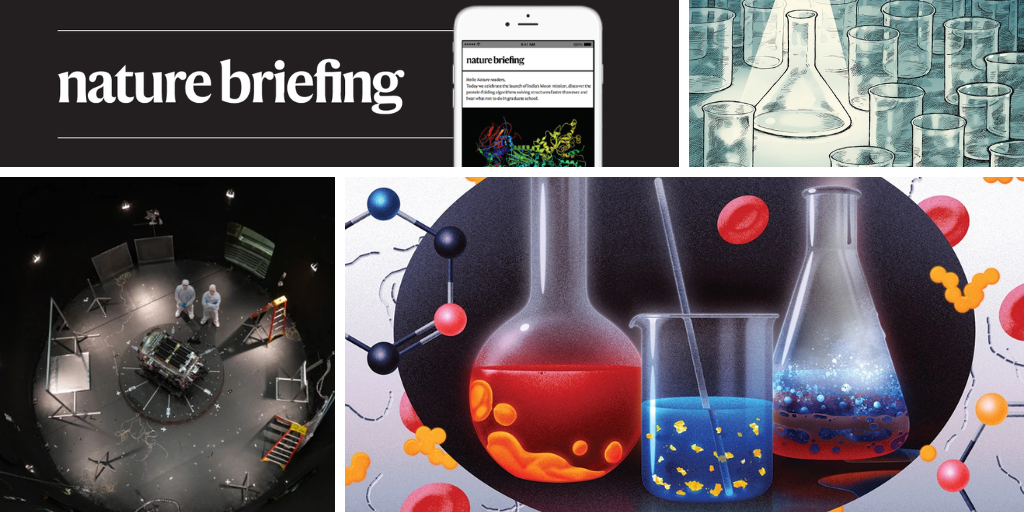
The LINK spacecraft (centre) is tested at NASA’s Goddard Space Flight Center. The craft is scheduled to blast off as early as 27 June on a satellite-rescue mission.Credit: NASA/Sophia Roberts
NASA is preparing to launch a first-of-its-kind mission to rescue an ageing satellite from an impending fiery death. The mission aims to raise the orbit of the Neil Gehrels Swift Observatory, which gathers valuable data on cosmic explosions but is slowly falling to Earth. The robotic craft will fly to Swift, grab it with extendable arms and ferry it upwards by around 200 kilometres. That should be high enough to get Swift past the atmospheric drag that would otherwise force it to fall out of the sky by the end of this year.
A new type of liquid can harvest and store energy from light to act as a rechargeable power source. The liquid contains two types of molecule, one of which donates an electron to the other when exposed to light. The donation prompts the liquid to restructure into a jelly-like substance. This gel remains stable for months at a time and can release the stored electrons upon contact with oxygen to power chemical reactions. The research is still in very early stages, but such a metal-free energy storage system could one day be useful to power small devices such as smartwatches.
An unusual comet that shot through the Solar System last year — and tempted some to dabble in the idea that it was an alien spaceship — could have formed as long as 12 billion years ago. From the chemical composition of the comet, 3I/ATLAS, researchers estimate that it formed relatively early in the history of the Universe, after an intense period of star formation. Gathering data on more interstellar objects — those that aren’t tied to an orbit and can ‘wander’ the galaxy — could “totally revolutionize what we know about the field of interstellar comets, but also star and planet formation in general”, says planetary scientist Darryl Seligman.
Features & opinion
Amid chaos in US science and geopolitical turmoil, Europe wants to position itself as a research haven — not least through the European Union’s €900 million (US$1 billion) Choose Europe initiative. And that’s on top of Horizon Europe, the EU’s main pan-national research-funding programme — which could top €175 billion in its next seven-year cycle — and countries’ own programmes. But business research and development funding in Europe still languishes behind that in China and the United States, and the region has found it hard to translate its academic research prowess into innovation and economic benefits.

Source: OECD/UNESCO
Leaders who insist that their employees give up remote work completely tend to have one thing in common, write organizational psychologists Adam Grant, Marissa Shandell and Courtney Elliott — narcissism. “Some leaders say they insist on full-time in-person work because it boosts productivity, despite clear evidence that it does not,” write the researchers. “Our new research reveals that the objection to any work from home is more likely to be driven by something else entirely: ego.”
The New York Times | 10 min read
Reference: Organizational Behavior and Human Decision Processes paper
An early-career researcher of Asian heritage working in an engineering research group in western Europe writes to Nature’s advice column asking how to deal with unequal treatment and unfair comments. They ask, “what options exist when speaking out feels unsafe, even years into a career?” A group of experts offer their advice — including accepting that leaving, if you have to, doesn’t equate to failure. “Nobody will raise statues to us because we thrived in a situation that was hostile,” says pedagogical advisor Joelyn de Lima.
Lately I’ve been pondering how to get a rather large object into my back garden, and today I’m inspired by NASA’s solution to a similar problem. To move the Nancy Grace Roman Space Telescope to Kennedy Space Center in Florida, NASA used its enormous Pegasus cargo barge, which was originally built to transport the giant external tanks of the space shuttles. Enjoy this beast of burden in a zippy timelapse, which I spotted thanks to cosmographer Daniel Pomarède. The Roman telescope, named after NASA’s first Chief of Astronomy, is gearing up for launch at the end of August.
Let me know your favourite mode of cargo transport, and why it is barges, at [email protected].
Thanks for reading,
Flora Graham, chief editor, Nature Briefing
With contributions by Jacob Smith
• Nature Briefing: Careers — insights, advice and award-winning journalism to help you optimize your working life
• Nature Briefing: Microbiology — the most abundant living entities on our planet — microorganisms — and the role they play in health, the environment and food systems
• Nature Briefing: Anthropocene — climate change, biodiversity, sustainability and geoengineering
• Nature Briefing: AI & Robotics — 100% written by humans, of course
• Nature Briefing: Cancer — a weekly newsletter written with cancer researchers in mind
• Nature Briefing: Translational Research — covers biotechnology, drug discovery and pharma

