


Cell culture, drug treatment and fractionation
143B cells were cultured in Dulbecco’s modified Eagle medium (DMEM) (Gibco, 11965-126) supplemented with 10% Nu-serum IV (Corning, 355504), 10 mM HEPES (Corning, 25-060-CI), 1× GlutaMAX (Gibco, 35050061), 1× antibiotic–antimycotic solution (Gibco, 15240062), 2.5 µg ml−1 plasmocin prophylactic (InvivoGen, ant-mpp), 1 mM methyl pyruvate (Sigma-Aldrich, 371173) and 400 µM uridine (Sigma-Aldrich, U3003). Mouse ES cells were cultured in 2i medium consisting of 0.5× Neurobasal medium (Gibco, 21103049), 0.5× DMEM/F12 (Gibco, 11320033), 0.5× N-2 supplement (Gibco, 17502048), 0.5× B-27 supplement (Gibco, 17504-044), 0.05% bovine albumin fraction V (Gibco, 15260037), 1× antibiotic–antimycotic solution (Gibco, 15240062), 2.5 µg ml−1 plasmocin prophylactic (InvivoGen, ant-mpp), 1 μM PD0325901 (Reprocell, 04-0006-02), 3 μM CHIR99021 (Reprocell, 04-0004-02), 2 mM glutamine (Gibco, 25030081), 150 μM 1-thioglycerol (Sigma-Aldrich, M6145), 1,000 U ml–1 leukaemia inhibitory factor (Sigma-Aldrich, ESG1106), 1 mM methyl pyruvate (Sigma-Aldrich, 371173) and 400 µM uridine (Sigma-Aldrich, U3003). DMSO, ethanol, piericidin A (Cayman, 15379), 3-NPA (Sigma-Aldrich, 164603), atpenin A5 (Cayman, 11898), antimycin A (Sigma-Aldrich, A8674), myxothiazol (Sigma-Aldrich, T5580), sodium azide (NaN3) (Sigma-Aldrich, S8032), l-ascorbic acid (Sigma-Aldrich, A92902), TMPD (Sigma-Aldrich, T7394), AOA (Sigma-Aldrich, C13408), DMKG (Sigma-Aldrich, 349631), 4-CBA (Sigma-Aldrich, 135585) and MDH2 inhibitor (Ambinter, Amb5965675) were used to treat cells in different experiments. 143B cells were treated with various drugs for 24 h, whereas the mouse ES cells were treated for 16 h unless mentioned otherwise. Cells were incubated at 37 °C, 5% CO2 and 95% humidity. For anoxia experiments, cells were incubated for 24 h in a H35 HEPA Hypoxystation (Don Whitley Scientific) at 0% O2, 5% CO2, 95% N2 and 37 °C under humidified conditions.
For 13C5–l-Gln tracing, the cell culture medium was switched to a labelling medium containing DMEM without glutamine (Gibco, 11960044), 2 mM 13C5–l-glutamine (Cambridge Isotope, CLM-1822-H-0.01), 10 mM HEPES (Corning, 25-060-CI), 1× antibiotic–antimycotic solution (Gibco, 15240062), 2.5 µg ml−1 plasmocin prophylactic (InvivoGen, ant-mpp), 1 mM methyl pyruvate (Sigma-Aldrich, 371173), 400 µM uridine (Sigma-Aldrich, U3003) and 10% dialysed FBS (PEAK serum, PS-FB2).
Mitochondrial and cytosolic fractions were prepared with a Cell Fractionation kit-standard (Abcam, ab109719). Nuclei were isolated with a Nuclear Extraction kit (Abcam, ab113474).
Cell lines
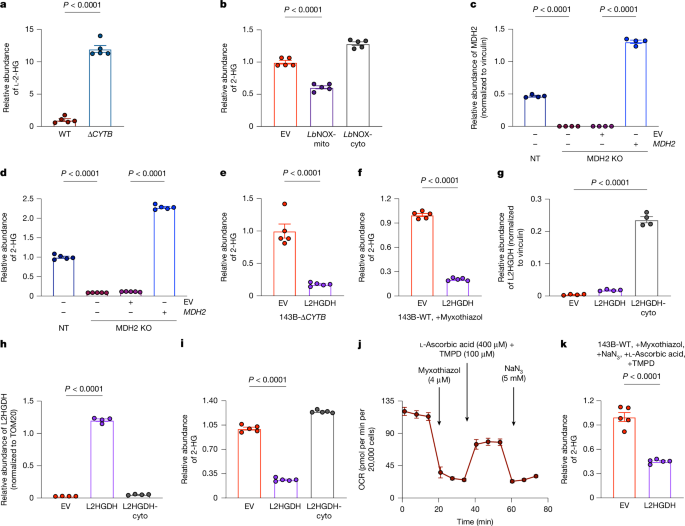
WT 143B cells and 143B ΔCYTB cells transduced with EV or expressing LbNOX-mito, LbNOX-cyto or AOX have been previously described26.
To generate the 143B ΔCYTB NT and MDH2 KO cell lines, a NT sgRNA and a sgRNA targeting MDH2 (sgMDH2), respectively, were separately cloned into pSpCas9(BB)-2A-GFP (PX458) plasmids (Addgene, plasmid no. 48138; a gift from F. Zhang), according to the provider’s instructions. Oligonucleotide sequences were as follows: sgMDH2: 5′-CGATATCATAGAGGGTCAGG-3′ (targeting the negative strand of exon 2); NT sgRNA: 5′-GTAGCGAACGTGTCCGGCGT-3′. 143B ΔCYTB cells were independently transfected with either construct using jetPRIME transfection reagent (Polyplus). Forty-eight hours after transfection, the GFP+ cells were single-cell sorted into 96-well plates using a BD FACSAria cell sorter. The sorted cells were grown in culture for 2–3 weeks, and the resultant clonal cell lines were expanded. KO of MDH2 was confirmed by Simple Western analysis, and our MDH2 KO clone was identified.
For lentiviral expression, full-length coding sequences of human MDH2, rat L2hgdh, rat L2hgdh–cyto (rat L2hgdh without the mitochondrial targeting sequence), LbNOX-mito (Addgene, plasmid no. 74448; V. Mootha laboratory) and LbNOX-cyto (Addgene, plasmid no. 75285; V. Mootha laboratory) were subcloned into the pLV-EF1A-IRES-mRFP1 vector (VectorBuilder, vector ID VB160708-1059xrd) using BamHI (5′) and SalI (3′) restriction sites. Human MDH2, rat L2hgdh and rat L2hgdh-cyto sequences are provided in the Supplementary Methods. L2hgdh–cyto was cloned using the GenScript service. These constructs or EV control, along with pMD2.G and psPAX2 lentiviral packaging vectors, were then transfected into 293T cells (American Type Culture Collection, CRL-3216) using jetOPTIMUS (Polyplus) to generate lentivirus. Cells were transduced with lentivirus, and RFP+ cells were sorted using a BD FACSAria cell sorter. The cells were periodically sorted to maintain high RFP expression. L2HGDH, L2HGDH-cyto and MDH2 overexpression were confirmed by Simple Western analysis. All cell lines tested negative for Mycoplasma contamination.
Simple Western analysis
Cells and tissues were lysed in NP40 cell lysis buffer (ThermoFisher Scientific, FNN0021) supplemented with 1× Halt protease inhibitor cocktail (ThermoFisher Scientific, 78430). Protein concentrations were measured using a Pierce BCA Protein Assay kit (ThermoFisher Scientific, 23225). Simple Western analysis was performed using the Wes or Jess platform (Bio-Techne) according to the manufacturer’s instructions. For p-eIF2α and eIF2α, RePlex Module (Bio-Techne, RP-001) was used. Protein abundance was quantified using Compass software. Primary antibodies used were anti-L2HGDH (Abcam, ab230230; 1:250; 1:1,000), anti-cofilin (Cell Signaling Technology (CST), 5175; 1:2,500), anti-vinculin (CST, 13901; 1:50,000), anti-MDH2 (Abcam, ab181873; 1:5,000), anti-TOM20 (CST, 42406; 1:50), anti-eIF2α (CST, 9722; 1:200) and anti-p-eIF2α (Ser51) (CST, 9721; 1:20).
OCR and extracellular acidification rate measurements
OCRs and extracellular acidification rates were measured in an XFe96 extracellular flux analyzer (Agilent Bioscience) according to the manufacturer’s instructions. Cells were seeded in an Agilent Seahorse XFe96/XF Pro cell culture microplate (20,000 cells per well) and incubated overnight in a CO2 incubator at 37 °C. One hour before the assay, the growth medium was replaced with XF assay medium containing Seahorse XF DMEM (pH 7.4) (Agilent, 103575-100), 10 mM Seahorse XF glucose (Agilent, 103577-100), 1 mM Seahorse XF pyruvate (Agilent, 103578-100) and 1× GlutaMAX (Gibco, 35050061), and the plate was placed in a 37 °C incubator without CO2. Basal respiration was calculated by subtracting the average OCR obtained after injections of antimycin A + piericidin A from the baseline OCR.
Metabolite measurements
Cells were washed once with 0.9% NaCl, and soluble cellular metabolites were extracted using acetonitrile–water (80:20, v/v) at 1 μl per 1,000 cells. Serum metabolites were extracted by mixing 15 μl serum with 65 μl acetonitrile–water (80:20, v/v). Metabolites from snap-frozen tissues were extracted in acetonitrile–water (80:20, v/v) at 20 μl per 1 mg of tissues. Tissues were disrupted for 30 s using a Tissue Ruptor II (Qiagen). Acetonitrile–water (80:20, v/v) was spiked with 1 or 2 μM D5–l-2-HG (Toronto Research Chemicals, TRC-H942572). Cell and tissue extracts were frozen in liquid N2 or at −80 °C and thawed on ice 3 times and vortexed for 60 s after each freeze–thaw cycle. Serum extracts were vortexed 3 times (60 s each time, 1 min on ice between each vortex). Homogenized samples were incubated at −20 °C overnight to precipitate proteins. Subsequently, the samples were thawed and centrifuged at 17,000g for 30 min at 4 °C to pellet the debris. The supernatants were transferred to new vials for analysis by ultrahigh-performance liquid chromatography and high-resolution mass spectrometry and tandem mass spectrometry (UHPLC–MS/MS). For metabolite profiling, the system consisted of a Thermo Q-Exactive in line with an electrospray source and an Ultimate3000 (Thermo) series HPLC consisting of a binary pump, a degasser and an autosampler outfitted with an Xbridge Amide column (Waters; dimensions of 3.0 × 100 mm and a 3.5 µm particle size). The mobile phase A contained 95% (v/v) water, 5% (v/v) acetonitrile, 10 mM ammonium hydroxide and 10 mM ammonium acetate, pH 9.0. Phase B was 100% acetonitrile. The gradient was as follows: 0 min, 15% A; 2.5 min, 30% A; 7 min, 43% A; 16 min, 62% A; 16.1–18 min, 75% A; 18–25 min, 15% A with a flow rate of 150 μl min–1. The capillary of the ESI source was set to 275 °C, with sheath gas at 35 arbitrary units, auxiliary gas at 5 arbitrary units and the spray voltage at 4.0 kV. In positive/negative polarity switching mode, an m/z scan range from 60 to 900 was chosen, and MS1 data were collected at a resolution of 70,000. The automatic gain control (AGC) target was set at 1 × 10⁶ and the maximum injection time was 200 ms. The top 5 precursor ions were subsequently fragmented, in a data-dependent manner, using the higher energy collisional dissociation cell set to 30% normalized collision energy in MS2 at a resolution power of 17,500. Besides matching the m/z, metabolites were identified by matching either the retention time with analytical standards and/or the MS2 fragmentation pattern. Data acquisition and analysis were carried out using Xcalibur (v.4.1) software and Tracefinder (v.4.1) software, respectively (both from Thermo Fisher Scientific).
For targeted separation and measurement of 2-HG, 2-OG, succinate and fumarate, samples were analysed by UHPLC–MS/MS, which consisted of a Thermo TSQ in line with an electrospray source and a Vanquish (Thermo) series HPLC consisting of a binary pump, a degasser and an autosampler outfitted with an Ascentis Express C18 column (Supelco, dimensions of 2.1 × 150 mm and a 2.7 μm particle size). LC was performed using a 98% buffer A (water with 2 mM ammonium formate, pH 3.5 adjusted by formic acid) and 2% buffer B (methanol) isocratic elution of 10 min per sample. In negative mode, the capillary of the ESI source was set to 325 °C, with sheath gas at 50 arbitrary units, auxiliary gas at 10 arbitrary units and the spray voltage at 2,500 V. A selective reaction monitoring of the deprotonated precursor ion and the related product ions were monitored. The transitions are listed as follows: 2-HG, 147→129; D5–l-2-HG, 152→134; 2-OG, 145→101; fumarate, 115→71; and succinate, 117→73. The peak area was integrated, and data acquisition and analysis were carried out using Xcalibur (v.4.1) software and TraceFinder (v.4.1) software, respectively (both from Thermo Fisher Scientific).
Resolution of enantiomers of 2-HG was accomplished by derivatization with diacetyl-l-tartaric anhydride (Sigma-Aldrich, 358924) in acetic acid (ThermoFisher Scientific, A6283) as previously described60 and measured by UHPLC–MS/MS21.
Metabolomics data were analysed using MetaboAnalyst (v.6.0)61 and GraphPad Prism.
LC–MS analysis of CoQ
Cells were washed with pre-chilled 0.9% NaCl (−20 °C), extracted in 500 µl acidified methanol and the lysate was collected. Ice-cold hexane was added, the suspension was vortexed for 1 min at 4 °C and phase separation was achieved by centrifugation at 17,000g for 5 min at 4 °C. The upper (hexane) layer containing CoQ species (ubiquinol (CoQH2) and ubiquinone (CoQ)) was recovered and dried under nitrogen at room temperature to complete dryness. Dried extracts were reconstituted in 100 µl methanol containing 2 mM ammonium acetate, vortexed and analysed by LC–MS. Chromatography was performed on a Thermo Scientific Ultimate 3000 using a Waters BEH C8 column. Mobile phase A was water–methanol–formic acid (95:5:0.1) with 10 mM ammonium acetate, whereas mobile phase B was methanol–formic acid (99.9:0.1). The gradient was: 0 min, 20% B; 3 min, 80% B; 10 min, 100% B; 13 min, 100% B; 14 min, 20% B; 19 min, 20% B at 0.45 ml min−1. Data were acquired on a Thermo Scientific Exploris 240 in positive-ion electrospray with full-scan acquisition over m/z 220–1,100. To align with commonly reported lipidomics settings, the following explicit source and acquisition parameters were used: resolving power 120,000 (at m/z 200); spray voltage 3.0 kV; capillary temperature 290 °C; vaporizer temperature 325 °C; sheath gas 40 (arbitrary units); auxiliary gas 10; sweep gas 2; RF lens 60; 1 microscan; and maximum injection time 100 ms62. Raw files were processed in El-MAVEN63 for targeted peak detection and integration of CoQ redox species (ubiquinol (CoQH2) and ubiquinone (CoQ)) with manual review of peak boundaries when required. The peak identity was assigned from accurate mass and retention time relative to authentic standards.
NADH consumption assay
NADH consumption assays were performed as previously described32, but with minor modifications. Reactions for rhMDH2 (Sigma-Aldrich, SRP6104) were conducted in potassium phosphate buffer (pH 7.4) in UV-transparent 96-well plates (Corning) with reaction volumes of 100 µl. rhMDH2 was used at 15 µg ml−1. To calculate Km values for 2-OG, 0.22 mM NADH (Roche, 10107735001) and different concentrations (1 mM, 2 mM, 4 mM, 8 mM and 12 mM) of 2-OG (Sigma-Aldrich, 75890) were used. Similarly, to calculate Km values for NADH, 1 mM 2-OG and different concentrations of NADH (0.02 mM, 0.06 mM, 0.10 mM, 0.14 mM, 0.18 mM and 0.22 mM) were used. A SpectraMax M2e microplate reader (Molecular Devices) was used to read the absorbance at 340 nm every 30 s throughout the course of the reaction. The mean rate of NADH consumption for triplicate control reactions without enzyme was subtracted from the rate of NADH consumption for triplicate experimental reactions with enzyme. Reaction velocities were calculated using an extinction coefficient for NADH at ɛ340 of 6,220 M−1 cm−1 and a path length of 0.28 cm for a 100 µl reaction volume in a standard 96-well plate.
NADH/NAD+ ratio measurement
NADH/NAD+ ratios were measured using a NAD/NADH Glo Assay kit (Promega, G9071) according to the manufacturer’s protocol.
Bulk RNA-seq
RNA was isolated with an AllPrep DNA/RNA Micro kit (Qiagen, 80284) according to the manufacturer’s protocol. For mouse ES cells, RNA was isolated from four biologically independent samples per condition. For mouse kidney and liver, RNA was isolated from tissues collected from five mice per group. The quantity and quality of the extracted RNA were assessed using TapeStation 4200 (Agilent). mRNA libraries were prepared using a NEBNext Ultra kit with polyA selection (New England BioLabs, E7530 and E7490) and sequenced on a NextSeq 500 instrument (Illumina) with a NextSeq 500 High Output reagent kit (1 × 75 cycles, 400 million reads; Illumina) or on a NextSeq 2000 (Illumina) using a NextSeq 2000 P2 (100 cycles, 400 million reads; Illumina) reagent kit (Illumina) with average target read depths of 14 million aligned reads per mouse ES cell sample, 26 million aligned reads per kidney sample and 10 million aligned reads per liver sample. FASTQ files were generated using bcl2fastq (v.2.19.1) (Illumina) or BCL Convert (v.3.10.4 or v.4.2.7; Illumina). Data were processed using nf-core/rnaseq (v.3.12.0) of the nf-core collection of workflows. The pipeline was executed using Nextflow (v.23.10.1) and singularity (v.3.8.1) with the public nu_genomics configuration. Transcriptome alignment and gene-level count assignment were performed using the STAR/Salmon method with the GRCm38/mm10 genome as the reference. The resulting length-scaled DESeq2 object was then imported directly for downstream analysis. Downstream analysis was performed using custom scripts (available in the NUPulmonary/utils GitHub repository) in R (v.4.2.3). Differential expression analysis was performed using DESeq2 (v.1.38.3). For GSEA, the fgsea (v.1.24.2) package was used. Hallmark gene set lists were downloaded from the Mouse MSigDB Collections. The ISR list was a gift from C. Sidrauski54. Plotting was performed using ggplot2 (v.3.4.2) unless otherwise noted. Heatmaps were generated using pheatmap (v.1.0.12) using Euclidean distance as the distance metric and the Ward D2 clustering method.
Lysate-based PISA
Frozen pelleted nuclei were thawed on ice and resuspended in lysis buffer (1× PBS pH 7.4, 0.5% NP40, 1 mM MgCl2, protease inhibitor and 1 µl ml–1 benzonase). The extracts were spun at 20,000g for 10 min to remove any insoluble material. The resulting lysate was diluted to 2 mg ml–1 in lysis buffer. Each molecule was added to the lysis buffer at a 2× concentration. To initiate the experiment, equal volumes of crude extract and treatment buffer were combined to achieve a final protein concentration of 1 mg ml–1 and a 1× compound concentration and incubated for 30 min. After incubation, an equal volume of each sample was transferred to 10 PCR tubes. The PCR tubes were heated across a thermal gradient ranging from 48 °C to 58 °C for 3 min to induce thermal denaturation. An equal volume from each PCR tube was pooled. Samples were spun at 21,000g for 90 min to separate insoluble aggregates from soluble protein. An equal volume from each soluble fraction was collected and prepared for LC–MS/MS analysis.
LC–MS sample preparation for proteome profiling and PISA
Samples (n = 4 per condition) for total proteome profiling were lysed using a buffer containing 200 mM EPPS pH 8.5, 0.1% SDS, 8 M urea, and protease inhibitors. The resulting protein concentration was determined using a BCA Assay kit. In brief, 20 μg protein from each sample was prepared for LC–MS/MS, starting with the addition of 10 mM tris(2-carboxyethyl)phosphine hydrochloride. PISA samples (20 µg protein) were diluted in prep buffer (400 mM EPPS pH 8.5, 1% SDS and 10 mM tris(2-carboxyethyl)phosphine hydrochloride) and incubated at room temperature for 10 min. Iodoacetamide was added to a final concentration of 10 mM in each sample and incubated for 25 min in the dark. Finally, DTT was added to each sample to a final concentration of 10 mM. A buffer exchange was carried out using a modified SP3 protocol64,65. In brief, about 250 µg Cytiva SpeedBead magnetic carboxylate-modified particles (65152105050250 and 45152105050250) mixed at a 1:1 ratio was added to each sample. Next, 100% ethanol was added to each sample to achieve a final ethanol concentration of at least 50%. Samples were incubated with gentle shaking for 15 min. Samples were washed 3 times with 80% ethanol. Protein was eluted from SP3 beads using 200 mM EPPS pH 8.5, containing trypsin (ThermoFisher Scientific, 90305R20) and Lys-C (Wako, 129-02541). Samples were digested overnight at 37 °C with vigorous shaking. Acetonitrile was added to each sample to achieve a final concentration of about 33%. Each sample was labelled, in the presence of SP3 beads, with around 60 µg TMTPro 16plex reagents (ThermoFisher Scientific). Following confirmation of satisfactory labelling (>97%), excess TMT was quenched by the addition of hydroxylamine to a final concentration of 0.3%. The full volume from each sample was pooled, and acetonitrile was removed by vacuum centrifugation for 1 h. The pooled sample was acidified using formic acid, and peptides were desalted using a Sep-Pak 50 mg tC18 cartridge (Waters). Peptides were eluted in 70% acetonitrile and 1% formic acid and dried by vacuum centrifugation. The peptides were resuspended in 10 mM ammonium bicarbonate pH 8, 5% acetonitrile, and fractionated by basic pH reverse-phase HPLC. In total, 24 fractions were collected. The fractions were dried in a vacuum centrifuge, resuspended in 5% acetonitrile and 1% formic acid and desalted using a stage-tip. Finally, peptides were eluted in 70% acetonitrile and 1% formic acid, dried, resuspended in 5% acetonitrile and 5% formic acid, and analysed by LC–MS/MS.
Offline basic reversed-phase fractionation
TMT-labelled peptides were solubilized in 5% acetonitrile and 10 mM ammonium bicarbonate, pH 8.0, and around 300 µg TMT-labelled peptides were separated using an Agilent 300 Extend C18 column (3.5 μm particles, 4.6 mm i.d., and 250 mm in length). An Agilent 1260 binary pump coupled with a photodiode array detector (ThermoFisher Scientific) was used to separate the peptides. A 45-min linear gradient from 10% to 40% acetonitrile in 10 mM ammonium bicarbonate pH 8.0 (flow rate of 0.25 ml min–1) separated the peptide mixtures into a total of 96 fractions (36 s). A total of 96 fractions were consolidated into 24 samples in a checkerboard fashion and vacuum-dried to completion.
MS data acquisition
Total proteome data were collected on an Orbitrap Eclipse mass spectrometer (ThermoFisher Scientific) coupled to a Proxeon EASY-nLC 1000 (or 1200) LC pump (ThermoFisher Scientific). Peptides were separated using a 90–100 min gradient at 500 nl min–1 on a 30 cm column (i.d. 100 μm, Accucore, 2.6 μm, 150 Å) packed in-house. High-field asymmetric-waveform ion mobility spectroscopy was enabled during data acquisition with compensation voltages set as −40 V, −60 V and −80 V (ref. 66). MS1 data were collected using an Orbitrap (resolution of 60,000; scan range of 400–1,600 Th; automatic gain control (AGC) of 4 × 10⁵; normalized AGC target of 100%; maximum ion injection time of 50 ms). Determined charge states between 2 and 6 were required for sequencing, and a 90-s dynamic exclusion window was used. Data-dependent mode was set as the cycle time (1 s). MS2 scans were collected in the Orbitrap after high-energy collision dissociation fragmentation (resolution of 50,000; AGC target of 1 × 10⁵; normalized AGC target of 200%; normalized collision energy of 36; isolation window of 0.5 Th; maximum ion injection time of 86 ms).
MS data analysis
Raw files were first converted to mzXML, and monoisotopic peaks were assigned using Monocle67. Database searching included all mouse entries from UniProt (downloaded in 2014). The database was concatenated with one composed of all protein sequences in the reversed order68. Sequences of common contaminant proteins (for example, trypsin, keratins, among others) were also appended. Searches were performed with Comet69 using a 50 ppm precursor ion tolerance and 0.02 Da product ion tolerance. TMT on lysine residues and peptide amino termini (+304.207 Da) and carbamidomethylation of cysteine residues (+57.0215 Da) were set as static modifications, whereas oxidation of methionine residues (+15.9949 Da) was set as a variable modification. Peptide-spectrum matches (PSMs) were adjusted to a 1% FDR68. PSM filtering was performed using linear discriminant analysis as previously described70 while considering the following parameters: XCorr, ΔCn, missed cleavages, peptide length, charge state and precursor mass accuracy. Each run was filtered separately. Protein-level FDR was subsequently estimated at a dataset level. For each protein across all samples, the posterior probabilities reported by the linear discriminant analysis model for each peptide were multiplied to give a protein-level probability estimate. Using the Picked FDR method71, proteins were filtered to the target 1% FDR level. TMT reporter ion intensities were measured using a 0.003 Da window around the theoretical m/z of each reporter ion. Proteins were quantified by summing the reporter ion counts across all matching PSMs. Reporter ion intensities were adjusted to correct for the isotopic impurities of the different TMT reagents according to the manufacturer’s specifications. Peptides were filtered to exclude those with a summed signal-to-noise < 160 across all TMT channels. To control for different total protein loading in a TMT experiment, the summed protein quantities of each channel were adjusted to be equal in the experiment.
Statistical analyses for PISA
Proteomics data were analysed using Perseus72. For the total proteome profile, significant changes were determined using a t-test with a Benjamini–Hochberg correction (FDR < 0.05). For the PISA data, significant changes were determined based on a t-test-derived nominal P values (P < 0.05) and log2 fold change (>0.25).
m6A sequencing
Total RNA was isolated from mESC-EV and mESC-L2HGDH cells treated with or without myxothiazol (500 nM) using TRIzol (ThermoFisher Scientific, 15596026) (n = 3 for mESC-EV and n = 4 for all other conditions). mRNA was then isolated using a Ambion Dynabeads mRNA Direct kit (ThermoFisher Scientific, 61012), with two rounds of oligo-dT Dynabeads purification to eliminate rRNA contaminants. Next, 5 μg mRNA was fragmented by heating at 94 °C for 4 min in fragmentation buffer (100 mM Tris-HCl and 100 mM ZnCl2), followed by the addition of EDTA to a concentration of 45 mM. Samples were purified using a Zymo RNA Clean and Concentrator kit (Zymo Research, R1013). The resulting mRNA was then immunoprecipitated using m6A antibody (Synaptic Systems, 202-003) pre-conjugated Protein A Dynabeads (ThermoFisher Scientific, 10001D) for 2 h at 4 °C. The beads were then washed 3 times with 500 μl IP buffer (10 mM Tris-HCl, 150 mM NaCl and 0.1% NP40) supplemented with RNase inhibitors and eluted by incubating with 100 μl elution buffer (10 mM Tris-HCl, 150 mM NaCl, 0.1% NP40 and 6.67 mM m6A) supplemented with RNase inhibitors for 1 h at 4 °C. The supernatant was collected, and the elution was performed again on the beads to ensure complete elution. The eluates were combined and purified using a Zymo RNA Clean and Concentrator kit and used for library building with an Illumina TruSeq Stranded mRNA Library Prep kit (Illumina, 20020594). The libraries were sequenced on an Illumina HiSeq 4000 with a single-end 50 bp read length. Read alignment was performed using STAR mapping to the GRCm38 mouse genome. m6A peaks consistent across three biological replicates were identified using the exomePeak package. Differential m6A RNA methylation analysis was also performed using the exomePeak package, and differential expression analysis of the RNA-seq data was performed using DESeq2. Figures were generated using R and GraphPad Prism.
PRO-seq
PRO-seq73 was performed according to the qPRO-seq protocol74. In brief, 2.5 million mouse ES cell nuclei and 1% spike-in fly S2 nuclei were used for nuclear run-on assay with biotin-11-UTP/CTP/ATP/GTP, 40 µM each (Revvity). The REV3 adaptor was ligated to the 3′ end of fragmented nuclear RNA using T4 RNA ligase 1 (NEB). 5′ Hydroxyl repair with PNK (NEB), decapping with RppH (NEB) and REV5 ligation to the 5′ end of RNA were performed on Dynabeads MyOne Streptavidin C1 beads (ThermoFisher Scientific, 65001). cDNA was generated using SuperScript III reverse transcriptase (ThermoFisher Scientific, 18080093). Libraries were amplified using Phusion Hot Start II (ThermoFisher Scientific) with 15 PCR cycles and sequenced on a NextSeq 2000 (Illumina).
The adaptors and low-quality bases were removed from the 3′ end of paired-end reads using cutadapt (v.4.2)75 with a minimum length of 30 bases. The unique molecular identifier (UMI) was extracted using UMI-tools (v.1.1.5)76. After UMI removal, the paired-end reads were aligned to a concatenated genome (mm10 + dm6) using Bowtie2 (v.2.4.5) with –very-sensitive option77. The mapped reads with MAPQ ≥ 20 were retained and deduplicated based on the mapping coordinates and UMI using UMI-tools. After the strand of R1 reads were swapped, a single base incorporated during nuclear run-on assays was removed from the 3′ end. Coverage of the 3′ end of the resulting R1 reads was calculated using bedtools genomecov78 and converted to bw.
Actively transcribed genes were identified using the PRO-seq reads and the UCSC gene annotation. In brief, unnormalized coverage of the 5′ end of pooled R2 reads was converted to the unidirectional 5′ clusters using CAGEfightR79. The clusters located in 5′ regions (−1,000 to +100 bp) of UCSC knownGene (mm10) were retained and annotated with gene ID. The nucleotide with the maximum coverage per gene was assigned as the observed TSS. The gene region was then defined as the interval between the observed TSS and the 3′ end of the annotated UCSC gene. Genes with a length >1,000 bp were retained for the downstream analysis.
The raw read counts in the gene body (from TSS +250 bp to TES –500 bp) were obtained using BRGenomics80. The counts from the exclusion list (ENCODE, ENCFF547MET) were discarded. For spike-in reads, the raw counts in the gene body (from TSS +500 to TES –500) of the UCSC genes (dm6) with a length >1,500 bp were obtained. For both the sample and spike-in counts, the genes with >3 counts in at least 3 samples were retained. Differential expression analysis was performed using DESeq2 (ref. 81) with the controlGenes option of estimateSizeFactors. The DEGs were identified using the threshold of Benjamini–Hochberg-adjusted P value < 0.1. The log2 fold change shrinkage was estimated using ashr82.
ChIP–seq
ChIP–seq was performed following a previously reported protocol83. In brief, the cell culture medium was aspirated and cells were washed at least twice with ice-cold PBS (ThermoFisher Scientific, 14190250). Fixation was performed using 1% paraformaldehyde (PFA) (ThermoFisher Scientific, 28908) while shaking for 10 min at room temperature. Successively, PFA was quenched using 0.125 M glycine (Fisher Scientific, BP381-5) for 5 min at room temperature. Cells were washed again with ice-cold PBS, followed by centrifugation at 500g for 5 min at 4 °C. For H3K9me3 and H3K27me3 ChIP–seq, chromatin sonication was performed using 20% duty cycle, 140 peak intensity power and 200 cycles per burst for 10 min. Successively, the pulldown of chromatin was carried out overnight at 4 °C using the following antibodies: H3K9me3 (CST, 13969) and H3K27me3 (CST, 9733S). Drosophila spike-in chromatin and antibody were added as an internal normalization control following the manufacturer’s instructions (Active Motif, 53083, 61686). The following day, Protein A/G PLUS-Agarose beads (Santa Cruz Biotechnology, sc-2003) were added to the immunoprecipitates and incubated at 4 °C for 4 h. Nonspecific proteins were washed away, and bead-bound proteins were digested using 400 μg ml–1 proteinase K (Roche, 3115828001). Reverse crosslinking was performed at 65 °C overnight while shaking at 1,200 rpm. Immunoprecipitated DNA was extracted using a ChIP-DNA purification kit (Zymo Research, D5205) following the manufacturer’s instructions. DNA was eluted in 10 mM Tris-HCl (pH 8) and quantified using Qubit. Sequencing was done on a NextSeq 2000 (Illumina) instrument as paired-end 50 bp reads. Reads were aligned to the mm10 genome assembly using Bowtie (v.1.1.2)84 with the parameters –sensitive –no-unal, and only reads with mapping quality ≥30 were retained for further analysis. bigWig files were normalized to the internal spike-in. Broad regions for H3K9me3 and H3K27me3 marks were called using MACS2 (ref. 85) with parameters -q 0.05 –broad –broad-cutoff 0.01 –nomodel; regions were annotated with homer (v.4.11)86. Occupancy plots were generated using DeepTools87, and peak distribution analysis was done using ChIPpeakAnno library88.
ATAC–seq
ATAC–seq was performed following a previously published protocol89. In brief, we centrifuged 50,000 cells, washed them with PBS and performed extraction of nuclei using a cold lysis buffer. Next, we proceeded with the transposition reaction using an Illumina Tagment DNA Enzyme and Buffer Large kit (Illumina, 20034198) and purification steps with a MinElute PCR Purification kit (Qiagen, 28004). We then performed the PCR amplification step using KAPA HiFi HotStart Ready Mix master mix (KAPA, KR0370). To remove small fragments, we performed size selection using KAPA pure beads: 40 µl KAPA beads was added to 50 µl of the PCR solution. We ran 2 µl of the library on a TapeStation to verify the nucleosome footprints and to confirm a successful assay. Libraries were sequenced as 150 bp paired-end reads on a HiSeq 4000 platform. Paired-end ATAC–seq reads were aligned to the mouse genome (mm10) using Bowtie 2 (ref. 77) with the option “–very-sensitive-local”. Mitochondrial reads were excluded from downstream analysis. Mapped bam files were converted to bed files using BEDTools78. For the four ATAC–seq samples, 12 million reads from mESC-EV+myxothiazol (rep 1), 13 million from mESC-EV+myxothiazol (rep 2), 12 million from mESC-L2HGDH+myxothiazol (rep 1) and 11 million from mESC-L2HGDH+myxothiazol (rep 2) were used as input for seqMINER90. The reads normalization assumes that the samples have similar aggregated intensity around all gene TSSs. To compare the TSS openness around DEGs, ATAC–seq read densities were plotted around ±500 bp region of the gene TSS.
mRRBS analysis
DNA extraction (n = 4 per condition) and DNA methylation measurement and analysis were performed as previously described using mRRBS91,92,93. The bisulfite conversion efficiency averaged 99.5% (s.d. 0.05%) as estimated by the measured percentage of unmethylated CpGs in λ-bacteriophage DNA (New England BioLabs, N3013S) added at a 1:200 mass ratio to each sample. Eight libraries were multiplexed for single-end sequencing using a NextSeq 500/550 V2 High Output reagent kit (1 × 75 cycles) on an Illumina NextSeq 500 sequencer. Demultiplexing, trimming, alignment to the GRCm38/mm10 reference genome and methylation calling were performed as previously described94. Quantification was performed using the SeqMonk (v.1.48.1)95 platform, as previously described94.
Teratoma formation assay
In brief, 5 × 10⁵ mESC-EV or mESC-L2HGDH cells in PBS were injected into the flanks of male NSG mice (The Jackson Laboratory, stock 005557) (n = 10 mice per group) at age 8–10 weeks. Seven mice in each group developed tumours. Mice were euthanized before the tumour diameter exceeded 15 mm, and tumours were isolated for histology.
Mouse models
β-Actin-Cre mice were obtained from The Jackson Laboratory (B6N.FVB-Tmem163Tg(ACTB-cre)2Mrt/CjDswJ, stock 019099). L2hgdh knock-in mice were generated at the Ingenious Targeting Laboratory using a strategy we previously used for making Ndi1 knock-in mice20. In brief, we designed a targeting construct containing 5′- and 3′-Rosa26 homology arms as well as lox-STOP-lox (LSL) cassette upstream of the rat L2hgdh gene. The targeting construct, which contains a neomycin-resistance gene cassette, was electroporated into C57BL/6 embryonic stem cells. Neomycin-resistant ES clones were picked, and PCR was used to confirm the proper incorporation of the targeting construct into the Rosa26 locus. ES cell clones containing the L2hgdhLSL allele were injected into blastocysts to produce germline-transformed heterozygous L2hgdhLSL mice. Ndufs2flox and Sftpccre mice were previously described96,97. For the generation of Kaplan–Meier survival plots, mice that died or were moribund were included as events (deaths), whereas data points were censored when non-terminal animals were euthanized for experimentation and tissue analysis. Mouse weights were recorded twice a week for up to 12 weeks. Only male NSG mice were used for teratoma-formation assays, as described above. Both male and female mice were used for all other experiments. We did not observe any differences in phenotypes based on sex among the experimental and control mice; therefore, mice of both sexes were analysed together. All animals were housed at the Northwestern University animal facility with a standard dark–light cycle, temperature of 22 ± 1 °C and approximate humidity of 30–70%. The housing conditions and welfare were monitored in accordance with the policies of Northwestern University’s Institutional Animal Care and Use Committee. Animal welfare was evaluated daily. All animal procedures were reviewed and approved by the Institutional Animal Care and Use Committee at Northwestern University.
L2HGDH mouse genotyping primers
For PCR to detect the L2hgdhLSL allele, we performed PCR that detects both the WT allele (224 bp) and the L2hgdhLSL allele (509 bp), but not the L2hgdh-expressing allele. The following primers were used in this PCR: Rosa26 WT allele (no L2hgdh) 224 bp and L2hgdhLSL allele 509 bp; Rosa B forward primer 5′-GAGTTCTCTGCTGCCTCCTG-3′; Rosa B reverse primer: 5′-CCGACAAAACCGAAAATCTG-3′; and WPRE B forward primer: 5′-GACGAGTCGGATCTCCCTTT-3′.
For PCR to confirm Cre recombination (LSL Excision/L2HGDH Expression), we performed PCR to confirm Cre recombination and removal of the loxP-flanked stop cassette upstream of the L2hgdh gene. This PCR amplifies both the L2hgdhLSL allele (165 bp) and the L2hgdh-expressing allele (250 bp). The following primers were used in this PCR: L2hgdhLSL allele 165 bp, L2hgdh-expressing allele 250 bp; CAG forward primer: 5′-CAACGTGCTGGTTATTGTGC-3′; Neo reverse primer: 5′-CTAAAGCGCATGCTCCAGAC-3′; and L2HGDH reverse primer: 5′-AATGAGCTGGTACTGGAGCTG-3′.
Histology
Tissues were fixed in 10% neutral buffered formalin (Sigma-Aldrich, HT501128) for more than 48 h and embedded in paraffin. All paraffin-embedded tissues were prepared for 4-μm-thick sections and stained with H&E, Jones’ stain, PAS and PSR. Images were acquired using a TissueGnostics system.
Histological quantification of renal fibrosis
Renal interstitial fibrosis was quantified on PSR-stained, paraffin-embedded kidney sections. Whole-slide images were acquired at ×20 magnification using a TissueGnostics scanner. All subsequent image analysis was performed using Fiji (ImageJ). For each image, stain separation was achieved using the Colour Deconvolution plugin with custom-defined vectors for PSR-positive collagen and the background tissue counterstain. These vectors were generated from a representative control section to ensure consistent colour recognition across all samples. This process isolated the greyscale signal corresponding to PSR-positive collagen. A single, global intensity threshold was established on a control image and applied uniformly across all images in the study to create a binary mask of the fibrotic area. The percentage of the total tissue area positive for PSR staining (% area) was then quantified. To ensure unbiased sampling, one section was analysed per kidney. On each section, 15 fixed-size, nonoverlapping square regions of interest (ROIs) (1,000 × 1,000 pixels; 330 × 330 μm), covering about 70–80% of the cortex, were systematically placed in the renal cortex, avoiding the medulla and large blood vessels. The percentage area was calculated for each ROI, and the average of the 15 ROIs was taken as the final fibrosis score for that kidney.
Histological quantification of cortical glomerular density
PAS-stained kidney sections were imaged at ×20 magnification using a TissueGnostics scanner. For each kidney, five non-overlapping ROIs confined to the renal cortex were selected for quantification. Glomeruli in each cortical ROI were manually counted, and cortical glomerular density was calculated as the number of glomeruli per unit area (glomeruli per mm2). The mean cortical glomerular density of the five cortical ROIs was used as the value for each biological replicate.
BUN, albumin and total protein quantification in serum
BUN and albumin concentrations in mouse serum samples were determined using a QuantiChrom Urea Assay kit (BioAssay Systems, DIUR-100) and a QuantiChrom BCG Albumin Assay kit (BioAssay Systems, DIAG-250), respectively, according to the manufacturer’s protocol. Total protein in serum was measured using a Pierce BCA Protein Assay kit (ThermoFisher Scientific, 23225).
CUT&RUN
Mouse kidneys were minced in ice-cold nuclei EZ lysis buffer (Sigma-Aldrich, NUC101) using scissors and homogenized with 10 (pestle A) and 5 (pestle B) strokes of 2-ml Dounce tissue grinders (DWK, 8853000002). The homogenized samples were filtered through 100 µm and 30 µm strainers (Miltenyi, 130-110-917, 130-110-915). Nuclei were centrifuged at 300g for 5 min at 4 °C and resuspended in CUT&RUN wash buffer. Reagents in the CUT&RUN Assay kit (CST, 86652) were used throughout the assays. In brief, 500,000 nuclei were bound to concanavalin A beads and incubated at 4 °C overnight with antibodies (H3K9me3: Abcam, ab176916; RPB1-S2P/S5P: CST, 13546; IgG: CST, 66362). Note that RPB1-S2P/S5P antibody recognizes the PolII carboxy-terminal domain phosphorylated at both serine 2 and serine 5 and is used to target elongating PolII. Following the incubation with pAG-MNase at 4 °C for 1 h, DNA was digested in the presence of calcium chloride at 4 °C for 1 h. STOP buffer containing yeast spike-in DNA was added to stop the digestion. The targeted DNA was eluted from nuclei at 37 °C for 10 min and purified using DNA Clean & Concentrator (Zymo, D5205).
Libraries were prepared using a KAPA HyperPrep kit (Roche) with minor modifications. End repair and A-tailing reactions were carried out at 20 °C for 30 min, followed by inactivation at 50 °C for 30 min. Next, 100 fmol UDI barcodes (Revvity, NOVA-514150) were used for adapter ligation. The ligated DNA was cleaned up by 1.2× volume of AMPure XP beads (Beckman Coulter, A63881). Following PCR amplification, the libraries were cleaned up 3 times using 1.2× volume of AMPure XP beads. The pooled libraries were sequenced on a NextSeq 2000 (Illumina) to obtain 2 × 51 bp paired-end reads.
Adapter removal and quality trimming were carried out using cutadapt (v.4.2)75. The paired end reads were aligned to the concatenated genome assembly (mm10+sacCer3) by Bowtie2 (v.2.5.4)77 with local alignment mode and very-sensitive option. Read mates that dovetailed were allowed. To study H3K9me3 and PolII occupancies at repetitive sequences, the multimappers were included in downstream analysis as previously described98 by keeping the aligned reads with MAPQ ≥ 1. The duplicated reads were discarded using picard (v.2.21.4)99. Pairwise correlation was assessed using deepTools (v.3.5.6)87. Samples with Pearson coefficient > 0.8 in the same condition and target were kept. The reads generated from different mice (H3K9me3 WT, n = 5; H3K9me3 L2HGDH(OE), n = 5; PolII WT, n = 5; PolII L2HGDH(OE), n = 4) were merged to obtain sufficient coverage at repetitive sequences. The occupancy was normalized by the spike-in reads.
H3K9me3 broad peaks were called by epic2 (ref. 100) using the merged H3K9me3 reads and the control IgG reads. The peaks that either overlapped with the suspect list101 or were located on chromosomes X, Y or M were excluded from downstream analysis. The coordinates for retrotransposons were obtained from the UCSC genome browser RepeatMasker tracks (https://genome.ucsc.edu/index.html) using the Table browser. The CUT&RUN tracks were visualized using IGV (v.2.19.1)102. The meta-profiles and heatmaps were generated using deepTools (v.3.5.6)87.
Preparation of single-cell suspension and scRNA-seq libraries
After mice (P11) were euthanized, they were perfused via the left ventricle with ice-cold Hanks’ balanced salt solution (HBSS) to remove blood, and the kidneys were collected and minced with a sterile razor blade into small pieces (<1 mm diameter). The tissue was digested in HBSS containing Liberase TM (0.30 mg ml–1) (Sigma-Aldrich, 5401119001), hyaluronidase (10 μg ml–1) (Sigma-Aldrich, H4272) and DNase1 (20 μg ml–1) (Sigma-Aldrich, 11284932001) for 40 min at 37 °C on a shaker (300 rpm, Eppendorf Thermomixer 5355). The suspension was centrifuged at 300g for 5 min at 4 °C, and the supernatant was discarded. The cells were washed twice with 2 ml cold PBS (ThermoFisher Scientific, 14190250) and pelleted. The pellets were resuspended in 5 ml of 0.25% Trypsin with DNase1 (20 μg ml–1) and incubated for 15 min at 37 °C on a shaker for further digestion. Trypsin was inactivated with 2 ml 10% FBS in PBS after digestion, followed by centrifugation at 300g for 5 min at 4 °C. Cell pellets were washed once again with 10% FBS, followed by resuspending the cell pellets in ice-cold PBS supplemented with 0.01% BSA. The cell suspension was filtered sequentially through 70 μm and 40 μm strainers, pelleted and resuspended in 0.01% BSA. Cell number and viability were analysed using a Nexcelom Cellometer Auto2000 with the acridine orange and propidium iodide fluorescent staining method. All resuspensions used wide-bore tips. Libraries were then generated using a 10x Genomics Universal 3′ V4 kit, according to the manufacturer’s instructions, using a 10x Genomics Chromium X Controller. After quality checks, single-cell RNA-seq libraries were pooled and sequenced on a NextSeq 2000 (Illumina).
scRNA-seq analysis and processing
Data were processed using the Cell Ranger (v.8.0.1) pipeline (10x Genomics) with intronic reads disabled using the nf-core/scrnaseq (v.4.0.0) pipeline103. Reads were aligned to the 10x Genomics 2020-A reference genome (GRCm38, GENCODE vM23/Ensembl98). Putative heterotypic doublets were then flagged for removal using scrublet (v.0.2.3), with manual thresholding of doublet scores, before removal using custom scripts in R (v.4.4.0). Cell calling was performed using the cellranger pipeline. Thresholding of initial filtering and preprocessing was performed using Seurat (v.5.3.0)104, followed by integration using scVI in scvi-tools (v.1.2.2.post1)105 and re-imported into Seurat for all clustering, dimensional reduction and all downstream high-level analysis using in-built Seurat functions and custom scripts in R. Normalization was performed using sctransform (v.0.4.2)106, and clustering was performed using the Leiden algorithm. Default parameters were used unless otherwise specified.
Pseudobulk RNA-seq analysis
Pseudobulk analysis was performed using the pseudobulk_DEA function in the pseudobulk_DEA_seurat5.R script in the NUPulmonary/utils repository. In brief, raw counts were aggregated and summed by sample (mouse) and major cell type as indicated and passed from Seurat to DESeq2 (v.1.34.0)81 with relevant metadata. Samples with fewer than 50 cells for a given comparison cell type were excluded from analysis. Size factor estimation, dispersion fitting and Wald tests were performed using the DESeq function in DESeq2. ‘Parametric’ and ‘local’ models of dispersion were compared visually for goodness-of-fit, and the most reasonable fit was chosen. Results were then extracted using the results function with alpha set to 0.05.
RT–qPCR
RNA was isolated with an AllPrep DNA/RNA Micro kit (Qiagen, 80284), and genomic DNA was removed using a TURBO DNA-free kit (Invitrogen, AM1907), both according to the manufacturers’ protocol. cDNA was synthesized using a SuperScript VILO cDNA Synthesis kit (Invitrogen, 11754-250). qPCR (10 μl reaction volume) was performed using TaqMan Fast Advanced master mix (ThermoFisher Scientific, 4444557) on a Bio-Rad CFX Opus 384 instrument with the following cycling conditions: 95 °C for 20 s, followed by 40 cycles of 95 °C for 3 s and 60 °C for 30 s. TaqMan Gene Expression Assays were used for Gapdh (assay ID Mm99999915_g1, FAM-MGB reporter) and L1MdTf UTR107,108 (assay ID APAAM94, VIC-MGB reporter). Relative expression was calculated using the 2−ΔΔCq method. Target gene expression was normalized to Gapdh as the internal control.
Lung histology and epithelial cell isolation
Mouse lung histology and epithelial cell isolation were performed as previously described59.
Statistics and reproducibility
All data analyses and statistical tests, unless otherwise specified, were performed using GraphPad Prism (v.10 and v.11). The number of biological replicates for each experiment is indicated in the figure legends. Investigators were not blinded during experiments or outcome assessment. No statistical method was used to predetermine sample size, and experiments were not randomized.
Reporting summary
Further information on research design is available in the Nature Portfolio Reporting Summary linked to this article.

