


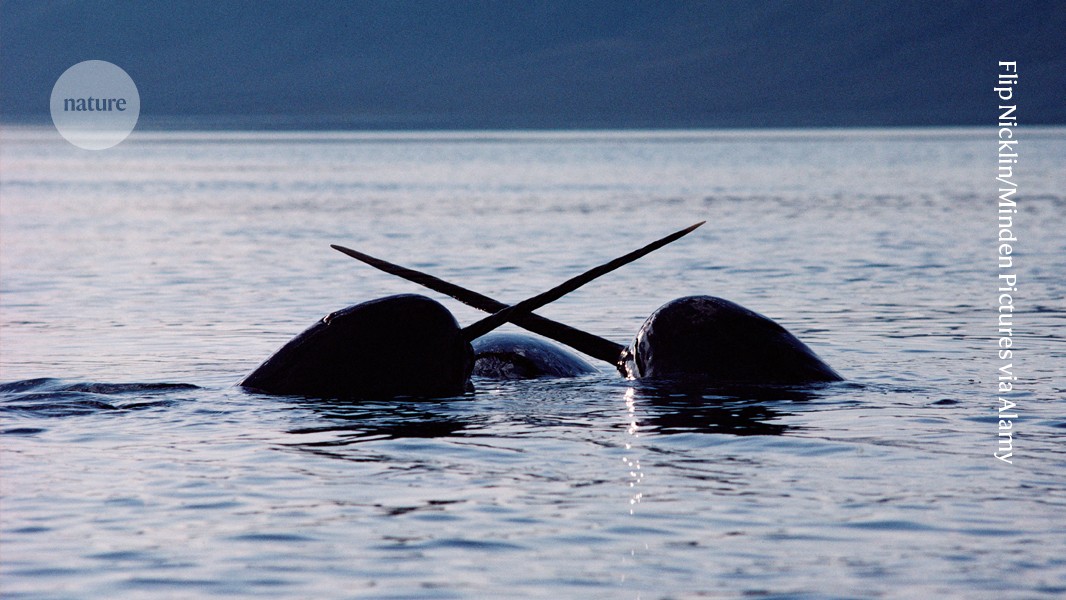
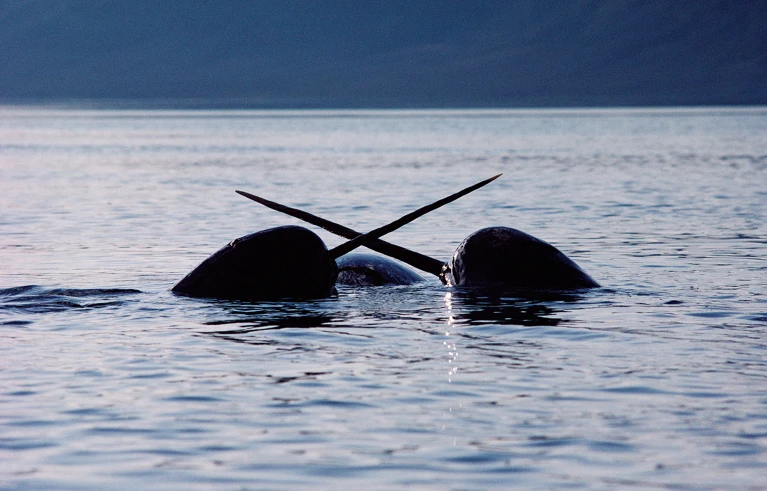
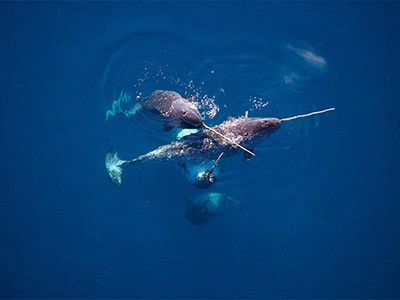
Male narwhals fighting over the carcass of a female off Baffin Island, Canada.Credit: Flip Nicklin/Minden Pictures via Alamy
In March, Kathleen Hunt unpacked the first shipments of equipment and samples at her new laboratory at Oregon State University’s Marine Mammal Institute in Newport, on the Pacific coast. On empty benches, the conservation biologist began setting up centrifuges, a spectrophotometer, drills to turn samples into powder and a station for performing biochemical assays. But her most prized possessions were shrouded in orange bubble wrap.
As she removed a 2-metre-long plate of keratin that looks like horsehair trapped in fingernails, she lamented her clumsy first attempts, back in 2013, to sample it for hormones. Five-centimetre-long punctures where her drill bit pierced the material are visible every few centimetres, along striations that seemed to represent growth lines. “We took enormous amounts of powder because, at the time, we thought we needed it,” she explains.

Hello puffins, goodbye belugas: changing Arctic fjord hints at our climate future
The plate is baleen, or whalebone, which North Atlantic right whales (Eubalaena glacialis) and a dozen or so other species use to filter plankton, krill and other food. Each plate can range from 0.5 to 2.5 metres in length, and whales can have several hundred of them hanging from each side of the upper jaw. The sheets grow continuously as the oldest material at the bottom is filed away, and can represent up to about ten years of life history in North Atlantic right whales: a time-stamped record of their reproduction, stress levels and environment.
For many species, these signatures can easily be measured using blood samples. But whales are among the most elusive creatures on Earth and samples of their blood are all but impossible to collect. Studies of baleen by Hunt and other researchers have opened a window into the inner lives of these animals and buoyed the field of wildlife endocrinology, which looks for clues as to how hormones, diet and environmental pollutants affect their fecundity and overall welfare. In recent years, she and others have expanded their research to include other unconventional sample types, such as tusks, teeth, whiskers and bone.
“I cannot look at animals the same way any more,” she says. Where others see a giraffe, say, Hunt fixates on the creature’s tail hairs, or wonders how much of its lifetime could be represented in its horns or hooves.
These scientists’ findings have upended estimates of gestation length and the location of breeding grounds. They have also documented changes in stress over time through analysis of archival samples. For species in the rapidly changing Arctic, such as belugas (Delphinapterus leucas) and narwhals (Monodon monoceros), “it feels like we are on mad dash to get baseline data,” says Justine Hudson, a biologist at Fisheries and Oceans Canada in Winnipeg.
Marine mammals were once among the most inaccessible species on the planet. Now, says Hunt, whales have “suddenly become the mammal where we can get the best continuous, long-term, longitudinal data”. And scientists are just starting to crack the code in ways that promise to shed light on population dynamics as well as species resilience.
The ‘poop person’
Early in her career, Hunt was a self-described “poop person”. For struggling populations of large animals, such as elephants and bears, hormones offered a fantastic lens to study both reproduction and stress, and the easiest way to sample them was to analyse faeces.
But things took a turn when Hunt began working with whales in 1999. These massive migratory creatures have slow reproductive cycles and a long period of sexual immaturity, which exacerbates the difficulty of tracking their population dynamics.
Some species, including the North Atlantic right whale, are among the most critically endangered mammals on the planet — and the most mysterious. “To this day, we still don’t know where most North Atlantic right whales go to for most of the year. They just disappear,” Hunt says. But in the 1990s, scientists had a good handle on their population and could see that it had plateaued. Struggling amid increased collisions with ships and entanglements with fishing gear, the whales were taking longer to breed. Hunt wanted to look for evidence of stress. She started with faeces but soon realized she needed something that reflected more than the previous day’s hormone response. “I needed a way to study cumulative stress that didn’t involve stressing the animal,” she says.
In the early 2000s, researchers realized that they could detect hormones in a range of animal parts including fur, feathers and turtle claws, all of which are made from keratin. Hunt wondered whether baleen might also retain some chemical clues.
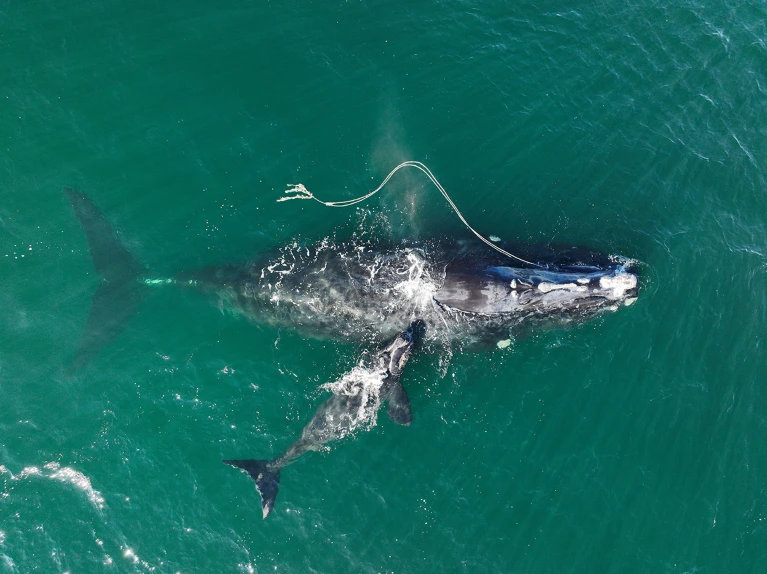
An entangled North Atlantic right whale, with a calf alongside.Credit: Georgia Department of Natural Resources/NOAA Permit #20556 via AP/Alamy
Her first step with each baleen plate is to drill a sample — ideally from every centimetre of its length — to do a bulk stable-isotope analysis of nitrogen and carbon, which reflects foraging, habitat and migration. Distinct prey have characteristic isotopic ratios of carbon-13 to carbon-12 and nitrogen-15 to nitrogen-14, Hunt explains. Quantified using a mass spectrometer, the stable isotopes 12C and 14N enable her to differentiate seasonal feeding cycles and create a timestamp on which to overlay the hormone data. One animal, for example, had 9.5 isotope cycles in her baleen, representing almost the entire final decade of her life. “It’s not until we get the isotope data back that we can make sense of the hormones,” says Hunt.
Placing the sample in alcohol, with a shake and a spin, Hunt and her colleagues have been able to extract more than ten steroid hormones from baleen, including cortisol, oestrogens, progesterone and testosterone, as well as two thyroid hormones, all of which they measure using a biochemical test called ELISA. The method works for both contemporary and archival samples. “The keratin keeps the steroids safe even if the baleen has been kept at room temperature for 20 years,” says Danielle Dillon, a researcher at the New England Aquarium’s Anderson Cabot Center for Ocean Life in Boston, Massachusetts, who also works with baleen.
Killer whales have menopause. Now scientists think they know why
But to make sense of the data, researchers also need individual life histories, for example, known calf births or injuries. Around 2014, Hunt told her then-boss at the New England Aquarium that she was looking for baleen samples from female whales that also had robust sighting records over the previous decade. To her amazement, he reached behind his door and pulled down a piece of baleen. It was from a whale, known as Stumpy, who died while pregnant not far from her calving grounds, after being struck by a ship in 2004. Whale-sighting records suggested it was her sixth pregnancy.
In 2016, Hunt published what she calls “the biggest eureka moment of my career”. She showed that two deceased, pregnant female bowhead whales (Balaena mysticetus) — Stumpy and Staccato — had levels of the pregnancy hormone, progesterone, that were orders of magnitude greater than in non-pregnant females or males1. Hunt was also able to reconstruct that Stumpy’s level of the stress hormone cortisol rose unexpectedly in the years that she didn’t get pregnant, which was unusual. She recalls thinking that this was “going to be the method that allows us to look at a whale’s past” and chronicle its most recent decade or two of life. “I saw this vision in my head of this graph spanning 150 years of different human impacts on whale populations,” she says. “I’ve been chasing that figure ever since, and I think we’re about to draw that exact figure.”
Much of Hunt’s research has been descriptive, reliant on the few samples she’s acquired with associated calving data. Nevertheless, it has opened a world of enquiry. “We worked really hard to get as many validation papers out as fast as I could, partly because I felt such urgency that we can’t just be twiddling our thumbs for the next 50 years,” she says. Following her eureka moment, Hunt had a sobering realization. “There’s going to be ten years of validating and proving that this method actually tells us anything real. So, I just dug in,” she says. “We need to get these methods working so that we can help whales now.” So far, Hunt has co-authored 26 of the roughly 30 papers published on hormones in baleen, and is aware of some 15 more in preparation.
Pregnancies in whales are one of the easiest forms of physiological stress to validate because, for several whale species, there are calf-sighting records for individual animals. But work on baleen hormones has also caused marine biologists to rethink what they know about gestation. In 2023, Nadine Lysiak, a research scientist at the New England Aquarium, used baleen analysis to suggest that gestation in bowhead whales might last just under two years — almost twice as long as was thought2. Hunt’s 2025 study of four southern right whale (Eubalaena australis) individuals found that gestation length in that species was 20–25 months3.

Samples being taken from a baleen plate.Credit: Vanessa Kahn/New England Aquarium
Dillon has also analysed roughly 20 North Atlantic right whale baleen plates. As she and her colleagues extend their data set to cover a longer period, they are beginning to catalogue hormone patterns that indicate failed pregnancies in North Atlantic right whales. “We’re starting to see patterns in more-recent baleen plates that would suggest that females have far more failed pregnancies than we might have thought.”
Testosterone cycles in male North Atlantic right whales can also plummet after stress. Using baleen, Hunt found that one male nearly skipped a breeding season after an entanglement. She also found evidence that bowhead whales, previously thought to be sexually immature until age 20, begin to produce testosterone much earlier.
Narwhals’ mixed-up response to fear could kill them
An analysis of the stress hormone corticosterone in archival samples from the Smithsonian Museum in Washington DC, reveals yet another stressor: whaling. In 1946, international whaling renewed in earnest after the Second World War, and that correlated with rising stress hormones. If more data corroborate this, Hunt says, “it’s an eye-opening example of how human impacts may be stronger than ecological impacts”.

