


The way matter emits and absorbs light across the electromagnetic spectrum underpins much of modern science, including global communications, the diagnosis and treatment of disease, and observations of the Universe. The electromagnetic radiation (photons) that originates from nuclear processes is called gamma (γ) radiation7. The first description of the nature of γ-rays emitted during a radioactive decay came in 1904 by Ernest Rutherford7. Three decades later, it was again Rutherford who confirmed that γ-rays were also emitted during nuclear reactions8. Today, γ-rays are considered the fingerprints of atomic nuclei and are used in many applications, from basic research into nuclear structure and astrophysics to food sterilization, medicine and national security9,10,11,12,13.
Gamma-rays are emitted when nuclei transition from high-energy quantum states to lower energy ones. At low excitation energies, the emitted γ-rays are individually resolvable with discrete and characteristic energies. At high excitation energies, however, the number of available quantum levels per unit energy (nuclear level density or NLD) is large and the transitions between these levels are complex so that our ability to resolve individual γ-rays diminishes. The resulting measured γ-ray energy emission is no longer discrete but instead follows a largely continuous distribution as a function of energy, known as the radiative strength function or γ-ray strength function (γSF)1,2.
Electromagnetic transitions are defined as either electric or magnetic in nature. In electric transitions, the average distribution of nuclear charge (spatial redistribution of protons) changes between the initial and final states. Magnetic transitions involve changes in how the charge and magnetic moments are moving (redistribution of currents, orbital angular momenta and spin orientations). Both types of transitions represent different ways in which the nucleus can rearrange itself and release γ radiation. The most probable electromagnetic transitions in the γSF, especially at high γ-ray energies, are of electric dipole (E1) character, where the changes in the angular momentum (l) and parity (π) of the initial and final states involved in the transition are both equal to 1. Magnetic dipole (M1) transitions do not result in a parity change (Δπ = 0) but do lead to a change in angular momentum (Δl = 1) and are generally weaker than E1 transitions.
The γSF is a measure of the average electromagnetic decay of a nucleus and has been studied since the mid-20th century, predominantly in stable isotopes. It was found to be characterized by a broad ‘giant resonance’ structure that peaks around 12–20 MeV (ref. 14). Over the last 40 years, explorations of the γSF have revealed other, smaller, resonance-like structures, which have been attributed to certain types of electromagnetic behaviour. In deformed nuclei, a decay resonance at Eγ = 1–4 MeV (now known as the ‘scissors mode’) was first observed in 161Dy by Guttormsen et al.15 and in 156Gd by Bohle et al.16. This resonance is thought to be the result of the orbital part of the M1 operator causing protons and neutrons to oscillate with opposite phase around the nuclear core17,18. Additionally, a resonance occurring from 5 MeV to 10 MeV, known as the pygmy dipole resonance, is thought to arise from the collective oscillations of a neutron skin around a proton–neutron core, although gaining an understanding of the origin and properties of this resonance is still a work in progress19,20,21.
In this work, we focus on the most poorly understood feature of the γSF: the low-energy enhancement (LEE). The LEE appears as an enhancement in the low-energy portion of the γSF (Eγ < 3 MeV) and was first discovered in 56,57Fe by Voinov et al.3 and confirmed in 95Mo by Wiedeking et al.4. Following these initial measurements, the LEE has been observed in many (although not all) light- and medium-mass nuclei close to stability22 as well as in some radioactive23,24 and higher mass25,26,27 nuclei. The presence of the LEE has a notable impact on predictions of nuclear reaction rates, as it increases radiative neutron-capture reaction cross sections compared with theoretical expectations. Better predictive power regarding which nuclei contain the LEE is imperative to modelling astrophysical nucleosynthesis5,6. Since its discovery, the LEE has been investigated extensively. After over two decades of research, it still remains unclear what the electromagnetic nature of the LEE is or how its amplitude and shape might depend on nuclear structure effects24. Many theoretical studies22,28,29,30,31,32,33,34 have predicted that the LEE results from M1 transitions (with some exceptions30), but these results have yet to be confirmed experimentally. In 2013, Larsen et al.35 showed that the LEE is of dipole nature, but despite significant efforts36, no clear conclusion has been drawn on whether the LEE is of electric or magnetic character (E1 or M1).
Here we present results from an experiment conducted at the Facility for Rare Isotope Beams at Michigan State University, where we studied the electromagnetic behaviour of the LEE in the γSF of 70Zn using a new combination of experimental β-decay and γ-ray spectroscopy techniques and analytical methods. Using our measurement, we show that the LEE is of magnetic nature, thus providing an answer to a decades-long unanswered question in the nuclear physics community.
In this experiment, the γSF of the nucleus 70Zn was extracted from the population of excited states using the β-decaying nucleus 70Cu. Details regarding this experiment and analysis using the shape method37,38 and the β-Oslo method39 are presented in Methods. Here we use a new technique to extract the γSF by feeding the nucleus of interest (70Zn) using the β-decay from two states in the same nucleus (70Cu). Specifically, the γSF of 70Zn was extracted from both the second isomer (70Cum2, Jπ = 1+) and the ground state (70Cugs, Jπ = 6−) β-decays of 70Cu. Beta-decay is a very selective process for populating states in the nucleus of interest. If there are allowed β-decay transitions, β-decay will populate states with a spin in the range 0 or \(\pm \)1 from the spin of the parent state, and they will retain the same parity. The spins of the low-energy decaying states in 70Cu have been confirmed using laser spectroscopy and are firm assignments40. Thus, the β-decay of 6− 70Cugs is expected to directly populate the 5−, 6− and 7− states in 70Zn. The β-decay of 1+ 70Cum2 is expected to directly populate the 0+, 1+ and 2+ states in 70Zn, resulting in two 70Zn γSFs that can be compared. The total energy released in the β-decay (Qβ value) of 70Cugs is 6.58 MeV (ref. 41). The relative population of different excitation energies within the Qβ window following the decay of either parent state can be obtained from total absorption spectroscopy, which was measured for the present dataset (Methods and ref. 42). The insets of Extended Data Fig. 1 show the total absorption spectra. In general, the β-decay from 70Cum2 favours decays to lower energy positive-parity states in 70Zn, whereas the β-decay from 70Cugs favours decays to higher energy negative-parity states in 70Zn, although experimentally observed feeding is present up until around Qβ in both cases. Following β-decay, the excited states decay through the emission of photons until the ground state is reached.
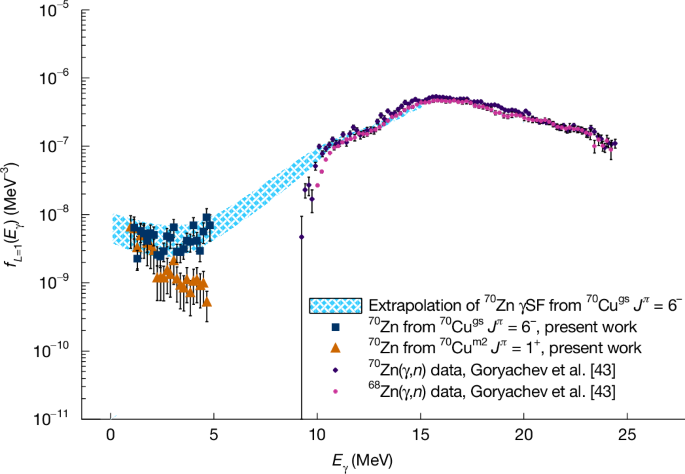
The two strength functions extracted from 70Cum2 and 70Cugs β-decay are plotted in Fig. 1. The blue data are associated with 70Cugs, and the orange data are associated with 70Cum2 (Methods). In Fig. 1, the high-energy portion (9–25 MeV) of the γSF in the region of the giant dipole resonance comprises data from the 70Zn(γ,n)69Zn and 68Zn(γ,n)67Zn reactions43.

The data from the β-decay of 70Cugs are normalized in magnitude and extrapolated to giant dipole resonance data from the 70Zn(γ,n)69Zn and 68Zn(γ,n)67Zn measurements by Goryachev et al.43 shown in the blue band. The absolute normalization of the data following the β-decay of 70Cum2 is relative to the blue band.
In the low-energy region (Eγ < 3 MeV) of the γSFs presented in Fig. 1, there is a significant difference in the shape between the γSF extracted from the β-decay of the 6− 70Cugs state compared with that extracted from the 1+ 70Cum2 state. The difference between the shapes of the two γSFs can be explained by the different starting distribution of states in 70Zn populated by the two respective β-decays and the distribution of positive- and negative-parity states in 70Zn. The high-energy γ-rays of the two strength functions shown in Fig. 1 connect the states at high excitation energy with states at low excitation energy in 70Zn. At low excitation energy in 70Zn below 3 MeV, there are almost exclusively positive-parity states. The 1+ 70Cum2 parent state populates the 0+, 1+ and 2+ states at high excitation energy in 70Zn. There are few available negative-parity states at low excitation energy in 70Zn, and as a result, the E1 γSF inferred following the decay of the 1+ 70Cum2 is significantly suppressed. In this interpretation of selective suppression of the E1 γSF, the difference in the two γSFs from 70Cum2 and 70Cugs β-decay does not seem, according to in our interpretation, to violate the generalized Brink–Axel hypothesis44,45 but instead reflects the different availability of final states.
The discrepancy in the parity of states is illustrated by the low-energy-level scheme of 70Zn (ref. 41), reproduced in Fig. 2a,b. Below approximately 3 MeV there are only two negative-parity states. We use Gogny+Hartree–Fock–Bogoliubov calculations46 of the NLD within the Hauser–Feshbach code TALYS47 to describe the ratio of the negative- and positive-parity states in 70Zn, shown in Fig. 2c. The ratio is zero at low energy, matching the expectation based on discrete levels where there are few negative-parity states in the nucleus. It approaches 1 towards higher excitation energies, where there should be an equal number of positive- and negative-parity states. The two lines in Fig. 2c distinguish the parity asymmetry for the two different spin ranges J = 0–3 (orange, 70Cum2) and J = 4–8 (blue, 70Cugs). Shell model calculations using the jun4548 and jj44b49 Hamiltonians produce qualitatively similar ratios for the parity asymmetry as a function of excitation energy. Experimental levels with a firmly assigned spin-parity exhibit similar behaviour, as above 3 MeV, the ratio of negative-parity states to positive-parity states is higher for spins J = 4–8 than it is for spins J = 0–3.

a,b, Schematic of known levels of 70Zn showing their associated energies in kilo-electronvolts and their spins and parities up to 3 MeV populated from 70Cugs β-decays (a) and 70Cum2 β-decays (b)41. Transitions of M1 character are shown in green, and transitions of E1 character are shown in purple. In the level scheme of 70Cum2, the decay of high-energy positive-parity states to low-energy positive-parity states heavily favours dipole transitions of magnetic nature, unlike 70Cugs, for which E1 is favoured. c, The parity distribution of 70Zn (represented by the ratio of negative-parity states to positive-parity states) up to 10 MeV for two different spin ranges: the spins populated following β-decay of the 6− 70Cugs state and one dipole transition (spins 4–8, blue) and the spins populated following the β-decay of the 1+ 70Cum2 state and one dipole transition (spins 0–3, orange).
To qualitatively demonstrate the suppression of the E1 strength function, we first modelled the experimental γSF extracted following the β-decay of the 6− 70Cugs state (blue squares in Fig. 1). Here the shape of the E1 strength was based on the Gogny+Hartree–Fock–Bogoliubov with the QRPA model (using the D1M version of the Gogny force) developed by Goriely et al.50. The shape of the M1 strength was modelled by a generalized Lorentzian51. Another exponential component was added to account for the M1 LEE, as the LEE is expected to have an energy dependence that can be modelled by an exponential function20,28,29,30,31,32,33,34. The three components (E1, M1 and the M1 exponential LEE) were fitted to the γSF extracted from the 6− 70Cugs decay. The amplitude of the E1 and M1 exponential LEE components were allowed to freely vary and the non-exponential M1 component was fixed to be approximately an order of magnitude weaker than the E1 strength. This order of magnitude difference between the E1 and M1 strengths was expected based on data for other nuclei within this mass region14. The total γSF obtained by summing the contributions from E1, M1 and M1 exponential LEE is presented as the solid black line in Fig. 3. This line falls within the blue band in Fig. 1.

The E1 + M1 + LEE γSF from the Gogny+Hartree–Fock–Bogoliubov calculation in TALYS 1.96 (ref. 46) is shown as the solid black line. The individual components of this γSF are as follows. The E1 component is the solid blue line. The M1 component is the solid pink line. The M1 LEE is the solid orange line. The γSF with the applied E1 suppression factor is the dashed black line. The reduced E1 component is the dashed blue line. The two M1 components (pink and orange lines) remain the same. The hollow blue squares represent the 70Zn γSF extracted from 70Cugs, and the hollow orange triangles represent the 70Zn γSF extracted from 70Cum2. There is good agreement between the data from 70Cugs and the standard E1 + M1 + LEE γSF, and good agreement between the data from 70Cum2 and the suppressed E1 + M1 + LEE γSF.
The asymmetric parity distribution illustrated in Fig. 2c significantly alters the γSF inferred from the decay of the 1+ 70Cum2 state. Low-spin positive-parity states populated in 70Zn from 70Cum2 β-decay transition to the ground state through cascades of γ-rays. The lack of negative-parity states at low energy in 70Zn suppresses the presence of E1 transitions in the γSF because those states are not allowed to decay to final positive-parity states. The suppression of the E1 strength is present at all γ-ray energies but is strongest for the high-energy transitions. The M1 transitions are unaffected.
To account for and quantify the impact of the parity asymmetry on the extracted γSF, we determined an E1 reduction factor for each γ-ray energy. For a given primary γ-ray energy (Eγ), we first identified all excitation energies (Ex) for which it is energetically possible to emit a primary Eγ. We then determined the reduction factor based on the parity asymmetry at the energy Ex − Eγ to account for the lack of negative-parity levels at the destination excitation energy. Above Eγ ≈ 3.5 MeV, the multiplicative E1 reduction factor is 0, as there are no available negative-parity states in the nucleus to accommodate the emission of a primary E1 γ-ray at these energies. The reduction factor at each Ex is weighted by the population of that specific Ex in β-decay, taken from total absorption spectroscopy results41. The final reduction factor for each Eγ was applied to the E1 strength function, leading to the dashed blue line in Fig. 3. The M1 and M1 exponential LEE are unaffected by the parity asymmetry. The total reduced strength function (dashed black line in Fig. 3) matches the shape of the experimentally measured γSF from the 1+ β-decays of 70Cum2. Note that this behaviour holds if the M1 LEE exponential is allowed to vary in slope within the error of the experimental data at low energies. Further, the difference in shape between the 70Zn γSF extracted from the 70Cum2 β-decays and the 70Cugs β-decays is attributable to the suppression of the E1 strength and the existence of the M1 exponential LEE. Therefore, the experimental data confirm that the LEE is M1 in nature.
The determination that the LEE is M1 in nature sheds light on a long-standing open question regarding the nature of γ-ray radiation in nuclei. With the nature of the LEE finally fully established for 70Zn, we can focus our efforts onto addressing the remaining questions regarding the γSF, such as how does the amplitude and shape of the LEE depend on nuclear structure? How can we predict this behaviour52? How is it related to the generalized Brink–Axel hypothesis? Understanding the nature of the LEE will improve our ability to predict neutron capture reaction rates in astrophysical environments and will help us begin to disentangle the complex picture of stellar nucleosynthesis and understand the complex interplay of nucleons in atomic nuclei.

