


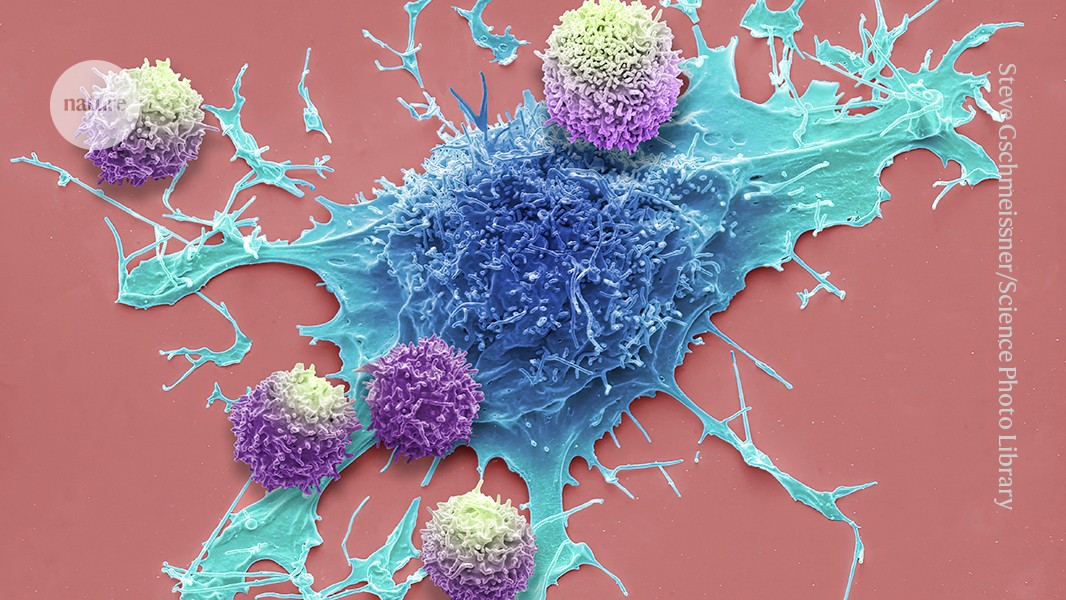

Conventional CAR T cells (purple and yellow spheres; artificially coloured) attack a cancer cell.Credit: Steve Gschmeissner/Science Photo Library
The first clinical trial to test the tumour-fighting power of a stem-cell-like class of long-lived immune cells suggests that they could be more potent and less toxic than the standard mix of cells used in therapies for cancer.
The study, published in Cell on 30 April1, was small, and larger trials are needed to establish the treatment’s effectiveness. But the early results are promising: of 11 people with difficult-to-treat blood cancers, 5 entered remission after receiving a treatment called CAR-T-cell therapy that contained an unusually high proportion of immune cells with properties similar to stem cells.
This formulation was effective at lower doses than normal CAR-T-cell therapy and produced milder side effects. “On a per-dose basis, these cells definitely seemed more potent,” says Christine Brown, who studies cancer immunotherapy at City of Hope, a cancer treatment centre and research institute in Duarte, California, who was not involved in the study. “It’s a first step, but an important one.”
Many flavours
Chimeric antigen receptor (CAR) T cell therapies reprogram immune cells called T cells to target and kill cancer cells. To make these complex, living drugs, researchers normally isolate T cells from the recipient’s blood and then genetically engineer them to express a protein that binds to cancer cells. But T cells come in a variety of flavours, each with unique functions, and CAR-T-cell therapies normally contain a mixture of them.

How to supercharge cancer-fighting cells: give them stem cell skills
Previous research suggested that the presence of a subset of T cells called stem-cell memory T cells is correlated with the success of CAR-T therapy2. These cells have properties similar to stem cells, including an ability to generate many different types of T cell.
Luca Gattinoni, a cancer researcher at the Leibniz Institute for Immunotherapy in Regensburg, Germany, and his colleagues decided to test whether an ‘enriched’ therapy consisting mainly of these cells might be more effective than normal CAR-T-cell treatments.
Working with James Kochenderfer, a cancer researcher at the US National Cancer Institute in Bethesda, Maryland, the authors devised a procedure that increased the proportion of stem-cell memory T cells in a dose of CAR T cells nearly tenfold. They used the enriched mixture to treat people with blood cancers whose disease had either relapsed after a blood-stem-cell transplant or had failed to respond to therapy. The team compared those individuals’ responses to those of people who had previously been treated with standard CAR-T-cell therapy.
Powerful product
The authors found that their CAR T cells were more likely to evoke complete remission in the participants than were similar doses of conventional CAR T cells. Of the 20 people treated with conventional CAR-T-cell therapy, one entered a full remission. But of the 11 participants who received the new therapy, 5 experienced a full remission, and another experienced a partial remission. Only one participant in this arm of the trial saw their disease worsen soon after treatment.

