


Antibodies and chemicals
Reagents were obtained from the following sources: antibodies against HA (3724S, clone C29F4; 1:1,000 dilution for western blot), LC3B (3868S, clone D11; 1:1,000 dilution for western blot), VINCULIN (13901S, clone E1E9V; 1:1,000 dilution for western blot), LAMTOR4 (13140S, clone D4P60; 1:300 dilution for immunofluorescence), HRS (15087S, clone D7T5N; 1:1,000 dilution for western blot), TOM20 (42406S, clone D8T4N; 1:1,000 dilution for western blot), ATG5 (2630S; 1:1,000 dilution for western blot), ATG13 (13468S, clone E1Y9V; 1:1,000 dilution for western blot) from Cell Signaling Technology; LAMP2 (sc-18822, clone H4B4; 1:300 dilution for immunofluorescence), CHMP1A (sc-271617, clone B-5; 1:300 dilution for immunofluorescence) from Santa Cruz Biotechnology; TFG (ab156866, clone EPR8766; 1:300 dilution for immunofluorescence, 1:1,000 dilution for western blot) and NPC1 (ab36983; 1:1,000 dilution for western blot) from Abcam; SEC31A (612350, clone 32; 1:300 dilution for immunofluorescence) from BD Biosciences; SEC31A (17913-1-AP;1:300 dilution for immunofluorescence), TSG101 (67381-Ig, clone 2B7G8; 1:1,000 dilution for western blot), ALIX (67715-Ig, clone 1H9D9; 1:1,000 dilution for western blot), PDCD6/ALG2 (12303-1-AP; 1:1,000 dilution for western blot) from Proteintech; TFG (NBP2-62212, clone TFG-03; 1:300 dilution for immunofluorescence) from Novus; LLOMe (16008) from Cayman; DMSO (D2650-100mL) from Sigma-Aldrich; Pierce Protease Inhibitor Tablets (A32965) from Thermo Fisher; DMEM (11965), DMEM-Phenol Red (31053-028), 0.25% Trypsin-EDTA (25300062), 0.05% Trypsin-EDTA (25300054) from Gibco; U1866A (1638) from Tocris Bioscience; Puromycin (Gibco, A1113803) and Blasticidin (Gibco, A1113903).
CRISPRi cell line generation and validation
K562 sgNT and K562 sgNPC1 cell lines were generated using Cas9–sgRNA ribonuclear protein transfection (sgNPC1 sgRNA sequence: GGACGATCCTTGGCTTGGAC) as previously described26, and knockout was validated by western blot (Extended Data Fig. 1b). In total, 2 × 10⁵ cells were transduced with Ef1a-dCas9-KRAB-BFP construct lentivirus in cell culture medium supplemented with 1 μl ml−1 Polybrene (Millipore Sigma, TR-1003-G). Cells were spinfected at 1,000g for 1 h at room temperature and cultured overnight. Viral supernatant was removed next day and replaced with fresh K562 medium. Cells were expanded and then sorted for BFP+ population on a BD FACS Aria and maintained as a pooled cell line.
To validate CRISPRi efficiency, cells were transduced with lentivirus for guides targeting Gal4 (negative control) or CD55 (cell surface marker). Cells were selected with puromycin (Gibco, A1113803) to obtain a pool of guide containing cells. Cells were incubated with Fc block (Biolegend, 422302) in FACS Buffer (0.5% BSA in PBS) and stained for CD55 (Biolegend, 311312). Knockdown efficiency was analysed by flow cytometry on the Thermo Fisher Attune NxT Flow Cytometer and analysed on FlowJo.
sgRNA guide library plasmid production
The lentiviral expression vector used for CRISPR guide expression is available on Addgene as pLGR1002 (188320). The sgRNA sequences as well as the sgRNA library cloning procedure performed is as described50,51. sgRNA library representation was confirmed by next-generation sequencing.
Guide library lentivirus production and titration
Guide library virus was prepared using the Mega Lentivirus protocol from the Weissman laboratory with modifications (https://weissman.wi.mit.edu/resources/Large_scale_lentivirus_production.pdf). A total of 18 million Lenti-X 293T cells (Takara Bio, 632180) were plated on a 15 cm plate. The next day, transfection mixture was prepared using 125 μl Mirus LT1 transfection reagent (Mirus Bio, MIR2304), 1.5 ml DMEM (Gibco, 11965-092), 18 μg psPax2 (packaging vector), 4 μg MD2G (env expression plasmid, VSVG) and 18 μg of lentiviral plasmid (sgRNA library). Transfection mixture was incubated for 15–20 mins at room temperature. Transfection mix was added to the 293T cells and incubated for 6 h. After 6 h the medium was replaced with fresh 293T medium supplemented with 2 μg ml−1 ViralBoost (ALSTEM, VB100). Lentiviral supernatant was collected 48 h after transfection and filtered (0.45 μm). Lentivirus was stored at −80 °C until use.
Lentivirus titration was performed in K562 cells prior to the screen. Multiplicity of infection (MOI) was determined by percent infection shown by BFP signal via flow cytometry. K562 sgNT and K562 sgNPC1 cells (2 × 10⁵) were transduced with guide library lentivirus in a range of 5–250 μl in K562 medium supplemented with 1 μl ml−1 Polybrene (Millipore Sigma, TR-1003-G). Cells were left in virus for 24 h and then changed to regular medium. Forty-eight hours after infection, cells were analysed on the Attune NXT flow cytometer to determine BFP fluorescence and MOI.
Lentivirus for individual guide RNA experiments was produced in 6-well plates with adjusted protocol. Lenti-X 293T cells (0.8 × 10⁶) per well were seeded the day before transfection. Transfection mix consists of 7.5 μl Mirus transfection reagent (MIR 2700), 100 μl DMEM (Gibco, 11965-092), 1.2 μg psPAX2, 0.3 μg MD2G and 1.2 μg guide plasmid. The protocol is as described above.
Lysosomal integrity survival screen
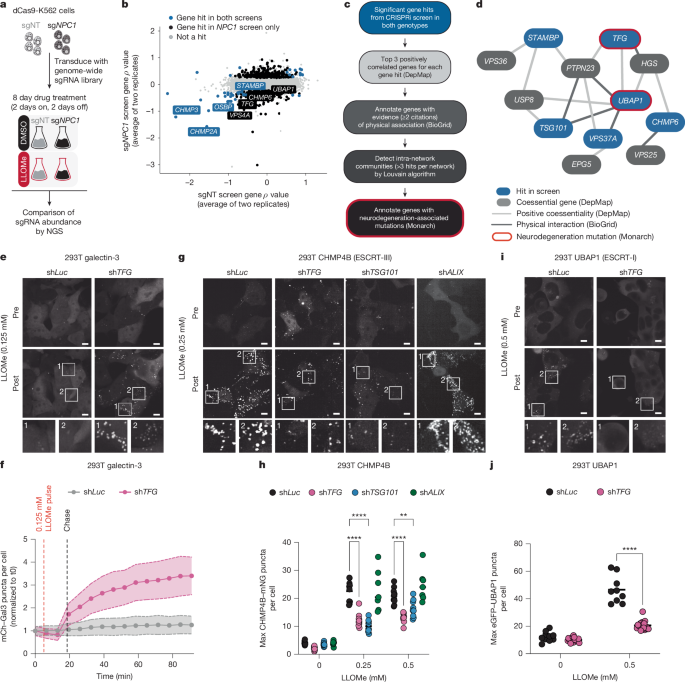
sgNT K562 dCas9-KRAB and sgNPC1 K562 dCas9-KRAB cells were infected with genome-wide sgRNA library lentivirus to target 1,000× coverage of all guides at a low MOI to ensure roughly 1 guide per cell. Cells from each cell line (around 550 million) were pelleted and resuspended in pure virus supplemented with 1 μl ml−1 Polybrene (Millipore Sigma, TR-1003-G). Cells with virus were plated into 6-well plates and spinfected at 1,000g for 1 h. Cells were then supplemented with complete medium and cultured in flasks in shaking incubators at 100g. Cells were maintained in shaking conditions throughout the screen. After ~24 h, virus was removed and cells were resuspended in fresh medium. The next day BFP infection percentage was assessed (34% for sgNT, 45% for sgNPC1) and selection was started with 1 μg ml−1 puromycin (Gibco, A1113803). Cells were selected with 1 μg ml−1 puromycin for 6 days until population reached ~80–90% BFP+. Cells were grown for an additional three days to reach numbers necessary for the screen.
On day T0 of the screen, samples were split for 850× coverage of the library to each replicate. Two replicates from each cell line were frozen in medium with 10% DMSO as backup. Two replicates from each cell line were pelleted and stored at −80 °C for T0 gDNA samples. Two replicates from each cell line were seeded at 0.25 × 10⁶ cells per ml and treated with 0.5 mM LLOMe hydrochloride (Cayman Chemicals, 16008) or 0.01% DMSO mock treatment for another arm of the screen (not shown) and cultured for 2 days. Drug treatment was then removed from cells and replaced with fresh medium for two days. This cycle of drug treatment and recovery was repeated, after which cells were expanded for 6 days until cell numbers were sufficient to end the screen. Multiple cell pellets representing 850× coverage of the library were stored at −80 °C for each sample for gDNA processing.
Genomic DNA processing, library preparation and sequencing
Cell pellets from the screen were processed using the NucleoSpin Blood XL Kit (Macherey Nagel, 740950) according to manufacturer’s directions and extracted DNA was quantified with DeNovix Nanodrop.
After DNA extraction, samples were processed for NGS sequencing using the protocol described50. DNA samples were amplified by PCR using NEBNext Ultra II Q5 MasterMix (NEB, M0544) with a common reverse primer (CAAGCAGAAGACGGCATACGAGATATGCTGTTTCCAGCTTAGCTCTT) and a unique forward primer per sample containing a 6 bp barcode (AATGATACGGCGACCACCGAGATCTACACGATCGGAAGAGCACACGTCTGAACTCCAGTCACnnnnnnGCACAAAAGGAAACTCACCCT) (sequences listed in Supplementary Table 1). For each sample total gDNA was amplified in multiple PCRs with an input of 10 μg per reaction. PCRs were run with the following cycling conditions: 98 °C for 30 s, followed by 24 cycles of 98 °C for 10 s and 62.6 °C for 75 s, and a final elongation at 65 °C for 5 mins. Reactions were pooled and purified with double-sided SPRI beads (Beckman Coulter, A63882). Samples were quantified on the Agilent TapeStation and pooled to generate a library with equal representation of each sample. Library was sequenced on the Illumina NextSeq 550 using a NextSeq High Output kit (75 cycles) (Illumina, 20024906). A custom sequencing primer (GTGTGTTTTGAGACTATAAGTATCCCTTGGAGAACCACCTTGTTGG) was added to the standard Illumina sequencing primer. Library runs were supplemented with PhiX DNA to increase sequence diversity.
Computational analysis of screens
Two integrated analysis pipelines for pooled CRISPR screens were used to generate and process sgRNA read counts. The first pipeline was a branched version of ScreenProcessing (https://github.com/ucsf-lgr/ScreenProcessing) developed by the Weissman laboratory52 using hitThreshold of 4. The second was MAGeCK-Vispr53,54.
Network analysis of screen hits
Significant (P < 0.05) sensitizing (score < 0) hits from sgNT and sgNPC1 screens were combined (and likewise for protective (score > 0) hits). Coessentiality data from DepMap (22Q2, Achilles_gene_effect.csv) was pre-processed to obtain locus-adjusted correlations (Mendillo laboratory; https://github.com/mendillolab/fireworks/tree/master/generate_corr_matrices)55. A custom Python script (https://github.com/claire-goul/local_DepMapandBioGrid) was written to obtain the top correlated genes to gene hits (using the default parameters of threshold > 0.2 and num = 3). Physical protein–protein interactions for gene hits were obtained from the BioGrid website (Biogrid_MV-Physical_4.4.243_Human; https://downloads.thebiogrid.org/BioGRID/Release-Archive/BIOGRID-4.4.243/), using default parameters (minimum number of citations; that is, numcitations parameter, equal to 2)56. Biogrid interactions were then mapped onto the correlated genes obtained from the gene hits, and networks containing at least 2 gene hits and at least 3 nodes per network were plotted in Cytoscape (v3.10.3). Genes implicated in neurodegenerative disease were downloaded from the Monarch Initiative (https://monarchinitiative.org/MONDO:0005559#causal-gene)57 and overlaid manually onto the Cytoscape networks by importing the downloaded file into Cytoscape. A custom Python script (Python v3.9.6) was written to cluster networks in communities using the Python Louvain package (https://github.com/taynaud/python-louvain), using a resolution value of 2. Communities and the top Gene Ontology term (https://geneontology.org/) for each community were manually annotated on Cytoscape networks.
Growth curves
Cells were seeded in 96-well plates at 10,000 cells per well in 100 μl complete medium, and the following day they were treated with 100 μl of LLOMe (2× concentration) prior to imaging, with images of each well taken every 4 h, on Incucyte S3 with a 10× objective (Sartorius).
Confocal imaging of live cells
Live imaging of eGFP–UBAP1, EAP30–mNeonGreen, PDCD6IP–mNeonGreen, CHMP4B–mNG and mCherry–Gal3, as well as endogenously tagged mNG lines, was performed on OperaPhenix (Perkin Elmer). Two days prior to imaging, 96-well plates were coated overnight in fibronectin, and cells were seeded the following day with 30K–40K cells per well onto 96-well CellVis (P96-1.5H-N) or Greiner Screenstar COC plates (655866) in 100 μl phenol red-free DMEM. The next day, 50 μl of Hoescht dye was added to cells to stain nuclei 30 min before the start of the experiment. Imaging of non-overlapping frames (at minimum 4 per well) were taken; first, the nuclei were imaged, then cells were imaged at baseline, followed by addition of the indicated concentrations of either LLOMe (or DMSO vehicle control), and imaged every 4−6 min. Temperature and CO2 levels were maintained at 37 °C and 5%, respectively, during the experiment. All images were taken with a 40× water objective. Image analysis of number of spots per cell was performed on Harmony 3D analysis software (v5.3) for nuclei and spot selection and masking and quantification of nuclei/spot number and spot relative intensity for all frames and time points collected.
For i3 neurons: At day 4 post-differentiation, i3 neurons plated in 24-well glass bottom plates (CellVis, P24-1.5H-N) were transduced with concentrated mCherry–Gal3 or CHMP4B–mNG lentivirus resuspended in BrainPhys neuronal medium, and 24 h later changed into fresh BrainPhys medium. Live imaging was performed 72–96 h post-transduction on OperaPhenix (Perkin Elmer). Prior to live imaging, medium was changed into BrainPhys neuronal medium lacking Phenol Red.
Immunofluorescence staining and confocal imaging
Cells were seeded on fibronectin-coated glass coverslips in 12-well plates the day before the experiment and treated with the indicated DMSO or LLOMe concentrations. Cells were then rinsed one time with PBS, permeabilized with 0.1% (w/v) saponin in PBS for 10 min at room temperature (or, for LC3B immunofluorescence, at −20 °C in ice-cold 100% methanol for 5 min) and rinsed once with PBS. Primary antibodies were diluted at 1:300 concentration in 5% normal donkey serum (Jackson ImmunoResearch, 017-000-121) and incubated for 1 h at room temperature. Coverslips were rinsed 3 times with DPBS and then labelled with fluorescently conjugated secondary antibodies (diluted 1:400 in 5% normal donkey serum in DPBS) for 1 h at room temperature, protected from light. Coverslips were rinsed with PBS four times and mounted on glass slides using VECTASHIELD Antifade Mounting Medium with or without DAPI (Vector Laboratories, H-1200 or H-1000). Confocal microscopy was performed on a spinning-disk Nikon Ti-E inverted microscope (Nikon Instruments) with Andor Zyla-4.5 cMOS camera (Andor Technology) using iQ3 acquisition (v3.6) and Andor Fusion software (v1.1.1) (Andor Technology). All images were taken with a 60× oil objective. Colocalization analysis from immunofluorescence was performed by importing raw, unprocessed, non-overlapping images to FIJI (v2.1.0/1.53c) or ImageJ (v2.16). Images of individual channels were thresholded independently to exclude background and converted to binary mask. Colocalization between lysosomes (LAMP2) and marker of interest (TFG or SEC31A) or TFG and ERES (SEC31A) was determined using the AND function of the image calculator. Confocal images of contact sites between TFG and LAMP were acquired using a 100× oil objective on a BC43 Andor Spinning-disk confocal microscope, and images shown in figures were pre-processed using deconvolution with Imaris Quant software (v10.2).
Immuno-electron microscopy
Cells in culture dishes were initially fixed by incubation for 5 min with an equal volume of 2% paraformaldehyde in 0.1 M phosphate buffer, mixed with the culture medium to minimize osmotic stress. The solution was then replaced with freshly prepared 4% paraformaldehyde in the same buffer, and fixation was continued for 2 h at room temperature. After fixation, samples were washed three times in PBS, and residual aldehydes were quenched by incubation with 0.15% glycine in PBS for 10 min. Cells were scraped in PBS supplemented with 1% gelatin and transferred to microcentrifuge tubes. Next, gelatin concentration was increased to 12%, and samples were incubated for 10 min at 37 °C. Cells were collected by centrifugation, and the gelatin-embedded cell pellets were allowed to solidify on ice for 30 min. Solidified pellets were trimmed into small blocks and cryoprotected by infiltration with 2.3 M sucrose overnight at 4 °C. The blocks were then mounted onto specimen pins and stored in liquid nitrogen until further processing.
For cryo-ultramicrotomy, sucrose-infiltrated, gelatin-embedded samples were sectioned at a nominal thickness of 80 nm at −110 °C using a diamond knife (DiATOME) on an ultracryomicrotome (Leica). Ultrathin sections were collected on Formvar- and carbon-coated TEM grids using a pickup solution consisting of a 1:1 mixture of 2.3 M sucrose and 1.8% methylcellulose.
For immunogold labelling, sections on the grids were first incubated in PBS at 37 °C for approximately 30 min to remove residual embedding material, followed by washing in PBS containing 0.15% glycine. Nonspecific binding was blocked by incubation in PBS supplemented with 0.5% fish skin gelatin (FSG; Sigma) and 0.1% BSA (BSA-c; Aurion). Sections were incubated with a primary antibody against TFG (ab156866; 1:30 dilution), followed by with Protein A conjugated to 10-nm colloidal gold particles (Cell Microscopy Core, UMC Utrecht). Post-labelling fixation was performed using 1% glutaraldehyde. Grids were rinsed six times in Milli-Q water and contrasted for 5 min with 2% uranyloxalate-acetate (pH 7), and 10 min with uranylacetate/methylcellulose (pH 4) on ice. Finally, grids were picked up using the loop-out method with a rhenium wire loop and air-dried for 30 min prior to imaging.
Imaging was performed on a TECHNAI12 transmission electron microscope (Thermo Fisher) operated at 80 kV. For each condition, images were acquired from two independent grids. A more detailed description of the immunolabelling procedure has been reported previously58.
Protein purification
Human codon-optimized truncated 6×His-TEV-mCherry TFG (WT, ΔPB1, LIR2-mut, ΔCC, PSAP, R106C mutant; residues 1–210) was expressed in Escherichia coli Rosetta (DE3) pLysS cells. Bacteria were grown in Luria broth (LB) medium until OD600 ≈ 0.8–1, induced with 0.5 mM isopropylthiogalactoside at 20 °C for 18 h. Cell pellets from 0.5 l of culture were frozen in liquid nitrogen, and subsequently resuspended in lysis buffer (50 mM 4-(2-hydroxyethyl)-1-piperazineethanesulfonic acid (HEPES) at pH 7.5, 500 mM KCl, 10 mM imidazole, 2 mM MgCl2, complete protease inhibitor (Roche)) followed by lysis with a tip sonicator (4× 50 mA; 30 s on/1 min off). Lysates were cleared by ultracentrifugation at 24,000g for 30 min at 4 °C (Beckman, Ti45 rotor). Cleared supernatants were applied to Ni-NTA resin (Qiagen, 30230) pre-washed in lysis buffer and incubated with rotation at 4 °C for 1 h, and the mixture was applied to a gravity column. Following washes with 15 bead volumes of lysis buffer, 6×His-tagged TFG constructs were rapidly eluted in 4 bead volumes of lysis buffer containing 300 mM imidazole. Elution was evaluated by Coomassie staining, flash frozen in liquid nitrogen, and stored at −80 °C.
Human 6×His-TEV-mCherry-P62 (Addgene #199780) was purified using the same protocol as for TFG, with additional separation on a HiLoad 16/600 Superdex column (Cytiva). Protein was eluted in buffer containing 25 mM HEPES pH 7.5, 500 mM KCl, and 1 mM DTT, protein containing fractions were pooled and concentrated with an Ultra Centrifugal Filter (50 kDa MWCO, Amicron), and frozen in liquid nitrogen.
Human 6×His–TSG101 UEV domain (WT, M95A, N45A or M95A/N45A) was expressed in E. coli strain BL21(DE3) Star cells, and bacteria were grown in Luria broth (LB) medium until OD600 ≈ 0.5, induced with 1 mM isopropylthiogalactoside at 37 °C for 4 h. Cell pellets from 0.5 l of culture were frozen in liquid nitrogen, and subsequently resuspended in lysis buffer (50 mM HEPES at pH 7.5, 150 mM NaCl, 2 mM MgCl2, complete protease inhibitor (Roche)), followed by lysis with a tip sonicator (4× 50 mA; 30 s on/1 min off). Lysates were cleared by ultracentrifugation at 24,000g for 30 min at 4 °C (Beckman, Ti45 rotor). Cleared supernatant was applied to GST resin pre-washed in lysis buffer and incubated with rotation at 4 °C for 30 min. Following washes with 10 bead volumes of lysis buffer, 6×His-tagged TFG constructs were eluted in 2 bead volumes of elution buffer (lysis buffer plus 20 mM glutathione, freshly made to pH 8) with 1× 10-min elution and 1× overnight elution. Elutions were evaluated by Coomassie staining, pooled, concentrated on an Amicron 30 kDA MWCO column, flash frozen in liquid nitrogen, and stored at −80 °C.
Plasmids and cloning
Human codon-optimized truncated 6×His-TEV-mCherry TFG (WT, deltaPB1, LIR2MUT, deltaCC, PSAP, R106C mutant; residues 1–210) was cloned into pETDuet-His-TEV-mCherry (Addgene #199780). Human pGST2-TSG101 UEV plasmid was obtained from Addgene (Addgene #184810) and cDNA for M95A, N45A, M95A/N45A (Twist Biosciences) was subcloned into the same plasmid. pCDH-CHMP4B–mNG-3×HA IRES-Blast and pCDH-mCherry-GAL3-IRES-Blast were received from the laboratory of H. Stenmark, and human codon-optimized ALIX or EAP30 cDNA (Twist Biosciences) was subcloned into the digested pCDH-mNeonGreen-3×HA IRES Blast vector. Human codon-optimized UBAP1 cDNA (Twist Biosciences) was subcloned into the pLJM1 eGFP Hygro vector. For rescue construct cloning, TFG human codon-optimized cDNA (WT, R22W, R106C, P285L, LIR2 mutant, LIR3 mutant, double LIR mutant, deltaPB1 and deltaCC; IDT and Twist Biosciences) were cloned into pLJM1 Hygro plasmid using Gibson assembly along with an IRES-mCherry cDNA fragment.
Short-hairpin oligonucleotides (shRNAs) directed against TFG (TRCN0000078660), TSG101 (TRCN0000007563), PDCD6IP (TRCN0000029395), ATG5 (TRCN0000151474), PDCD6 (TRCN0000053388, TRCN0000303757, TRCN0000303818), ATG13 (TRCN0000172801), FIP200 (TRCN0000315347) and luciferase (TRCN0000072243, used as a non-targeting control), were cloned into the pLKO.1 lentiviral vector (The RNAi Consortium, Broad Institute) according to the manufacturer’s instructions. TFG sgRNA sequences (sg1: TCAGCGGAGACCTGCGGAGG; sg2: CTCGCGTCCGCCCATTCAGG) were cloned into the pLG15 vector (Kampmann laboratory).
Peptide binding and fluorescence polarization
A binding curve of FAM-p62 LIR peptide (SGGDDDWTHLSSKEVDl; 12.5 nM final) with recombinant LC3B or GABARAP was generated by incubating FAM-p62 LIR peptide with serially twofold-diluted recombinant LC3 or GABARAP (starting at 50 nM), in triplicate. Fluorescence polarization of FAM-peptide was measured on a Tecan Spark Multimode Microplate reader. Recombinant LC3B or GABARAP (5 μM final) was incubated with FAM-p62 LIR peptide (12.5 nM final) for 30 min, followed by incubation with 3 mM or serially twofold-diluted unlabelled p62-LIR peptide, TFG-LIR2 wild-type (AASMSAFDPLKNQDEI) or LIR3 wild-type (YQPRPGFTSLPGSTMT), TFG LIR2-mutant (AASMSAADPAKNQDEI) or LIR3-mutant (YQPRPGATSAPGSTMT) peptides, in triplicate for 15 min, followed by fluorescence polarization measurement. All peptides were ordered from GenScript. Curves were plotted in Prism v10.2.0 (GraphPad), and Kis were calculated using the Prism One site fit ki algorithm, while Kds were calculated using the Prism One site total and nonspecific binding algorithm.
Mammalian cell culture
Human 293T sgNT and sgNPC1 knockout cell lines were generated using Cas9/sgRNA ribonuclear protein transfection (sgNPC1 sgRNA sequence: GCTGCTACTGTGTCCAGCGC) as previously described26. HEK293T, HeLa and U2OS cells and their derivatives, including HEK293T cells with ESCRT components tagged at their endogenous loci with mNG59, were cultured in DMEM base medium with 10% fetal bovine serum supplemented with 2 mM glutamine, penicillin and streptomycin. All cell lines were maintained at 37 °C and 5% CO2. The cells were free of mycoplasma contamination and routinely checked using mycoplasma PCR Detection kit (abm, G238) and/or DAPI staining. All wild-type parental cell lines, with the exception of the patient fibroblasts, were obtained from and authenticated by the UC Berkeley cell culture facility.
All K562 cell lines were maintained in Roswell Park Memorial Institute (RPMI) 1640 medium (Gibco, 11875085) supplemented with 10% FBS (Avantor Seradigm, 97068-085), 1% Penicillin-Streptomycin (Gibco, 15140122), and 1% Glutamax (Gibco, 35050-061) All cells were cultured at 37 °C in a humidified atmosphere containing 5% CO2. Cells were incubated in shaking conditions for the duration of the screen.
Human i3 neurons were obtained from M. Ward and cultured and differentiated according to the described protocol60. CRISPRi-i3 iPSCs containing NGN2-inducible cassette and dCas9-BFP-KRAB were a gift from M. Ward61,62. CRISPRi-i3 iPSCs were differentiated as described60. In brief, iPSCs were dissociated with Accutase (Gibco, A1110501) and seeded onto Matrigel (Corning, 354277) coated six-well plates. iPSCs were infected with lentiviruses concentrated in essential-8 medium (Gibco, A1516901) expressing sgNT or sgTFG. After 24 h, medium was replaced with fresh medium containing puromycin (1 μg ml−1). Medium was replaced daily with fresh medium containing puromycin for 72 h. After selection, cells were expanded for one passage before dissociating and seeding cells into induction medium containing N2 Supplement (Gibco, 17502048) in Knockout DMEM/F:12 (Thermo Fisher, 12660012) with non-essential amino acids (Gibco, 11140050), GlutaMax (Gibco, 35050-061) and doxycycline (2 μg ml−1, 35050-061). Medium was replaced with fresh induction medium for 72 h, before dissociating cells and seeding onto PLO (Sigma, P3655)/Laminin (R&D Systems, 3446-005-01) coated plates (prepared as described previously60) containing BrainPhys neuronal differentiation medium (StemCell Technologies, 5790) supplemented with B27+ (Gibco, A3582801) containing BDNF (Preprotech, 450-02), NT-3 (Preprotech, 450-03) and GDNF (Preprotech, 450-10). i3Neurons were given 60% medium changes (remove 40%, add back 60%) every 3 days until collected for experiments.
Patient fibroblasts were obtained from E. Lamantea63 and cultured in DMEM with 10% fetal bovine serum supplemented with 2 mM Glutamine, penicillin and streptomycin.
Lentivirus production and infection
Lentiviruses were made by co-transfecting pLJM1, pCDH, pLenti-sgRNA or pLKO constructs with psPAX2 and pMD2G packaging plasmids into HEK293T cells using PEI transfection reagent. Viral supernatant was collected 48–72 h post-transfection and filtered using a 0.45-µm syringe filter. The virus was then concentrated using Lenti-X concentrator (Clontech 631231) according to manufacturer’s protocol and stored at −80 °C. For lentivirus infection, target cells were seeded in 6-well plates and infected the following day with lentivirus and 10 µg ml−1 Polybrene (Millipore TR-1003-G). After 24 h, virus was removed, and cells were changed into fresh medium containing either puromycin (1 μg ml−1), blasticidin (5 μg ml−1) or hygromycin B (200 μg ml−1) for selection. Experiments on shRNA infected cells were performed 4–5 days post-transduction. For neuron experiments, mCherry–Gal3 virus was concentrated and resuspended in BrainPhys neuronal differentiation medium containing the described supplements, and neurons were infected 3 days prior to the experiment with concentrated virus (no Polybrene), and medium was changed into fresh BrainPhys (containing no antibiotics) the day following infection.
Immunoprecipitation
For GST–UEV immunoprecipitations with cell lysate, cells were rinsed once with PBS and lysed in lysis buffer (PBS, 1% NP-40, 1 mM DTT, 5 mM EDTA, EDTA-free protease inhibitor tablet) rotating for 15 min at 4 °C. Cell lysates were cleared by centrifugation in a microcentrifuge at 13,000 rpm for 10 min at 4 °C. Well mixed glutathione sepharose 4B resin slurry (Cytiva, 17-0756-05) was washed once in lysis buffer, then incubated with recombinant UEV domain (12 μl of GST slurry with lysis buffer containing 100 μg of UEV domain) for 30 min rotating at 4 °C. GST–UEV or empty beads were washed 3 times with lysis buffer, then incubated with cleared supernatant for 1 h at 4 °C, followed by 3 washes with lysis buffer and resuspended in a 1:1 ratio of 5× sample buffer and lysis buffer. Following incubation at 95 °C for 5 min, immunoprecipitated proteins were resolved by SDS–PAGE and analysed by immunoblotting.
Dextran assay for lysosomal deacidification
For dextran experiments in patient fibroblasts, cells were incubated with fluorescently labelled dextrans 16–20 h prior to imaging. Specifically, 10 kDa dextran conjugated to Alexa Fluor 647 (dextran−647, Thermo Fisher D22914) and 40 kDa dextran conjugated to fluorescein isothiocyanate (dextran-Fluorescein, Thermo Fisher D1845) were added to the culture medium at a final concentration of 25 μg ml−1 each. Two hours before imaging, cells were washed two times with phosphate-buffered saline (PBS) to remove extracellular dextran, then incubated in phenol red-free Dulbecco’s modified Eagle’s medium (DMEM, Thermo Fisher 31053-028) for the chase period.
Equilibrium binding assay using visual immunoprecipitation
For TSG101-UEV visual immunoprecipitation experiments, 90 μl glutathione sepharose 4B resin slurry (Cytiva, 17-0756-05) was washed with excess buffer (500 mM KCl, 50 mM HEPES), and beads were resuspended in 90 μl buffer. Ten micrograms recombinant GST-tagged UEV protein per μl of bead suspension was added and incubated with beads for 15 min nutating at 4 °C. Beads were spun down (1,200g for 2 min), washed once in excess buffer, and resuspended in 90 μl buffer.
For Flag–GFP–LC3B visual IP experiments, an 80–100% confluent plate of HEK293T cells expressing Flag–GFP–LC3B were resuspended in lysis buffer (50 mM HEPES at pH 7.3, 500 mM KCl, 1% Triton X-100 and protease inhibitor cocktail). Lysates were nutated for 15 min at 4 °C, after which unlysed precipitates were removed by spinning the lysates at 13,000 rpm for 10 min at 4 °C. Meanwhile, 30 μl of GFP-Trap agarose beads were washed with 500 μl of lysis buffer. Incubate washed beads with lysate for 30 min at 4 °C. After incubation, wash coated beads once with bulk lysis buffer and twice with wash buffer (50 mM HEPES at pH 7.3, 500 mM KCl) and resuspend beads in 60 μl wash buffer.
Three microlitres of UEV-coated GST beads or LC3B-coated agarose beads were incubated with 10 μl of recombinant TFG protein (at indicated concentration of 5 μM or lower) and samples were spotted onto glass slides and covered with glass coverslips. Confocal microscopy was performed on a spinning-disk Nikon Ti-E inverted microscope (Nikon Instruments) with Andor Zyla-4.5 cMOS camera (Andor Technology) using iQ3 acquisition software (Andor Technology). All images were taken with a 10× objective.
Statistical analysis and graphs
Statistical analyses were performed using unpaired two-tailed Student’s t-tests for comparisons of two groups, one-way analysis of variance (ANOVA) or two-way ANOVA for group comparisons using Prism (v10.2.0, GraphPad). Details of each statistical test are given in the legend accompanying each figure. Curve fitting for enzyme kinetics and other statistical analyses for peptide binding and polarization experiments are detailed in the appropriate methods. Graphs were plotted with Prism (v10.2.0, Graphpad), or RStudio (v1.4.1717). All data are displayed as mean ± s.d. All t-tests were two-tailed, unpaired; one-way ANOVAs used Dunnett’s multiple comparisons test with a single pooled variance for comparison to control sample, or for comparisons among all pairs, Tukey’s test; all two-way ANOVAs used used Dunnett’s multiple comparisons test with a single pooled variance for comparison to control sample, or for comparisons among all pairs, Šidák multiple comparisons test with a single pooled variance.
Reporting summary
Further information on research design is available in the Nature Portfolio Reporting Summary linked to this article.

